Blog
Stop Cold Calling and Start Selling: Insurance Agent Guide
Learn how to stop cold calling and start selling insurance. Discover smart workflows, verified leads, and follow-up tips to close more deals faster today.

What if your next hour of prospecting meant fewer random dials and more conversations with people who’ve already shown interest? If you’re searching for how to stop cold calling and start selling, the answer isn’t to abandon the phone. It’s to stop treating every number like a sales opportunity.
Low connection rates and unqualified conversations can drain time you’d rather spend understanding a prospect’s needs. A more focused process starts with intent: prioritize prospects who have requested information, then follow up promptly and consistently.
This guide shows you how to build a prospecting-to-sales workflow around lead context, organized follow-up, and responsible calling practices. You’ll learn how to compare lead sources, make each contact more relevant, and use tools such as a built-in dialer to support timely outreach. The goal is simple: spend less time chasing cold lists and more time having useful conversations with potential clients. Lead quality can help you focus, but your conversations and follow-through still drive the sale.
Key Takeaways
- Separate prospecting from selling so outreach creates room for meaningful client conversations.
- Use a repeatable lead-contact sequence: review context, reach out, ask permission, qualify, and agree on next steps.
- Learn how to stop cold calling and start selling by comparing cold lists, real-time leads, and aged leads based on context and follow-up needs.
- Protect selling time with dedicated blocks for new leads, follow-ups, and active client conversations, then track outcomes in your CRM.
- Use OTP phone-verified insurance leads, consent records, and a built-in dialer to support a more organized prospecting workflow.
Why cold calling can crowd out selling, and what to change first
A packed call log can look productive while leaving the day’s most valuable work squeezed into the margins. An agent moves from number to number, repeats an opening, leaves messages, and starts again. By the time someone is ready to discuss coverage, there may be little time left to understand their needs or explain relevant options.
The fix isn’t to eliminate outreach. It’s to identify which activities create useful opportunities and which consume time without moving a prospect forward. Understanding Cold Calling can help frame the traditional approach: contacting prospects without prior interaction. The issue isn’t simply making calls. It’s relying on repetitive dialing with little context as the default measure of progress.
Separate the work into four activities: building a list, making initial contact, qualifying a prospect, and holding a client-facing sales discussion. Each has a purpose, but they aren’t interchangeable. Prospecting creates opportunities to engage. Selling helps a prospect evaluate a relevant solution based on their circumstances. If list work and repeated first attempts take over the calendar, the sales conversation gets pushed aside.
Quote-ready definition: “Prospecting creates the opportunity for a conversation; selling helps a prospect decide whether a relevant solution fits their needs.”
That distinction gives you a practical starting point for how to stop cold calling and start selling. Don’t change every lead source or script at once. First, track where your working hours go. Record time spent building lists, attempting contact, qualifying people, and discussing solutions. This simple activity log can show whether the bottleneck is limited lead context, too much list preparation, or follow-up that crowds out scheduled client conversations.
Which parts of cold calling are worth replacing?
Start with the most repetitive activity: dialing through names without useful context. For a few workdays, record each prospecting task and the time it takes. Note whether an attempt led to a contact, a qualification conversation, or an agreed next step. Keep the categories separate. This gives you a baseline before you change the process, rather than relying on guesswork about what might help.
What should replace volume as the main measure?
Use two simple ratios to diagnose friction: contacts that become conversations, and conversations that produce a defined next step. Track the underlying counts too, so a percentage doesn’t hide a small sample or a change in activity. These measures aren’t sales forecasts. They help show where to investigate, such as whether your opening earns a discussion or whether qualified conversations end without a clear follow-up plan.
Compare the results with your own baseline, not an assumed industry benchmark. If calls connect but few conversations progress, review your introduction and qualification questions. If conversations happen but next steps remain vague, improve how you close each discussion. The target isn’t a bigger dial count. It’s a workflow that protects time for prospects who are ready to talk and gives each conversation a clear purpose.
How to turn an interested insurance lead into a real sales conversation
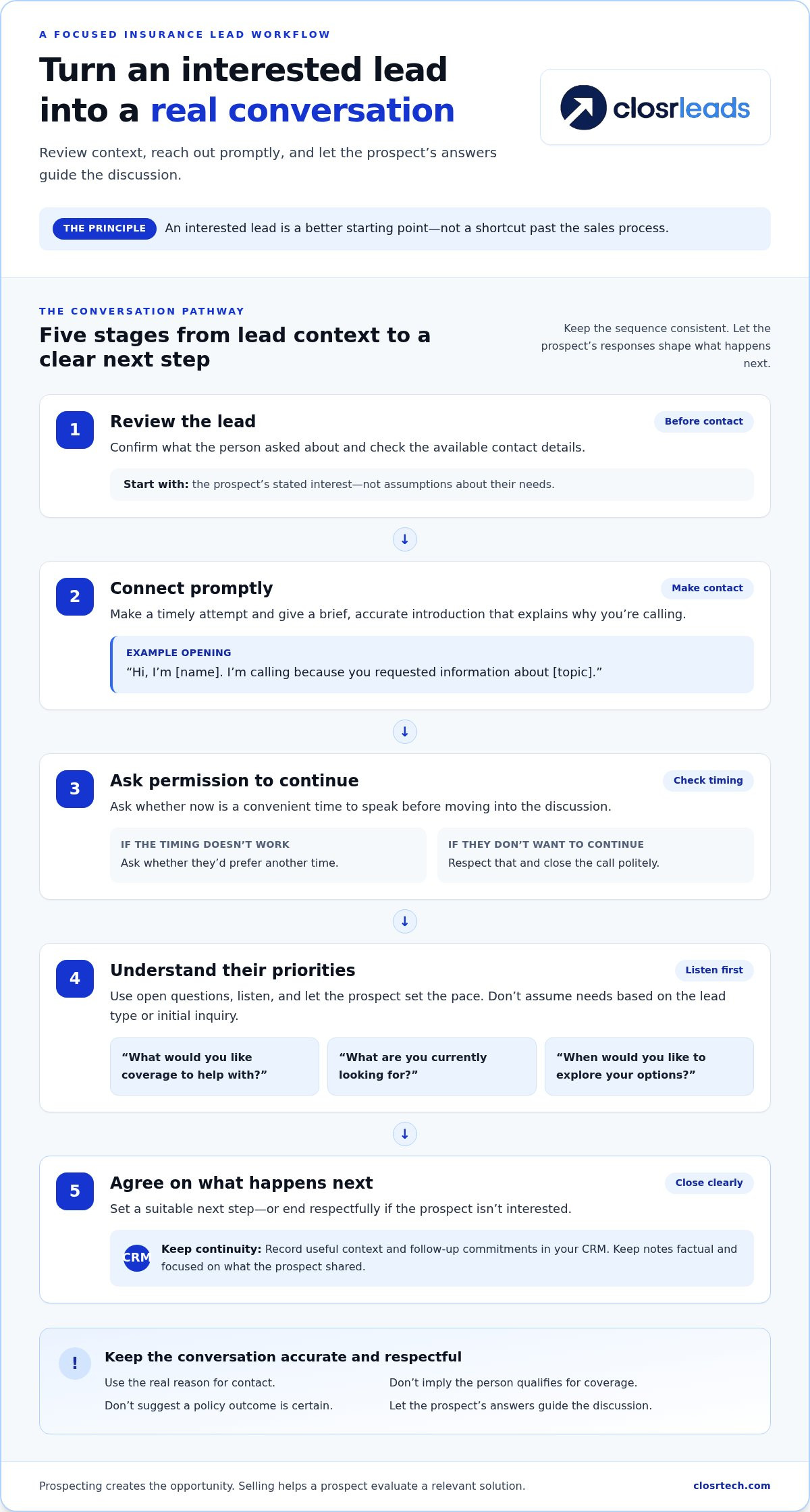
An interested lead gives you a better starting point, not a shortcut past the sales process. Before reaching out, review what the person asked about and any available contact context. Then make a timely attempt, introduce yourself and your reason for calling, ask whether it’s a convenient time, and listen before discussing coverage. The goal is a relevant conversation, not a rushed pitch.
Quote-ready: “Review the lead, reach out promptly, ask permission to continue, understand the prospect’s priorities, and agree on a clear next step.”
Use the sequence consistently, while letting the prospect’s answers shape the conversation:
- Review: Confirm the lead’s stated interest and available details before contacting them.
- Connect: Make a timely attempt and give a brief, accurate introduction.
- Ask: Check whether now is a convenient time to talk.
- Understand: Use open questions to learn what the prospect wants to address.
- Agree: Set a suitable next step, or end respectfully if they aren’t interested.
Record useful context and follow-up commitments in your CRM so the next interaction has continuity. A CRM can help organize lead and customer information across the sales process; Salesforce offers an overview of Customer Relationship Management (CRM) in Sales. Keep notes factual and focused on what the prospect shared.
How should an agent open the conversation?
Keep the first few sentences simple. For example: “Hi, I’m [name]. I’m calling because you requested information about [topic]. Is now a convenient time to speak?” Use the real reason for contact. Don’t imply the person qualifies for coverage or suggest a policy outcome is certain. If the timing doesn’t work, ask whether they’d prefer another time. If they don’t want to continue, respect that and close the call politely.
How can qualification lead into a useful discussion?
Ask open questions that invite more than a yes-or-no answer: “What would you like coverage to help with?” “What are you currently looking for?” “When would you like to explore your options?” Let the prospect set the pace. Their answers can help you understand priorities without assuming needs based on the lead type or initial inquiry.
Before discussing options, summarize what you heard: “So your main priority is [priority], and you’d prefer to review this [timing]. Have I understood that correctly?” Give the prospect a chance to clarify. Then discuss relevant possibilities based on what they’ve shared, without pressure or promises.
If they’re ready, agree on a specific next action, such as a follow-up conversation at a time that works for them. If they need time, ask whether they’d like you to reconnect and when. If they decline, thank them and end the conversation. For agents building this process around expressed interest, real-time insurance leads can provide a starting point for prompt follow-up. How to stop cold calling and start selling comes down to making each contact purposeful, listening carefully, and earning the next conversation.
Cold lists, real-time leads, or aged leads: compare the selling workflow
The lead source changes what you know at the start of a conversation. It doesn’t change your responsibility to be accurate, respectful, and attentive. Compare each option by its context, timing, and the work needed before a useful discussion can happen.
| Lead source | Context | Timing considerations | Workflow fit |
|---|---|---|---|
| Cold list | Often limited context about a person’s current interest. | Plan outreach around your calling process and review records before contact. | Requires more work to establish relevance and determine whether the person wants to talk. |
| Real-time lead | May reflect a recent request or expressed interest. | Have a prompt follow-up process ready for delivery. | Fits agents who can review the inquiry and act while its context is fresh. |
| Aged lead | Interest may have changed since the original inquiry. | Allow time to reintroduce yourself and confirm whether the need is still current. | Fits a deliberate follow-up workflow that begins by resetting context. |
These are workflow differences, not promises of conversion. A recent inquiry doesn’t mean the prospect is ready to buy, and an older inquiry doesn’t tell you whether their needs remain the same. The source is a starting point for a conversation, not a substitute for listening or qualification. For a closer look at phone verification and lead context, see this guide to OTP-verified insurance leads.
When does real-time lead delivery fit?
Real-time delivery suits a workflow built to review new inquiries and make a timely first attempt. Before calling, check what the prospect requested and use that context to explain why you’re reaching out. OTP phone verification indicates the number passed a one-time password check. Consent records add information about the lead’s contact context. Neither tells you what the person wants today, so confirm their interest during the conversation. For example, mortgage protection leads give an agent a specific inquiry topic to reference, not a reason to assume a prospect’s circumstances or eligibility.
When might aged leads suit an agent’s process?
Aged leads call for patient qualification. Start by reviewing the original inquiry if that context is available, then introduce yourself and check whether the person is still interested. Unlike a newly delivered lead, an older record may need a fuller explanation of why you’re calling. Don’t treat past interest as current intent. If the need has changed, update your notes and agree on a respectful next step, or end the conversation.
Choose the workflow your follow-up capacity can support. If you can respond promptly, real-time delivery may fit your process. If you have room for careful reintroduction, aged leads may fit better. Either way, how to stop cold calling and start selling means matching outreach to the available context, then letting the prospect’s answers guide what happens next.
Build a daily follow-up system that protects selling time
A reliable follow-up system gives each lead a clear place in the workflow and keeps prospecting from taking over the calendar. Set dedicated blocks for reviewing new leads, making first attempts, completing scheduled follow-ups, and speaking with active clients. The exact schedule depends on your workload. The principle is straightforward: reserve time for client conversations instead of filling every open slot with more dialing.
Quote-ready: “Review new leads, make first contact, schedule follow-ups, record outcomes, and protect time for client conversations.”
Build your CRM stages around actions you can observe. Track attempts, contacts, qualified conversations, agreed next steps, and dispositions such as no answer, not interested, or follow-up requested. Consistent categories make it easier to see where leads pause and what needs attention. A call attempt isn’t the same as a conversation, and a conversation isn’t the same as an agreed next step. Keep those outcomes distinct.
Review the pattern weekly. If new leads wait too long for a first attempt, adjust the lead-review block. If conversations happen but follow-ups aren’t completed, examine how you schedule and record next actions. Change one process variable at a time, then compare results with your own baseline. This keeps the review useful and helps you identify what actually affects your workflow.
How can a CRM and dialer reduce avoidable friction?
Direct lead delivery into a CRM can reduce manual handoffs, such as copying contact details between systems before an agent can begin work. A built-in dialer can help organize outreach within that workflow. Neither tool replaces judgment: review the available context, decide how to approach the conversation, and record what happened. Clear notes and consistent dispositions give you a more accurate starting point for the next follow-up.
Keep notes specific and factual. Record the prospect’s stated interest, the result of the interaction, and any agreed follow-up timing. Avoid vague entries such as “call again” when you can capture the actual next step. A consistent record helps prevent repeated questions and makes it easier to distinguish a scheduled conversation from a lead that still needs an initial attempt.
How do agents keep outreach responsible?
Before outreach, follow the consent information associated with the lead, honor opt-outs, and use your organization’s procedures. Calling requirements can depend on the circumstances and location, so don’t treat a workflow guide as legal advice or assume one rule covers every situation. Check current guidance from relevant authorities, such as the FCC and FTC, and follow applicable requirements. If contact preferences change, record them accurately and make sure your follow-up process reflects them.
Use a workflow that keeps lead details and calling activity organized. Explore the built-in dialer to support structured outreach and follow-up.
Make the shift with verified leads and a ready-to-work sales workflow
The right lead workflow is the one your team can handle consistently. Match lead timing and volume to your capacity to review records, follow up, qualify prospects, and document outcomes. Adding leads without a plan can create another queue to manage. A focused process turns each record into a clear next action.
ClosrLeads offers real-time and aged insurance leads across Final Expense, Veteran, Trucker, Mortgage Protection, and IUL. Leads are OTP phone-verified and include TCPA-compliant consent records. Real-time delivery and aged leads serve different follow-up rhythms, so decide how each will enter your process before adding them to your pipeline.
What should agents expect from a lead workflow?
Build a consistent path: receive the lead, review its context in the CRM, make an appropriate outreach attempt, qualify the prospect, and record the disposition. ClosrLeads delivers leads into your CRM in real time and provides a built-in dialer to support lead handling. These tools don’t replace an agent’s judgment or guarantee a sale. Invalid contacts are covered by a replacement guarantee. That applies to invalid contacts, not appointments, policies, or revenue.
Agents remain responsible for the quality of their conversations, respectful follow-up, and sales outcomes. Use the tools to stay organized, then let the prospect’s responses guide the discussion. A verified phone number or recorded consent can provide useful context, but neither tells you what the prospect needs today. Confirm interest directly and follow your procedures for outreach.
How can an agent start without disrupting the whole pipeline?
Introduce one clearly defined lead workflow alongside your existing prospecting activity. Decide which lead type you’re testing, who will handle follow-up, and how each outcome will be recorded. Set a review period before you begin. Compare attempts, contacts, qualified conversations, next steps, and dispositions with your own baseline. Keep other process changes steady so the comparison stays useful.
At the end of the review period, look at execution as well as outcomes. Are leads being reviewed and contacted as planned? Are records complete? Can the team keep up with follow-up? If the workflow is consistent and fits your capacity, consider expanding it gradually. If leads are waiting or notes are incomplete, adjust the process before increasing volume.
That’s how to stop cold calling and start selling without making a blind switch: choose a workflow that fits, test it, and expand only when your team can manage it well. Lead quality and organized tools can support prospecting, but sales still depend on relevant conversations and disciplined follow-through. Explore ClosrLeads and start building a focused prospecting workflow.
Make your next prospecting change deliberate
Your next step doesn’t need to be a complete overhaul. Choose one part of your prospecting process to improve, define what a useful outcome looks like, and give the change room to prove its value. That could mean protecting a daily block for follow-ups or introducing a lead source your team can handle consistently. Keep the focus on better conversations, not activity for its own sake.
That’s the practical path for how to stop cold calling and start selling: make a measured change, learn from the results, and strengthen the workflow as your capacity grows. A clearer process helps you spend more time serving prospects and less time repeating steps that don’t move the conversation forward.
Ready to build your next step? Explore ClosrLeads and build a more focused insurance sales workflow. Start with a process you can manage, then keep improving it with confidence.
Frequently Asked Questions
Can I stop cold calling completely and still sell insurance?
You can reduce or stop indiscriminate cold calling, but you’ll still need a reliable way to create new opportunities. To decide how to stop cold calling and start selling, review where your prospects currently come from and which sources lead to relevant conversations. You might test a focused lead source or strengthen another prospecting channel, then compare results with your usual process. Keep the test manageable, follow applicable outreach requirements, and don’t treat any source as a promise of sales.
How do I turn an insurance lead into a sales conversation?
Start with the reason the person showed interest, then tailor your questions to that inquiry. If someone requested information about a particular type of coverage, ask what prompted the request and what they hope to understand. Avoid assuming they’re ready to buy or that the inquiry tells the whole story. Listen for what matters most, check that you’ve understood correctly, and make the next step specific, such as arranging a time to continue the discussion.
Are real-time insurance leads better than cold calling?
Not automatically. Real-time leads can give you a recent inquiry as context, while a cold list may offer little information about current interest. The better fit depends on whether you can incorporate that context into your process. For a fair comparison, separate results by lead source in your CRM and compare similar types of inquiries over a consistent period. Consider both agent capacity and follow-up execution; neither lead type guarantees that someone will answer or purchase.
How quickly should I follow up with a real-time insurance lead?
Review new leads promptly, then make contact according to your availability, the recorded consent context, and your procedures. There isn’t a response time that guarantees a sale. If you can’t make an attempt right away, use your CRM to record the lead’s arrival time and assign a clear follow-up task, so it doesn’t disappear into an unworked queue. Track whether timing affects your own contact and conversation rates before changing your routine.
What should I say when an insurance prospect answers the phone?
Identify yourself and give an accurate reason for the call, then let the prospect guide the discussion. If they say they’re only researching, you might ask, “What information would be most helpful as you compare your options?” That invites them to set the focus without forcing a pitch. Pay attention to their answer, clarify anything unclear, and avoid claims about eligibility or policy outcomes. If they don’t want to continue, end politely.
Does an OTP-verified insurance lead guarantee a sale?
No. OTP verification helps verify the phone number, but it doesn’t establish that the person is available, interested now, eligible for coverage, or ready to buy. Consent records provide a separate part of the lead’s contact context; they aren’t a sales outcome. Treat these details as inputs for responsible follow-up. The agent still needs to understand the prospect’s needs, explain relevant options accurately, and manage each conversation without promising a particular result.
How can an insurance agent measure whether cold calling is working?
Track activity and outcomes using consistent definitions, then look for changes across comparable periods. For example, note whether a new opening or a different list changes how often attempts become conversations, while keeping other process changes steady. Separate source-specific results where possible, and include sales outcomes as a later measure rather than judging the process by dials alone. Your records can reveal where prospects disengage, but they don’t guarantee future performance.