Blog
Risks of Buying Non-Compliant Insurance Leads: What Agents Need to Know
Understand the major risks of buying non-compliant insurance leads. Learn how to audit consent, verify TCPA records, and protect your agency from costly fines.

A lead can look ready to call and still raise a costly question: can you show that the consumer agreed to hear from you? The risks of buying non-compliant insurance leads can follow a record from consent capture through resale, delivery, and every call or text your team makes. The consequences may include complaints, legal costs, regulatory scrutiny, and reputational damage.
A supplier should be able to explain where a lead came from and what permission supports outreach. But a general assurance alone isn’t a substitute for records tied to an individual lead. Before contacting a consumer, your team needs evidence it can review and a process for respecting consent and consumer requests. This guide explains the legal, financial, and operational risks, along with practical steps to assess leads before they enter your pipeline.
You’ll learn how consent gaps can emerge throughout the lead lifecycle, what documentation and supplier controls to assess, and how your contact practices affect exposure. ClosrLeads provides OTP phone-verified leads with TCPA-compliant consent records. These records support a more accountable buying process, but they don’t guarantee that every campaign or contact meets every legal requirement. Organized delivery and prompt, documented follow-up can help keep lead handling clear and easier to review.
Key Takeaways
- The risks of buying non-compliant insurance leads go beyond duplicate or invalid contacts. Separate data-quality issues from gaps in permission or compliant handling.
- Trace each lead from consumer inquiry through consent capture, transfer, outreach, and record retention to find where evidence could be lost.
- Compare suppliers using specific documentation and controls, including lead source, consent records, phone verification, delivery timing, and invalid-contact policy.
- Use a repeatable follow-up process: preserve records, apply relevant screening procedures, route leads responsibly, contact consumers, and log outcomes.
- Assess compliance evidence for both real-time and aged leads. Treat phone verification as one safeguard, not a guarantee of legal compliance.
Risks of Buying Non-Compliant Insurance Leads: Where Exposure Begins
The risks of buying non-compliant insurance leads start with a basic gap: adequate permission to contact the consumer is missing, the evidence of permission is unreliable, or the lead isn’t handled appropriately after collection. That’s different from a duplicate record or an invalid phone number, which are data-quality problems. A consent issue raises a separate question: what did the consumer agree to, and can the agent show that the agreement supports the contact being made?
The distinction matters. A lead can be accurate and reachable while still carrying unclear permission. If the record lacks useful consent details, an agent may struggle to respond to a complaint or explain why outreach occurred. Potential consequences include consumer complaints, legal expense, regulatory attention, and loss of trust. A supplier’s broad claim that leads are “compliant” doesn’t automatically resolve an agent’s responsibilities or replace evidence tied to the individual lead.
What makes an insurance lead a compliance risk?
Look for gaps between the consumer’s action, the permission captured, and the contact your team plans to make. Consent information may be missing, unclear, outdated, or mismatched to the seller, purpose, or contact method. Resale adds another link to the chain. The original inquiry may have passed through multiple parties, making it harder to establish what the consumer saw and which businesses the permission covered.
A working phone number shows reachability, not permission. OTP phone verification can help confirm access to a number, but it doesn’t by itself establish the scope or validity of consent. A useful lead record should connect the consumer’s inquiry with the permission information supplied to the agent. The Telephone Consumer Protection Act (TCPA) is one relevant U.S. framework for telemarketing and automated calls, but its application depends on the facts and current requirements. Treat this as an issue for qualified counsel, not a substitute for legal advice.
Why the risk continues after a lead is delivered
Delivery isn’t the finish line. The source and every later handling step matter, including how a record is routed, which script an agent uses, whether outreach involves calls or texts, and how requests and outcomes are logged. A sound source record can’t correct careless follow-up. Likewise, disciplined contact practices can’t create permission that was never adequately captured.
For example, a lead may enter a CRM with consent documentation, then be routed to the wrong team or contacted using language that doesn’t match the inquiry. Texting may also raise different requirements from calling. Internal processes should preserve the relevant records, guide agents on follow-up, and document what happened. Requirements vary by situation, so have qualified counsel review applicable federal and state rules.
Compliance follows the lead from the consumer’s first inquiry through every transfer, contact, and retained record. Exposure can begin before a lead reaches an agent, then grow or be reduced through the agent’s own workflow.
How Consent and Lead Transfers Create Compliance Exposure
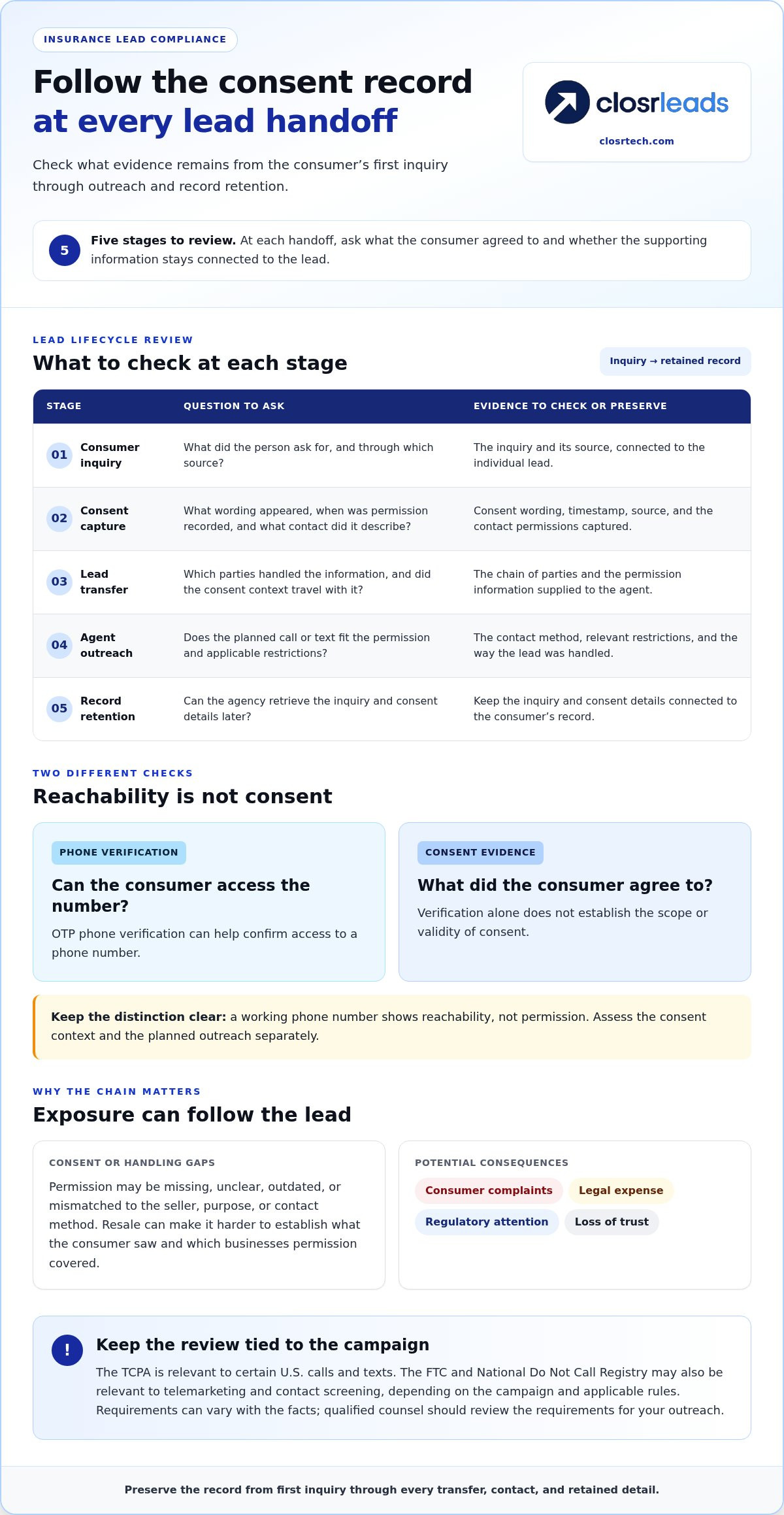
Consent is a chain of information, not a checkbox that travels unchanged with every record. To assess the risks of buying non-compliant insurance leads, trace five stages and ask what evidence remains at each handoff:
- Consumer inquiry: What did the person ask for, and through which source?
- Consent capture: What wording appeared, when was permission recorded, and what contact did it describe?
- Lead transfer: Which parties handled the information, and did the consent context travel with it?
- Agent outreach: Does the intended call or text fit the permission and applicable restrictions?
- Record retention: Can the agency retrieve the inquiry and consent details later?
The Telephone Consumer Protection Act (TCPA) is a relevant U.S. framework for certain calls and texts. The FTC and National Do Not Call Registry may also be relevant to telemarketing and contact screening, depending on the campaign and applicable rules. These frameworks can change and may apply differently depending on the facts. Treat this overview as educational, not legal advice, and have qualified counsel review the requirements for your outreach.
Consent records: what agents need to understand
A useful record helps reconstruct what the consumer agreed to and when. Look for the consent wording, timestamp, source, and contact permissions captured. Together, these details can clarify whether the record relates to the inquiry and planned outreach. Don’t assume one consent format is sufficient for every campaign, seller, or contact method. Preserve the information supplied with the lead and keep it connected to the consumer’s record.
Phone verification can show access to a number; it doesn’t prove what the consumer agreed to receive. OTP verification and consent evidence answer different questions. Both can support a review, but neither removes the need to assess the context and handling of a specific lead.
Do aged, shared, and resold leads carry different risks?
They raise different documentation questions, not automatic verdicts. For an aged lead, consider whether the original inquiry and permission records remain accessible and relevant to the planned contact. For a shared lead, establish how the consent context relates to multiple buyers. For a resold lead, trace the transfer path and confirm that the supporting record came with it. Age or resale alone doesn’t determine compliance.
ClosrLeads supplies OTP phone-verified leads with TCPA-compliant consent records, giving agents lead-level information to review as part of this chain. Real-time and aged lead options can fit different workflows, but assess the evidence for each lead type. For more on the role and limits of phone verification, explore this OTP-verified insurance leads guide. Agencies evaluating lead workflows can also consider how OTP phone-verified insurance leads fit their documentation and follow-up process.
How to Compare Insurance Lead Suppliers on Compliance Evidence
Don’t stop at a supplier saying “compliant” or “verified.” Compare what the supplier provides for an individual lead, how that information reaches your team, and what happens when a contact proves invalid. Use the same questions for every purchase, whether leads arrive in real time or are aged.
| Area | Evidence to assess | What to distinguish |
|---|---|---|
| Lead source | Where the consumer inquiry originated and what submission context is available. | A traceable source is more useful than a broad statement about sourcing. |
| Consent records | Lead-level records showing the consent wording, timestamp, and relevant context. | A general compliance claim isn’t a record of what a particular consumer agreed to. |
| Phone verification | What verification was performed and what the result confirms. | OTP can confirm access to a phone number; it doesn’t establish every consent detail. |
| Delivery timing | Whether the lead is delivered in real time or is aged, and what context accompanies it. | Timing affects workflow and context, but isn’t proof of consent by itself. |
| Invalid-contact policy | How the supplier defines an invalid contact and what remedy applies. | A remedy for invalid data is separate from consent documentation and legal responsibilities. |
Verification answers whether a number was accessed; consent evidence helps explain what contact the consumer agreed to. Treat them as separate checkpoints. Neither a working number nor a verification result replaces lead-level documentation.
Evidence and traceability to look for
Prioritize records your agency can associate with a specific lead, not just a supplier’s general policy. Look for details that help reconstruct the inquiry, submission context, and transfers before delivery. Apply the same review to real-time and aged purchases. A consistent standard makes gaps easier to spot and gives your team a clearer record to retain alongside its own outreach history.
Compare safeguards without confusing them with compliance
Lead age, delivery speed, phone verification, and invalid-contact remedies describe different attributes. Aged leads may call for closer attention to the inquiry context; real-time delivery describes timing, not permission. A replacement for an invalid number can address a data-quality issue, but it doesn’t resolve a consent question or determine whether outreach meets applicable requirements. ClosrLeads provides OTP phone-verified leads with TCPA-compliant consent records, and its replacement guarantee applies to invalid contacts. For a vertical-specific illustration of how verification fits into lead review, see this Final Expense leads guide.
Make the comparison operational: save the records received, note what each verification claim covers, and document how invalid contacts are handled. A built-in dialer and lead delivery workflow can support organized follow-up when it fits your agency’s process.
Reduce Risk with a Documented Insurance Lead Follow-Up Process
Good lead handling needs more than a fast first call. A consistent process helps agents connect each contact to its available records, apply agency procedures, and show what happened next. In consumer financial services, regulatory compliance and risk management consultancies like Versapien emphasize embedding strict governance directly into operational workflows. The risks of buying non-compliant insurance leads can be compounded by inconsistent routing, missing logs, or outreach that continues after a concern is raised. Build the workflow into everyday operations, not just occasional compliance reviews.
Use a clear sequence for every lead:
- Capture: Save the lead details and consent records received with it. Keep them associated with the lead in your CRM or other approved system.
- Check: Apply the agency’s current suppression and do-not-contact procedures, along with any other applicable restrictions.
- Route: Send the record to the right person or team, with the available contact context and handling instructions intact.
- Contact: Use an approved script and channel. Calling and texting may raise different requirements, so have qualified counsel review what applies to your campaigns.
- Log: Record attempts, responses, requests, and any escalation so the contact history remains traceable.
Create a repeatable pre-contact checklist
Before outreach, match the lead to the consent information available and the intended contact channel. Confirm that the record has passed your agency’s current screening procedures. Make sure the assigned agent can access the context needed to handle the inquiry appropriately. These checks help prevent a rushed handoff from turning a documentation gap into an avoidable contact issue.
Keep the checklist practical and consistent across teams. Record when the lead arrived, who received it, and which contact attempts followed. Include consumer responses and next steps. Set clear permissions for who can view, update, or escalate records, and define how long documentation is retained under agency policy and applicable requirements.
Handle complaints and documentation gaps consistently
If a consumer complains or the permission record raises a concern, pause relevant outreach while the agency reviews the issue. Preserve the available source, consent, transfer, and contact records. Avoid editing or discarding information that may help explain what happened. A designated person or team should review the concern, document the decision, and direct legal questions to qualified counsel rather than relying on assumptions.
Make consumer requests easy to route. Staff should know how to record a suppression request, apply the agency’s procedures, and communicate the request to teams or systems handling the same contact. Complaints and missing records also need a defined escalation path. The objective is to stop unreviewed activity, retain a reliable record, and make responsibility clear.
Revisit the process when lead sources, delivery methods, scripts, or internal systems change. A built-in dialer and direct CRM delivery can support organized routing, but agents still need to apply their own review and recordkeeping procedures. Explore ClosrLeads’ verified lead options to support an accountable lead workflow.
Choose Insurance Leads with Clearer Controls and Accountable Delivery
Lower-friction lead handling starts with clearer information. ClosrLeads supplies insurance leads with OTP phone verification and TCPA-compliant consent records. These safeguards give agents information to review and can support a more organized follow-up process. They don’t guarantee that every contact or campaign meets every legal requirement, and they don’t remove an agency’s responsibility to follow its own procedures.
What ClosrLeads provides for lead-level accountability
OTP phone verification addresses access to a phone number, while the supplied consent records provide information about permission. They serve different purposes, so agents should review the records rather than treating verification as a substitute for consent evidence. Keep the information associated with the lead as it moves through your agency’s workflow.
ClosrLeads offers both real-time and aged insurance leads. Real-time delivery can fit a workflow designed to route new inquiries promptly. Aged leads can fit a process built around reviewing and managing existing records. Neither option guarantees a particular contact or conversion outcome. The right fit depends on how your team handles intake, documentation, and follow-up.
A built-in dialer and direct CRM delivery can help keep lead routing and outreach organized within an agency’s workflow. Delivering records into the CRM lets teams manage lead details alongside their own contact activity. Agents still need to apply the agency’s screening, consent-review, and recordkeeping procedures before outreach.
The replacement guarantee has a specific scope: it applies to invalid contacts. It doesn’t cover consent disputes, complaints, or legal outcomes. Keep that distinction clear when comparing supplier safeguards. A remedy for a bad contact can help address a data-quality issue, but it’s separate from reviewing consent records and managing contact practices.
A practical next step for insurance agents
Match the lead type and delivery workflow to your documented process. Consider whether your team can preserve the supplied records, route leads to the right staff, and log follow-up consistently. Apply those criteria to both real-time and aged leads; a different delivery format shouldn’t mean a different standard for accountable handling.
The risks of buying non-compliant insurance leads are best managed with evidence and disciplined processes, not broad assurances. Review the available insurance lead options against your supplier comparison criteria, including consent records, phone verification, delivery timing, and invalid-contact policy. Maintain your own procedures for screening, outreach, consumer requests, and record retention. If a question depends on current federal or state requirements, get guidance from qualified counsel before acting.
Make Your Next Lead Decision More Accountable
Turn lead review into a repeatable buying standard. Before a new source enters your pipeline, define what evidence your team needs, how each record will be reviewed, and how follow-up will be tracked. That discipline can help you spot gaps early and keep responsibility clear across the contact process.
The risks of buying non-compliant insurance leads don’t disappear with a supplier’s assurance. Choose a workflow that gives your team usable records and makes lead handling easier to manage. Keep your own procedures current, and involve qualified counsel when a question depends on legal requirements.
Ready to assess lead options against your agency’s process? Explore ClosrLeads insurance leads and verification features. Build a clear standard, make informed decisions, and move forward with confidence.
Frequently Asked Questions
Does OTP verification mean an insurance lead is TCPA-compliant?
No. OTP verification can help confirm that someone had access to a phone number, but it doesn’t establish what they agreed to, which seller they agreed to hear from, or whether a particular call or text is appropriate. Review the lead’s consent records and the context of your planned outreach. ClosrLeads provides OTP phone-verified leads with TCPA-compliant consent records, but verification itself isn’t a guarantee against legal exposure.
Can an insurance agent be responsible for contacting a lead purchased from a vendor?
Yes. Buying from a vendor doesn’t automatically remove an agent’s potential responsibility for their own outreach. An agency may need to examine the records it received, how it routed the lead, and how its team handled a consumer response. The risks of buying non-compliant insurance leads can involve both the source and later contact practices. Responsibility depends on the circumstances, so seek qualified legal advice for a specific situation.
Are aged insurance leads automatically non-compliant?
No. A lead’s age alone doesn’t determine whether it can be used. The practical question is whether the available records give your agency a clear basis to assess the inquiry and planned outreach, and whether your current screening procedures allow contact. If a record lacks useful source or consent context, don’t treat its age as proof either way. Review the facts and consult counsel when requirements are unclear.
What records should I keep when buying insurance leads?
Keep the records received with each lead, including its source and submission context, consent information, delivery details, and any phone-verification result. Add your agency’s own history: when the lead entered your system, who handled it, contact attempts, consumer responses, and any suppression or escalation action. Keeping these together can help reconstruct the lead’s path if questions arise. Follow your agency’s retention policy and ask qualified counsel about applicable requirements.
Can I call or text a consumer if the lead includes a phone number?
Not based on the number alone. A phone number tells you where a contact might be made, not whether the person agreed to the specific outreach you plan. Before acting, review the lead’s records and apply your agency’s screening procedures. Calls and texts may be subject to different requirements, and details can depend on the campaign and circumstances. Have qualified counsel advise on the rules that apply to your outreach.
What should I do if a consumer disputes giving consent?
Pause relevant outreach while your agency reviews the concern. Preserve the lead details, consent records, supplier information, and contact history. Record what the consumer reported, when the dispute came in, and how your team responded. Don’t assume the supplier’s account resolves the issue, and avoid making legal conclusions on the spot. Escalate the matter through your internal process and consult qualified counsel about next steps.
Does a replacement guarantee cover compliance problems with an insurance lead?
Not necessarily. Check what the guarantee specifically covers. ClosrLeads’ replacement guarantee applies to invalid contacts; it doesn’t cover consent disputes, complaints, or legal outcomes. Those issues are different from an unusable phone number and require their own review. Keep any replacement record separate from the original lead’s consent and contact documentation, so a data-quality remedy isn’t mistaken for a resolution to a compliance concern.