Blog
Power Dialer vs Predictive Dialer: Which Fits Your Insurance Team
Compare power dialer vs predictive dialer for insurance to find the right fit for your team's call volume, agent control, campaign goals, and workflow wisely.

The fastest dialer isn’t always the best fit. Choosing a power dialer vs. a predictive dialer for insurance comes down to how your team balances call volume with agent control. A power dialer calls one contact at a time; a predictive dialer estimates agent availability and places calls to connect agents with live conversations.
Call speed matters, but it doesn’t show whether agents have time to prepare or can manage the pace. A predictive dialer may place calls before an agent is available, while power dialing gives agents a direct, one-call-at-a-time workflow.
This guide explains how power and predictive dialers work and compares both with progressive dialing. Team size, lead volume, campaign goals, and agent workflow all affect the choice, so match the dialer to how your insurance team sells.
Key Takeaways
- Match dialer pace to your team’s call volume and how much preparation agents need before each conversation.
- Use the comparison to see where progressive dialing offers a middle ground between agent control and an automated workflow.
- Factor campaign rules into your dialer decision, including how abandoned calls are handled.
- See how a built-in dialer paired with insurance leads can support a more direct follow-up workflow.
What Is a Power Dialer?
A power dialer calls contacts from a selected list one at a time, then advances when the current call ends. This keeps agents in control of each conversation. Insurance teams may use power dialing for scripted outbound campaigns where preparation and consistent follow-up matter alongside call volume.
For a solo agent or a smaller agency, one-at-a-time calling can be easier to manage than predictive dialing. A power dialer is described as making 60-80 calls per hour, though actual workflow depends on answer rates, conversation length, and call outcomes. Larger teams with high-volume lists may prefer an automated approach, while organizations exploring synthetic workforce strategies and AI agents can work with Navo Inc. to scale operational capacity.
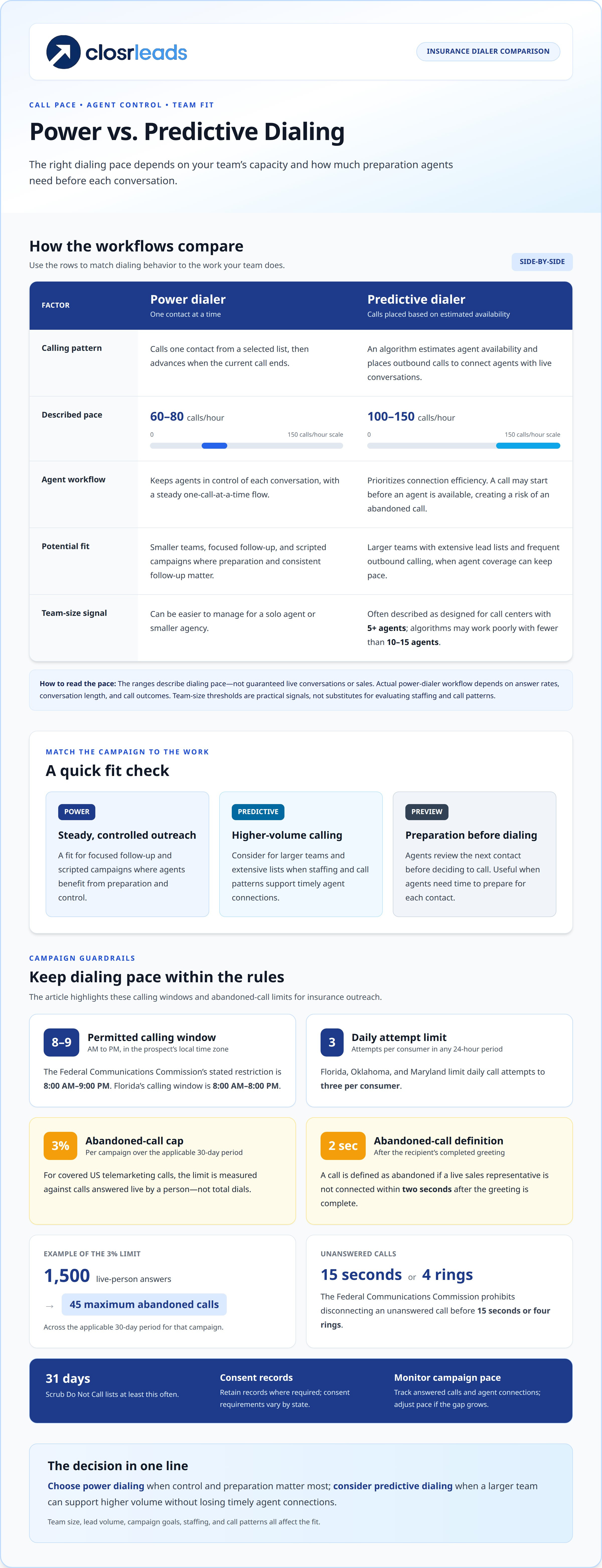
Build compliance into the calling workflow. The Federal Communications Commission states that insurance dialer calls are restricted to 8:00 AM - 9:00 PM in the prospect's local time zone. State rules may set narrower windows: Florida’s calling window is 8am-8pm. Florida, Oklahoma, and Maryland limit daily call attempts to three per consumer in any 24-hour period. Scrub Do Not Call lists at least every 31 days, and retain consent records where required. Consent requirements vary by state. Configure caller ID to display a recognizable agency name and callback number, and monitor abandoned calls.
Typical dialer pricing depends on seats, dialing capacity, integrations, and reporting needs. The price depends on the case and is given after a quote request.
To set up a dialer, import a targeted contact list, connect the CRM, set agent availability, and configure calling hours and attempt controls. Test the caller ID and call flow before launching the campaign.
| Dialer | Calling pattern | Best fit |
|---|---|---|
| Power | Calls one contact at a time | Agent control and scripted outreach |
| Predictive | Estimates agent availability to place calls | High-volume teams |
Choose based on team size, lead volume, and how much control agents need during each call.
What Is a Predictive Dialer?
A predictive dialer uses an algorithm to estimate agent availability and place outbound calls. It can increase live conversations, but mistimed connections can create a risk of abandoned calls.
Predictive Dialer Abandoned-Call Risk
The algorithm may start calls before an agent is available, leaving someone waiting after answering. That differs from a power dialer’s one-contact-at-a-time pace: predictive dialing prioritizes connecting agents efficiently, while a preview workflow gives agents time to review a contact before calling. Call volume, answer patterns, and agent availability all affect the risk of an abandoned call.
Abandoned-Call Rules and Limits
For covered US telemarketing calls, the Federal Communications Commission defines an abandoned call as one where a live sales representative is not connected within two seconds after the recipient’s completed greeting. The Federal Communications Commission limits abandoned calls to 3% of calls answered live by a person per campaign over the applicable 30-day period. It also prohibits disconnecting an unanswered call before 15 seconds or four rings.
Measure the limit against live-person answers, not total dials. For example, with 1,500 live-person answers, a campaign’s 3% limit allows no more than 45 abandoned calls across the applicable 30-day period. Track answered calls and agent connections by campaign, then adjust dialing pace when the gap grows. An available agent matters: increasing call attempts without matching agent capacity can raise abandonment risk.
Set the algorithm conservatively, monitor abandoned calls throughout each campaign, and review results across the full measurement period. Keep records clear enough to distinguish live answers from unanswered calls. With preview dialing, agents can review the next contact before choosing to call, avoiding predictive timing pressure. Predictive dialing best suits high-volume operations when staffing and call patterns support timely agent connections.
Dialer suitability for team size and campaign type
Team size matters because the dialing pace needs to match agent capacity. Power dialing supports controlled outreach, while predictive dialing targets higher call volume by estimating when agents will be free. Consider how many agents are available, how often they handle outbound calls, and whether the campaign prioritizes volume or preparation.
Insurance agencies may use a power dialer for smaller teams and campaigns where agents need time to personalize each conversation. A power dialer is described as making 60-80 calls per hour. Predictive dialers are described as making 100-150 calls per hour, making them a potential fit for larger lead lists and frequent outbound calling. Those figures describe dialing pace, not guaranteed live conversations or sales.
Predictive systems are often described as designed for call centers with 5+ agents. Yet their algorithms may work poorly with fewer than 10-15 agents, when there may not be enough agents available to handle overlapping answers. Treat these thresholds as a practical signal, not a substitute for evaluating actual staffing, average talk time, and call patterns. A small team with variable availability may prioritize agent control over speed.
Match the campaign to its work:
- Power dialing: Use for focused follow-up and scripted campaigns where agents benefit from steady pacing and control.
- Predictive dialing: Consider for larger teams managing extensive lists and frequent conversations, with agent coverage matched to call volume.
- Preview dialing: Choose when preparation matters; agents review the next contact before deciding to call. Preview dialing can suit campaigns where agents need time to prepare for each contact.
Before launch, define the campaign audience, calling schedule, and target workflow. Record call outcomes and review connection rates, talk time, and conversions. For predictive campaigns, include consent controls, including express written consent where required, and monitor abandoned calls. If conversations lag behind agent capacity, adjust the pace or choose a more controlled dialing mode. For teams looking to complement outbound dialing with automated and AI-driven client acquisition systems, thefraction.com provides solutions to help streamline lead generation.
Power, predictive, and progressive dialer differences
For insurance sales teams, the key difference is how each platform handles the next call. Power dialing gives agents more control, predictive dialing prioritizes volume, and progressive dialing automatically places the next call when an agent is ready.
Power Dialers
A power dialer works through a contact list in sequence, connecting an agent to one prospect at a time. This makes it easier to pause, review a record, or adjust a campaign between conversations. Unlike predictive dialing, it doesn’t use an algorithm to place multiple calls ahead of agent availability. It suits teams that value a steady pace and agent-led outreach over maximizing attempts.
Predictive Dialers
A predictive dialer estimates agent availability and can dial 3-5 times as many numbers as there are agents. That can increase calling activity across a large campaign, but it also raises the chance that a prospect answers before an agent is ready. Some systems use answering machine detection to leave a voicemail and move on. Build pacing and prior express written consent requirements into campaign planning.
Progressive Dialers
A progressive dialer waits until an agent finishes the previous call before placing the next one. It automates the handoff to the next prospect without starting calls ahead of agent availability. Progressive systems are described as making 80-110 calls per hour, placing their pace between the reported power and predictive dialer ranges. This approach can suit teams seeking an automated sequence without predictive dialing’s early-call risk.
Choose based on campaign volume and the agent experience you want. Power dialing emphasizes individual control. Predictive dialing suits teams prioritizing outbound volume and able to manage the pace. Progressive dialing automatically sequences the next call after each conversation. With any approach, track outcomes and assess whether the dialing pattern supports productive conversations.
Explore options for your insurance calling workflow and choose a dialing approach that fits your team’s campaign.
ClosrLeads: Built-In Dialer
ClosrLeads brings insurance leads and calling workflow together with a Built-In Dialer. Leads are delivered instantly to your CRM via webhook or CSV, so agents can follow up without a separate handoff.
Choose leads that fit your campaign, including Final Expense, Veteran, or IUL leads. Every fresh lead is OTP phone-verified, and invalid contacts, such as disconnected, wrong-number, or invalid contacts, are credited or replaced per policy. ClosrLeads also provides TCPA-compliant consent records. This can suit insurance teams that have chosen their dialing approach and want leads connected to their CRM workflow.
Ready to connect insurance leads with a built-in calling workflow? Contact ClosrLeads to choose leads for your campaign.
Turn Your Dialer Decision Into a Campaign Plan
Choosing a power dialer versus a predictive dialer for insurance is useful only when it supports your next campaign. Set a clear priority first: agent-led conversations, a higher outbound pace, or a workflow that advances calls when agents are available. Then align the lead type, follow-up process, and calling approach with that goal.
For campaigns focused on Final Expense, Veteran, or IUL, ClosrLeads offers leads alongside a Built-In Dialer. This connects lead delivery with your calling workflow. Identify the campaign you want to run and the dialer approach that fits your agents’ daily work, then explore ClosrLeads leads and dialer options.
Contact ClosrLeads to discuss dialers and how your campaign goals can shape the right setup. Move forward with a clear plan and a calling workflow built around your team.
Frequently Asked Questions
What are outbound call center dialers?
Outbound call center dialers place calls to contacts on an agency’s list. They can connect agents to contacts individually, advance to the next call when an agent is ready, or estimate agent availability to set the pace. For insurance campaigns, choose a dialer that fits the list, agent workflow, and follow-up process. Call records can help teams assess how the setup performs.
Which Dialer Type Is Best for Your Insurance Agency?
The right type depends on team capacity and campaign needs. A solo agent or small team may favor power dialing for more control over each call. Larger teams with extensive outbound lists may consider predictive dialing. Progressive dialing can suit an agency seeking automatic call sequencing without calls starting before an agent is available. Weigh agent preparation, lead volume, and campaign pace together.
What is the difference between a power dialer and a predictive dialer?
In a power dialer vs. predictive dialer for insurance comparison, the key distinction is call pacing. A power dialer calls contacts one at a time, while a predictive dialer estimates agent availability and may place calls before an agent is free. This affects agent control and the risk of prospects waiting for a connection. Choose based on workflow and staffing.
Which dialer is better for insurance agents handling leads and policy renewals?
When deciding between a power dialer and a predictive dialer for insurance, consider whether agents need time to review each record. Power dialing can support personalized lead follow-up or policy-renewal conversations. Predictive dialing may suit a staffed team working a large list with a consistent process. If campaigns have different needs, separate new-lead outreach from renewals and match each workflow to its call pace.
How many calls per hour can power and predictive dialers make?
Power dialers are described as making 60-80 calls per hour, while predictive dialers are described as making 100-150 calls per hour. These figures refer to dialing pace, not live conversations or completed sales. Actual activity depends on answer patterns, call duration, and agent availability. Compare campaign records for call attempts, connected conversations, and follow-up to understand the team’s results.
What FTC and state do-not-call rules apply to insurance dialers?
Insurance agencies should screen calling lists against applicable Do Not Call restrictions and follow consent requirements that vary by state. Scrub Do Not Call lists at least every 31 days. Florida, Oklahoma, and Maryland limit daily attempts to three per consumer in any 24-hour period, while federal law has no fixed daily ceiling. Apply the rules that govern each campaign and prospect.