Blog
Pay Per Lead Insurance: A Practical Guide for Agents in 2026
Discover how pay per lead insurance works in 2026. Learn to assess lead quality, compare pay-per-call, verify billing triggers, and maximize your sales ROI.

A cheap contact isn’t a bargain if you can’t reach it. With pay per lead insurance, the key question is what triggers the charge: delivery of a contact record, a live call, or a resulting policy? Those terms shape your costs and how you judge whether a lead source is working.
If you’ve paid for invalid details or watched a fresh inquiry go cold while you were busy, you know the purchase is only one part of the equation. Lead quality, delivery timing, and consistent follow-up all affect the value you get. ClosrLeads’ insurance leads include OTP phone verification and TCPA-compliant consent records, details you can factor into your evaluation.
This guide explains how pay-per-lead insurance works and how it differs from pay-per-call. You’ll learn what to clarify about billing, how to assess lead freshness and contact quality, and which measures help you compare sources beyond the initial price. You’ll also get a repeatable process for handling leads and tracking whether your approach supports your sales goals.
Key Takeaways
- With pay per lead insurance, distinguish the charge for a delivered prospect record from later application, underwriting, and policy outcomes.
- Compare pay-per-lead and pay-per-call by what reaches your team, what triggers billing, and what follow-up each requires.
- Track a lead cohort from initial contact through appointments, applications, and issued policies to see where progress stalls.
- Set an evaluation goal before buying, then review results against the outcomes that matter to your agency.
- ClosrLeads offers real-time and aged leads across insurance verticals, plus a built-in dialer and CRM delivery to support follow-up.
What Is Pay-Per-Lead Insurance and What Does the Agent Pay For?
In pay-per-lead insurance, an agent pays for a prospect lead delivered under an agreed billing model. The purchase is for an opportunity to follow up, not a completed insurance transaction. A lead charge doesn’t mean the prospect will answer, book an appointment, submit an application, pass underwriting, or buy a policy.
Pay-per-lead insurance is a model where an agent is billed for a prospect record that meets the provider’s agreed delivery and validity criteria, rather than only when a policy is sold. Those criteria matter because there’s no single definition of a “valid lead” that automatically applies to every provider or campaign. One agreement may focus on the details delivered; another may specify additional conditions.
This model sits within the broader practice of Lead generation, which connects potential customers with businesses. For an agent, the practical distinction is what you receive and what happens next. A contact record gives you information to use in outreach. A call-based product may instead bill for a connected call or transfer, depending on its terms.
How Pay-Per-Lead Differs from Commission-Based Insurance Sales
Lead acquisition is an upfront business expense. Agent compensation is separate and follows the agent’s compensation arrangement, which may depend on a policy outcome. Paying for a lead doesn’t pay your commission, and earning commission isn’t typically what triggers a charge for a delivered lead.
The steps are distinct: a lead is delivered, the agent attempts contact, a conversation may lead to an appointment, and the prospect may choose to apply. The application then goes through underwriting, and a policy may be issued afterward. Track each stage as a separate outcome. A delivered record can be difficult to reach, and a conversation may not progress to an application.
What Can Trigger a Lead Charge?
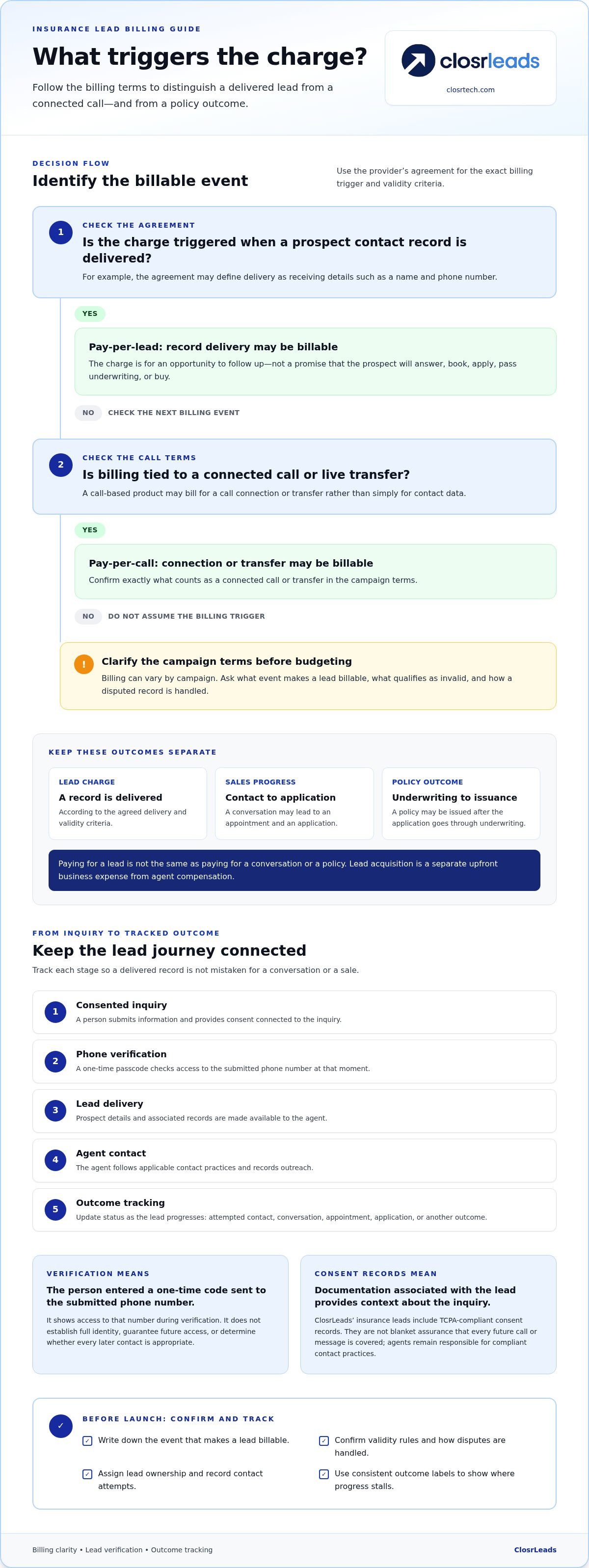
Read the billing terms before setting a buying budget. Identify the event that makes a lead billable and the provider’s stated validity criteria. Does billing happen when a record is delivered, when it passes a defined validation check, or when a call connects? The answer can vary by campaign.
- Delivered contact record: The charge may be tied to receiving prospect details, such as a name and phone number, according to the agreement.
- Connected call or live transfer: This is a different delivery model. The billable event may relate to a call connection or transfer, rather than simply receiving contact data.
- Validity exception: The agreement should explain what qualifies as invalid and how those cases are handled. Don’t assume an unanswered call or an unconverted prospect automatically meets that definition.
Before launch, write down the billing trigger, validity rules, and process for disputing a record. Then match those terms to your reporting. Clear definitions prevent a common mix-up: paying for a lead is not the same as paying for a conversation or a policy.
How Pay-Per-Lead Insurance Moves from Verification to Agent Follow-Up
A lead’s path doesn’t end when a prospect submits a form. In a well-organized pay per lead insurance process, the inquiry, verification details, delivery, agent outreach, and final status connect in one workflow. That structure helps you see what happened at each stage instead of treating every delivered record as a conversation or a sale.
- Consented inquiry: A person submits their information and provides consent connected to the inquiry.
- Phone verification: The phone number is checked through a one-time passcode process.
- Lead delivery: The prospect’s details and associated records are made available to the agent.
- Agent contact: The agent follows applicable contact practices and records outreach.
- Outcome tracking: The lead is updated as it progresses, for example, from attempted contact to a conversation, appointment, application, or another outcome.
What Verification and Consent Records Tell an Agent
OTP phone verification means a person entered a one-time code sent to the submitted phone number, showing access to that number during the verification step. OTP verification establishes access to a phone number at that moment; it doesn’t establish the person’s full identity, guarantee future access, or determine whether every later contact is appropriate. Verification can help you assess a contact record, but it isn’t a substitute for careful follow-up.
Consent records provide documentation associated with the lead, such as evidence connected to the inquiry. ClosrLeads’ leads include TCPA-compliant consent records. Treat those records as useful context, not a blanket assurance that every future call or message is automatically covered. Agents remain responsible for compliant contact practices and should seek appropriate legal guidance about their obligations. For more detail on the verification step, see OTP verified insurance leads.
Why Delivery and Follow-Up Need One Workflow
Fresh delivery creates an operational task: the information is ready, but the agent still needs to see it, act on it, and record what follows. If delivery sits apart from outreach and tracking, leads can be missed, duplicated, or left without a clear next step. Assign ownership, record contact attempts, and use consistent outcome labels so your team can distinguish “not yet reached” from “not interested” or “appointment set.”
ClosrLeads’ built-in dialer supports lead handling, and delivery into users’ CRM systems connects incoming records with the tools agents use to manage follow-up. Assign the lead, review its associated details, contact the prospect according to your process, then update the record. This creates a clear handoff without promising a response time or conversion result.
A connected lead follow-up workflow can help your team handle and track leads. Verification, documentation, delivery, and consistent updates each play a distinct role. Keep them connected to see how leads move through your pipeline.
Pay-Per-Lead vs. Pay-Per-Call: Which Model Fits Your Team?
Both models can put insurance prospects in your pipeline, but they deliver different starting points. With pay per lead insurance, you receive contact information and your team handles outreach. With pay-per-call, a consumer initiates a call, and billing is tied to the call under the campaign’s terms. The better fit depends on your staffing, follow-up process, and insurance product.
| Factor | Pay-per-lead | Pay-per-call |
|---|---|---|
| What’s delivered | A prospect record for agent outreach | An inbound call from a consumer |
| What may trigger billing | Delivery of a lead that meets the agreed criteria | A connected call or other event defined by the campaign |
| Agent effort | Organize and initiate contact, then manage follow-up | Be ready to handle the call and continue the conversation |
Billing terms vary, so compare the actual trigger and included criteria rather than relying on the model’s label alone. A call product isn’t simply a data lead delivered by phone. The consumer starts the conversation, while a data lead puts the first outreach step on the agent.
Data Leads and Inbound Calls Serve Different Workflows
Data leads suit teams with a defined outbound process: assign records, make contact attempts, and track each result. Inbound calls require a different kind of readiness. Agents need to be available to answer and prepared to speak with someone who has called. If calls arrive when the team can’t respond, the workflow may not match the campaign. Choose based on staffing, availability, and follow-up capacity, not an assumption that one format always performs better.
Lead freshness is another consideration. Real-time leads come from recent inquiries, while aged leads are older. Both require a clear plan for ownership and follow-up.
How Insurance Vertical Changes the Buying Context
Final expense, mortgage protection, IUL, veteran, and trucker leads serve distinct audiences and call for different product knowledge and sales conversations. Match the lead category to your authorization, expertise, and process for handling that type of inquiry. A team equipped to work with one audience may not be equally prepared for another. For a closer look at the category, explore a guide to final expense leads.
Before committing to either model, map each lead or call to the person who will handle it, the next action they’ll take, and the outcome your team will record. If your agents work in scheduled outreach blocks, contact records may fit naturally. If they can answer incoming calls and manage live conversations, call-based delivery may align better. Let your operating workflow decide.
How to Evaluate Pay-Per-Lead Insurance Without Guessing at ROI
Don’t judge a campaign by the number of records delivered or cost per lead alone. Cost per lead doesn’t show whether prospects were reachable, progressed through your sales process, or became issued policies. A useful review connects lead quality and consistent follow-up to downstream outcomes.
Use a simple sequence: define the goal, track a cohort, review the results, then adjust. Your goal might be to assess contactability or measure how often conversations progress to appointments. Set that aim before leads arrive so you know which measures will guide the decision.
Build a Simple Lead Performance Scorecard
Track each stage separately. Start with the number of leads delivered, then record valid contacts, conversations, appointments, applications, and issued policies. These measures show where prospects move forward and where the process stalls. Keep “reached” distinct from “meaningful conversation,” and don’t treat an application as an issued policy.
For a fair comparison, use the same reporting window and follow-up definitions across comparable cohorts. Record the lead category and delivery type, too. Mixing different insurance audiences or delivery approaches can blur the results and make a source appear stronger or weaker than it is.
- Delivery: How many records entered the cohort?
- Contactability: How many had usable details, and how many prospects did the team reach?
- Progression: How many conversations led to appointments or applications?
- Policy outcomes: How many applications resulted in issued policies?
Attribute each outcome to its original lead source and cohort instead of relying on memory or a broad monthly total. Follow-up consistency matters just as much. If one group receives organized outreach and another doesn’t, the comparison won’t show whether the difference came from the leads or the process.
Set a Controlled Test Before Scaling
Start with a test volume your team can handle without disrupting its existing follow-up. Before delivery begins, define how you’ll assess validity, contactability, progression, and policy outcomes. Set a consistent review window that allows records to move through your sales process, and keep the same status labels from first attempt through final outcome.
Then adjust with discipline. If records are usable but few conversations progress, review the follow-up process before changing the lead category. If contactability is the issue, review the relevant lead criteria and delivery details. Where practical, change one campaign variable at a time. That makes it easier to identify what influenced the results.
A practical pay per lead insurance review asks more than “How many leads did we buy?” It asks what happened to those leads, how consistently the team handled them, and which stage needs attention next. To apply that approach, explore insurance lead options that match your team’s follow-up capacity.
How ClosrLeads Supports a More Connected Insurance Lead Workflow
A lead program works best when the category, contact information, delivery, and follow-up process fit together. ClosrLeads offers real-time and aged insurance leads across several verticals, with OTP phone verification and TCPA-compliant consent records. Evaluate those details alongside your team’s capacity and performance measures, rather than treating delivery as the entire workflow.
Lead Categories and Tools for Insurance Agents
ClosrLeads offers final expense, veteran, trucker, mortgage protection, and IUL leads. Each category serves a different market. Start with the audience you’re authorized and prepared to serve, then match the lead type and freshness to your contact process. Real-time leads come from more recent inquiries, while aged leads are older. The right fit depends on how your team plans to work each lead, not just the label.
OTP phone verification and TCPA-compliant consent records add useful context to the delivered lead. Verification checks access to the submitted phone number, while the consent record documents information associated with the inquiry. Neither replaces an agent’s responsibility to use appropriate contact practices.
Invalid contacts are covered by a replacement guarantee. The guarantee applies to invalid contacts, not unanswered calls, prospects who don’t progress, or policies that aren’t issued. These boundaries help agents assess a lead program against its stated terms and focus quality discussions on the issue the guarantee addresses.
ClosrLeads’ built-in dialer supports lead handling, while delivery into users’ CRM systems connects lead receipt with ongoing tracking. The dialer is part of the platform workflow, not a standalone lead category. Agents can assign records, manage outreach, and document outcomes. No tool can promise a conversation or policy outcome, but an organized handoff makes it easier to see where each prospect stands.
Choose a Practical Next Step
Before exploring options, name your target vertical and the number of leads your team can realistically handle. Decide who will own new records, how follow-up will be tracked, and which outcomes matter in your reporting. A focused starting point makes it easier to assess whether the lead category and delivery type match your sales operation.
Review ClosrLeads’ lead options with those requirements in mind. Compare real-time and aged leads as different ways to support your follow-up plan, and keep the category consistent when reviewing results. If a contact is invalid, use the replacement process; if the lead is valid but doesn’t convert, record that separately. This distinction keeps your evaluation grounded.
For agents weighing pay per lead insurance, the practical next move is straightforward: choose the market, set a manageable handling plan, and explore the available insurance lead options. Build from a process your team can execute consistently.
Turn Your Next Lead Decision into a Stronger Process
Your next step doesn’t have to be a large commitment. Treat your next pay per lead insurance decision as a chance to sharpen your buying process. Set a clear purpose, assign ownership, and decide how your team will use what it learns. The goal is not just to add more prospects. It’s to build a repeatable approach that helps your agency make informed decisions as needs change.
With a defined process in place, you can explore lead options with a clearer sense of what fits your market and your team’s capacity. Explore insurance lead options with ClosrLeads and take the next step toward a more deliberate buying process. Keep your focus on consistency, learn from each campaign, and build momentum one informed decision at a time.
Frequently Asked Questions
Is pay-per-lead insurance the same as buying an insurance policy?
No. It’s a way for an agent to acquire a prospect’s contact information, not a purchase of coverage for the agent or the prospect. The consumer still needs to discuss options, submit an application, and go through the insurer’s process. Receiving a lead for someone interested in coverage doesn’t mean that person has applied or is insured.
Can a new insurance agent use pay-per-lead leads?
Yes, a new agent can consider purchased leads if they’re authorized to sell the relevant products and have a workable follow-up process. Start with a volume you can handle alongside training, appointments, and other responsibilities. Before buying, decide how you’ll assign each contact, record outreach, and review results. An organized test can help you learn your workflow without overwhelming your pipeline.
How much should an insurance agent budget for lead generation?
There’s no universal budget that fits every agent. Set a spending limit your business can sustain, then base your test size on available follow-up capacity and the amount you can afford to risk while learning. Include lead expenses in your operating plan, and track them separately by campaign and lead type. Review actual progression and policy outcomes before deciding whether to maintain or adjust the budget.
What happens if an insurance lead does not become a customer?
A lead that doesn’t become a customer may still be a valid delivered contact, so a lack of sale doesn’t automatically mean the purchase is reversed. Check the campaign’s billing and validity terms to understand which cases qualify for a remedy. With ClosrLeads, the replacement guarantee applies to invalid contacts. Keep notes on the issue and separate invalid records from prospects who simply don’t proceed.
Can agents deduct purchased leads as a business expense?
Possibly, but deductibility depends on the agent’s tax situation, business structure, and applicable tax rules. Keep invoices and payment records, and note the business purpose of each campaign. Don’t assume every lead-related charge receives identical tax treatment. An accountant or qualified tax professional can advise how to classify the expense and what documentation to retain for your circumstances.
Do pay-per-lead insurance campaigns guarantee a certain number of sales?
No. A campaign can deliver leads according to its agreed terms, but that doesn’t guarantee conversations, applications, or issued policies. Sales depend on factors beyond delivery, including prospect fit, agent follow-up, and the insurer’s application and underwriting decisions. Treat sales as an outcome to measure, not a promised result. Set expectations around delivery and lead validity separately from your sales targets.
Can an insurance agent work leads from more than one insurance vertical?
Yes, if the agent is appropriately authorized and equipped to serve each audience. Working more than one vertical can broaden your pipeline, but it also means learning different product contexts and organizing distinct follow-up. Separate lead categories in your records so outreach, appointments, and outcomes remain easy to compare. Add another vertical only when your schedule and expertise can support it.