Blog
Marketing Mortgage Protection to New Homeowners Through Clear Coverage and Ads
Learn how marketing mortgage protection to new homeowners can clarify coverage, explain policy options, and create timely, compliant ads that build trust.

Clear positioning beats a broad promise. Effective marketing mortgage protection to new homeowners starts with explaining how personal coverage differs from mortgage insurance, which protects the lender rather than the borrower.
New homeowners have a lot to sort through, so make the purpose of coverage easy to understand. Explain how options may address death, critical illness, or disability, and describe coverage amounts, term lengths, and available riders in plain language.
This guide shows how to sharpen your offer, explain coverage clearly, and reach new homeowners with timely, useful outreach. It also covers Meta’s Special Ad Category rules for financial products and services campaigns, helping you align ads with platform requirements while keeping your message focused and transparent.
Key Takeaways
- Turn your unique selling proposition into a short, benefit-led message that prospects can quickly understand.
- Connect coverage choices to the needs they may address, and explain how policy amount, term length, and riders shape an offer.
- Build outreach around the new-homeowner journey, using helpful education and timely follow-up instead of one generic message.
- Account for Meta’s Financial products and services Special Ad Category when setting up mortgage protection campaigns.
1. Differentiating an insurance offer with a unique selling proposition
Start with the distinction buyers often miss: private mortgage insurance, or PMI, protects the lender, not the homeowner. In the United States, borrowers putting down less than 20% of a home’s purchase price typically pay mortgage insurance on conventional loans. Mortgage protection insurance serves a different purpose. It may provide life insurance coverage intended to help a family manage housing costs after a covered event. State that difference clearly in ads and conversations with prospects.
Homeowners insurance is different again. It generally covers damage to the home and belongings, while mortgage protection focuses on financial support tied to the policyholder’s death or another covered event. A concise unique selling proposition can name the audience, need, and value: “Explore life insurance options designed to help protect your family’s home.” Don’t suggest that mortgage protection replaces homeowners insurance or removes PMI. Some mortgage protection offers may be bundled with life insurance or home insurance, and sellers may present discounts or other incentives. Explain the actual terms, not an assumed saving.
To compare mortgage protection quotes, line up the coverage amount, term, premium structure, benefit recipient, and policy exclusions. Evaluate insurers by reviewing policy documents and coverage conditions, not premiums alone. Mortgage protection insurance is generally designed to provide a benefit after a covered event, with the payout and eligibility governed by the contract. For example, two quotes may offer different terms or benefit amounts even when both use the same product label.
Limitations and risks depend on each policy’s wording. Prospects should understand exclusions, eligibility conditions, benefit limits, and how the policy responds if circumstances change. Use a plain-language summary instead of implying every claim will be paid. For compliance records, documents provided pursuant to 12 CFR 1024.14 must be retained for five (5) years from the date of execution, according to the Consumer Financial Protection Bureau. That requirement is distinct from explaining coverage accurately to consumers.
2. Emphasizing coverage for death, critical illness, or disability
Show prospects what a policy is designed to cover, then connect that coverage to the homeowner’s priorities. A mortgage protection offer may focus on a death benefit for a family or include coverage for critical illness or disability through available options. Explain each covered event separately. Don’t imply every policy covers all three.
Mortgage protection insurance and term life insurance can both provide a death benefit, but their policy structures and beneficiaries may differ. Mortgage disability insurance focuses on qualifying disability-related benefits, while mortgage protection may refer to different coverage designs. Explain the specific contract’s benefit, recipient, and conditions rather than treating these terms as interchangeable.
What coverage and benefit types are available? Options may include coverage for death, critical illness, or disability, with amounts, term lengths, and riders shaped by the policy. A rider can add a defined benefit or condition, but terms vary. Use a concrete example: describe a base death benefit, then explain how an available rider changes the protection.
For a new buyer, the mortgage balance is a useful starting point, not an automatic coverage target. Discuss the loan obligation alongside other needs, such as income replacement or support for dependents. A buyer seeking help with housing costs may prioritize a different amount or term than someone seeking broader family protection. At closing, connect the coverage decision clearly to the home purchase without suggesting it protects the lender.
How much does mortgage protection cost? Premiums depend on the applicant and selected coverage, including the amount, term, and any riders. The price is provided after a quote request, keeping the conversation focused on the actual policy rather than an unsupported estimate.
In lead generation, align each message with one coverage need. A death-benefit message, for example, differs from one focused on disability. Clear descriptions help prospects understand what they’re considering before discussing an application. For agents refining a relevant outreach plan, mortgage protection lead generation can connect campaign messaging with interested buyers.
3. Marketing to new homeowners
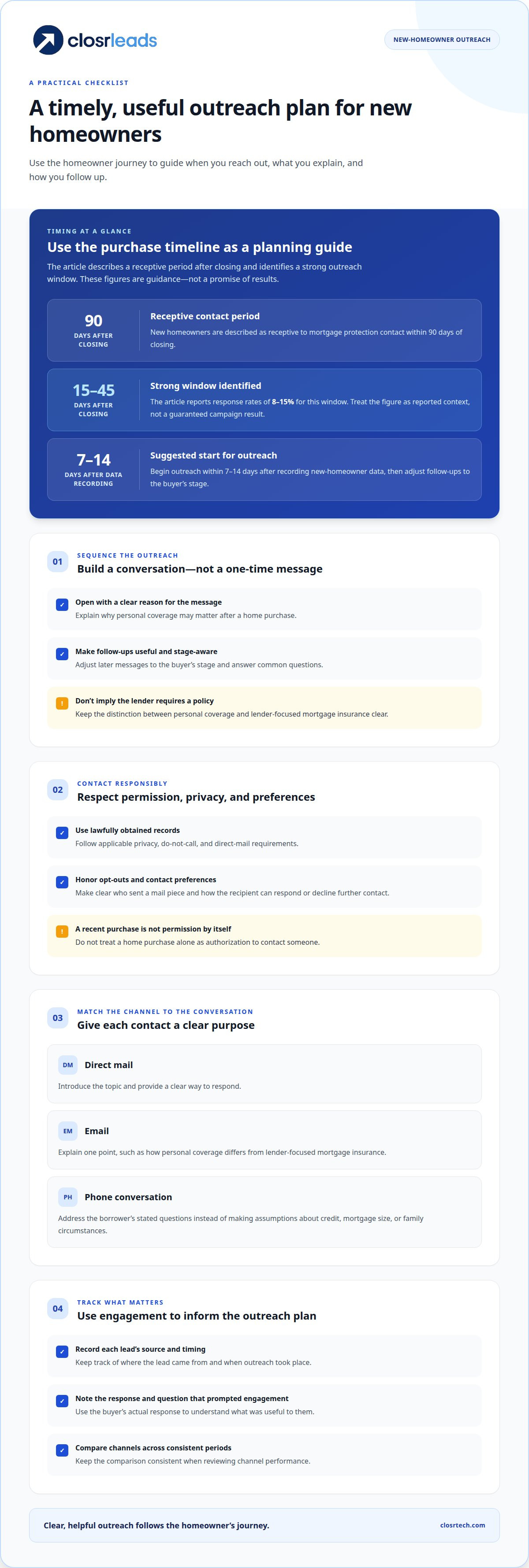
Timing gives outreach a practical starting point. New homeowners are described as receptive to mortgage protection contact within 90 days of closing. Days 15-45 are identified as a strong window, with reported response rates of 8-15%. Use that period to plan outreach, not as a promise of campaign results.
A disciplined approach to marketing mortgage protection to new homeowners starts with a sequence, not a single message. Begin outreach within 7-14 days after recording new-homeowner data, then adjust follow-ups to the buyer’s stage. An opening note can explain why personal coverage may matter after a purchase. A later message can answer common questions without suggesting the lender requires a policy.
Reach buyers through lawfully obtained records and follow applicable privacy, do-not-call, and direct-mail requirements. Honor opt-outs and contact preferences. For example, make clear who sent a mail piece and how the recipient can respond or decline further contact. A recent home purchase alone should not be treated as permission to contact someone.
Match each channel to the conversation. Direct mail can introduce the topic and offer a clear response path. Email can explain one point, such as how personal coverage differs from lender-focused mortgage insurance. A phone conversation can then address the borrower’s stated questions instead of making assumptions about credit, mortgage size, or family circumstances.
For an agency, track each insurance lead by source, timing, response, and the question that prompted engagement. Compare channels across consistent periods. Direct-mail response rates for new homeowners are listed at 1-3%, while campaigns sent 30-60 days after closing report 25-35% close rates among respondents. Treat these as planning benchmarks, not guarantees.
Marketing mortgage protection to new homeowners works best when each touchpoint is useful and consistent. State the next step clearly, explain what an application involves, and avoid implying coverage is automatic. Use buyer questions to refine future messages and make lead generation more relevant.
4. Meta Special Ad Category rules for mortgage protection ads
Meta classifies financial advertising through its Special Ad Category controls. For U.S. advertisers running financial products and services campaigns, the designation has been required since January 21, 2025. Meta introduced the Financial products and services category in October 2024, replacing its previous Credit ads category. Agents promoting mortgage protection should select the applicable category during campaign setup.
That platform setting is separate from insurance compliance. Federal and state requirements may apply to insurance advertising and outreach, while Meta’s category governs how campaigns run on its platform. The category itself does not establish that an ad complies with insurance rules. Keep claims accurate, explain coverage clearly, and avoid suggesting mortgage protection is lender-required mortgage insurance or private mortgage insurance.
Review compliance before launching each campaign. Check the selected category, creative, audience settings, and destination page together. For example, if an ad describes life coverage, the linked page should explain it as personal coverage, not lender protection. Keep the call to action consistent with the information presented, and remove unsupported promises or statements implying guaranteed approval.
Meta’s restrictions can affect campaign setup and audience options. Avoid building ad copy around assumptions about a viewer’s finances or health. A neutral message can explain that mortgage protection may help address family needs after a covered event, without implying knowledge of someone’s mortgage, credit, or circumstances. This distinction matters for consumer trust and campaign review.
Document the version of each creative, its destination page, and the category selected. If an ad is rejected, review Meta’s stated reason, revise the specific issue, and resubmit through the platform. Keep insurance compliance records separate from campaign notes. For a focused next step, plan your mortgage protection ad campaign around accurate coverage descriptions and the correct Meta category before publishing.
ClosrLeads: Mortgage Protection Leads
ClosrLeads provides Mortgage Protection Leads for agents ready to put clear coverage messaging into practice. Use these leads when your campaign needs a focused path to conversations with prospective buyers. ClosrLeads also offers real-time and aged insurance leads, all OTP phone-verified and TCPA-compliant. Invalid contacts, including disconnected, wrong-number, or otherwise invalid contacts, are credited or replaced per policy.
ClosrLeads’ built-in dialer delivers leads into your CRM via webhook or CSV, helping keep follow-up organized. This supports a process built around timely outreach, accurate product explanations, and respectful conversations. Agents can also explore Final Expense Leads, Veteran Insurance Leads, and IUL Leads when those audiences fit their business focus.
Choose Mortgage Protection Leads when your next step is reaching prospects interested in this coverage category. Keep your outreach aligned with the policy details and advertising rules covered above. Contact ClosrLeads to get started with Mortgage Protection Leads.
Build a More Focused Outreach Process
Make each campaign a learning loop. Use prospects’ questions to sharpen future explanations, clarify who the coverage may suit, and improve the handoff from ad to conversation. A disciplined approach to marketing mortgage protection to new homeowners keeps the message consistent while letting real prospect feedback guide what you refine next.
Lead support can help agents maintain that outreach focus. Alongside Mortgage Protection Leads, ClosrLeads offers Final Expense Leads, Veteran Insurance Leads, and IUL Leads. Each offering gives agents a distinct audience to consider when it fits their business goals. Choose the next step that supports your current focus without blurring the message homeowners receive.
Ready to discuss how lead support could fit your outreach plans? Contact ClosrLeads to discuss lead support. Keep the next campaign clear, relevant, and built around informed conversations.
Frequently Asked Questions
Is mortgage protection insurance required by law or by mortgage lenders in the United States?
Mortgage protection life coverage is generally separate from mortgage insurance a lender may require. For conventional loans, borrowers who put down less than 20% of the purchase price typically need private mortgage insurance, which protects the lender. That is not the same as personal coverage intended to help a household manage housing expenses after a covered event. Review loan requirements separately from optional insurance decisions.
When should new homeowners consider buying mortgage protection insurance?
Consider coverage while reviewing the household budget and existing life insurance after buying a home. For example, a homeowner with dependents, one primary income, and limited existing coverage may have different priorities from a buyer who already has substantial life insurance. Compare the policy’s benefits and term with the household’s needs rather than assuming a recent purchase automatically means coverage is necessary.
How can agents market mortgage protection insurance to new homeowners ethically and legally?
Use accurate descriptions, distinguish personal coverage from lender-required mortgage insurance, and never imply that a homeowner must buy a policy to keep a loan. Explain material terms plainly, respect contact preferences, and follow applicable federal and state outreach requirements. For digital campaigns, select Meta’s applicable financial products and services Special Ad Category. Keep the ad, audience settings, and destination page consistent and free of unsupported promises.
What federal and state rules govern marketing insurance to new homeowners?
Federal and state requirements may apply to insurance advertising and outreach. Use lawfully obtained records, follow applicable privacy, do-not-call, and direct-mail requirements, and honor opt-outs. Meta’s Special Ad Category rules are separate from insurance compliance.
How much does mortgage protection insurance cost for new homeowners?
Premiums depend on the applicant, coverage amount, term, and riders, so request a quote for the selected policy.