Blog
Is Buying Insurance Leads Worth It in 2026? A Practical ROI Guide
Is buying insurance leads worth it in 2026? Discover how to calculate real ROI, compare lead types, and build a profitable sales pipeline with this guide.

The cheapest lead can become your most expensive sale. So, is buying insurance leads worth it? It can be, but only when the numbers, prospect fit, and follow-up process work together. A lead that doesn’t answer or match your product can drain time and budget, while a well-managed source can support steady growth.
It’s reasonable to question whether contact rates and lead quality justify the spend. Price per record alone won’t tell you. Track how many prospects you reach, how many policies you place, and what it costs to acquire each client. Make sure you have a follow-up system in place before new leads arrive.
This guide shows you how to calculate your break-even point using your own close and retention data, compare shared, exclusive, real-time, and aged leads, and choose an approach that fits your products and sales capacity. You’ll also learn what to track when testing a source, including invalid contacts, response rates, and follow-up outcomes. The goal is a clear decision based on your results, not guesswork.
Key Takeaways
- Is buying insurance leads worth it? Judge by profitable policies and total acquisition costs, not lead price alone.
- Map each funnel stage, from contact and appointment rates to issued policies, to see where results change.
- Compare purchased leads with referrals and self-generated prospects based on cash commitment, time, volume control, and tracking needs.
- Run a focused test with one product and source, then use consistent lead records to assess performance before scaling.
- Expand only when the economics work, the prospects fit, and your team can follow up reliably.
Is buying insurance leads worth it? Start with the trade-off
Buying insurance leads can work, but profitability depends on measurable outcomes. A purchased lead gives an agent prospect information collected through a lead-generation process. That differs from a referral, which comes through an existing relationship, and from self-generated prospects, whom the agent finds through their own outreach. A live transfer is different again: instead of receiving contact details to follow up, the agent is connected to a prospect by phone.
The trade-off is straightforward. Buying leads gives you access to prospects without building every connection yourself. In return, you take on acquisition expense and the work of making contact, following up, and determining fit. More leads, faster delivery, or phone verification may support your process, but none guarantees an issued policy. Agents working in the broader sales ecosystem, including those performing the Role of Insurance Brokers, still need to assess each prospect and guide the sales process.
What are agents paying for when they buy insurance leads?
A lead may include contact details, information about the coverage the person requested, and records of the permission associated with submitting their information. What’s included depends on the lead type and its terms. OTP phone verification can help you review whether a contact number was verified, while consent records provide information to assess as part of your own process. Neither guarantees a sale or replaces your responsibility to follow applicable requirements.
Real-time leads are delivered soon after submission; aged leads were collected earlier. Real-time delivery may suit a workflow built for prompt outreach, while aged data may fit a different calling routine. Neither is automatically better. Shared leads may be distributed to multiple agents, while exclusive leads are allocated to one buyer. Review the terms for invalid contacts and replacements, then track results rather than relying on the label alone.
When can purchased leads make business sense?
Purchased leads are more likely to fit when you have capacity to respond, a product that matches the prospect’s request, and a consistent follow-up process. If new contacts pile up untouched, added volume creates work without a reliable path to results. Real-time CRM delivery and a built-in dialer can support organized follow-up, but your team still needs to use them consistently.
Referrals can come with an existing connection. Self-generated prospecting gives you more control over how you build a pipeline, but takes time and effort. Purchased leads offer another way to access prospects, with direct acquisition expense and a need to assess lead quality. No channel wins for every agent. If you’re evaluating a specific product, explore Final Expense leads for product-specific context.
How to calculate whether insurance leads can deliver a positive return
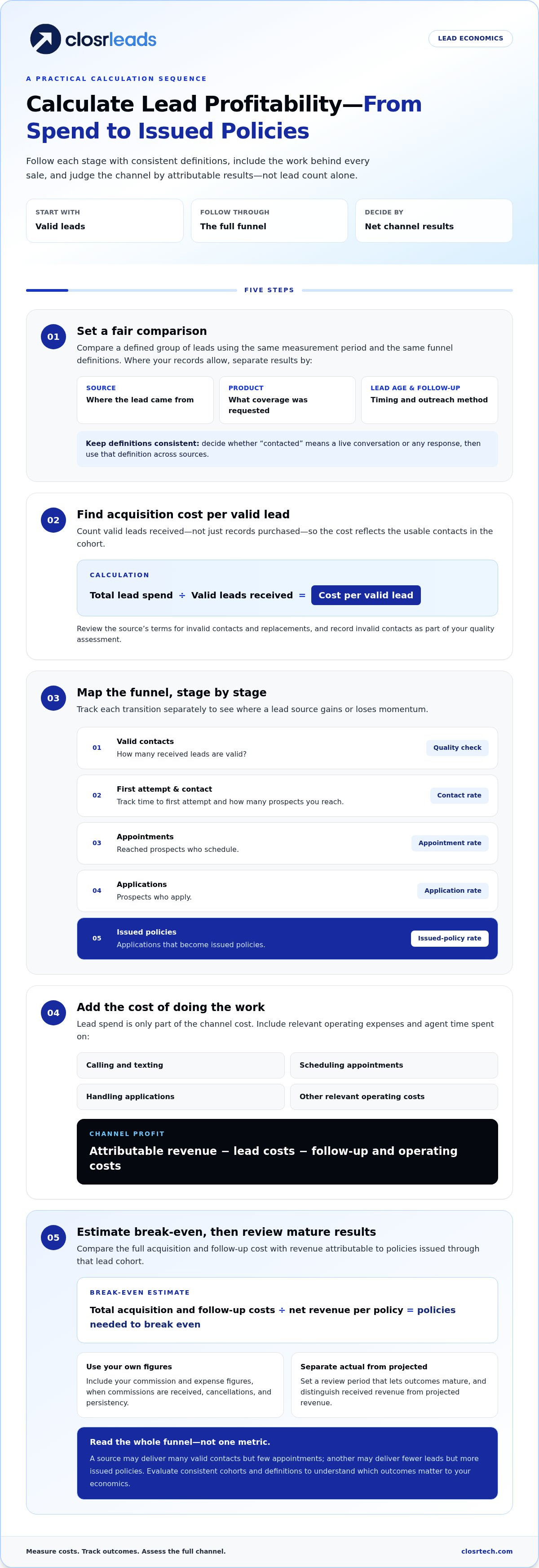
Start with the result, not the lead count. Lead-channel profit = attributable revenue − lead costs − follow-up and operating costs. Include agent time spent calling, texting, scheduling, and handling applications. The Insurance Sales Agent Outlook provides context on the role’s duties, which can help you account for the work behind each sale.
Keep the funnel stages separate. Cost per lead measures acquisition spend against leads received. Contact rate shows how many prospects you reach. Appointment rate tracks reached prospects who schedule. Application rate measures prospects who apply, and issued-policy rate shows how many applications become issued policies. Separating these stages helps identify where a source is losing momentum.
Build a break-even model with your own numbers
First, divide total lead spend by the number of valid leads received. That gives you acquisition cost per valid lead. Then calculate each conversion rate using the same definitions and measurement period. For example, decide whether “contacted” means a live conversation or any response, and apply that definition consistently across sources.
Add follow-up labor and relevant operating expenses to lead spend. Then compare the full cost with attributable revenue from policies issued through that lead cohort. A simple break-even estimate is:
- Total acquisition and follow-up costs ÷ net revenue per policy = policies needed to break even.
Use your own commission and expense figures. Account for when commissions are received, as well as cancellations and persistency. An application or newly issued policy may not represent the final value of the channel if revenue changes later. Set a review period that allows outcomes to mature, and distinguish received revenue from projected revenue.
Which metrics reveal whether the channel is improving?
Track valid-contact rate, time to first attempt, contact rate, appointments, applications, and issued policies. Review them together. A source may produce plenty of valid contacts but few appointments; another may produce fewer leads but more issued policies. Your funnel shows which results matter to your economics.
Compare cohorts by source, product, lead age, and follow-up method where your records allow. Keep the evaluation window and definitions consistent, or the comparison can mislead. If verification is part of your quality review, explore OTP-verified insurance leads as one factor alongside contact outcomes and policy results. That evidence helps answer “is buying insurance leads worth it” for your business, rather than relying on broad claims about lead performance.
Buying leads versus generating them: compare the real trade-offs
Buying leads can shorten the path to a prospect, but it doesn’t remove the work of reaching, qualifying, and following up. Referrals, organic prospecting, and paid self-generation each bring different demands. The right mix depends on your available time, cash flow, sales capacity, and ability to measure outcomes, including whether placed policies remain in force.
| Channel | Cash commitment | Time to prospect | Volume control | Measurement focus |
|---|---|---|---|---|
| Purchased leads | Direct acquisition spend | Prospects are supplied; outreach is still yours | Can adjust order volume | Source, lead age, contact, and policy outcomes |
| Referrals | Often less direct acquisition spend | Depends on relationship-building and referral flow | Limited control over timing and volume | Referral source and results over time |
| Organic prospecting | More time investment than direct lead spend | Usually takes ongoing effort to build awareness and trust | Grows with consistent activity | Time invested, inquiries, and resulting policies |
| Paid self-generation | Requires campaign spend and management | Requires setup and ongoing optimization | Can adjust campaign activity | Spend, inquiry quality, conversions, and policy outcomes |
This is a planning guide, not a universal ranking. Purchased leads may help agents who have follow-up capacity but need more prospect flow. They can strain an operation that can’t respond consistently. Referrals may suit agents with a strong relationship network, while organic or paid self-generation may fit those prepared to build and manage their own demand. Compare the full effort and outcomes, not just how quickly names arrive.
Real-time and aged leads solve different workflow needs
Real-time delivery creates a faster handoff. It fits agents who can act promptly when prospects arrive, including through CRM delivery and a built-in dialer. Aged leads call for a distinct workflow: set realistic contact expectations, organize attempts, and record outcomes consistently. Neither format is automatically the better fit. Choose based on your available calling time and the results you can track.
Match the lead approach to your insurance vertical
Lead volume matters only when the prospect’s requested coverage aligns with your expertise. Final Expense, Mortgage Protection, IUL, Veteran, and Trucker leads each point to a different product conversation. Consider where your knowledge is strongest and whether your process can address the prospect’s needs clearly. For a closer look at one vertical, read this guide to Mortgage Protection leads.
How to test insurance leads before increasing your spend
Don’t scale based on a strong first impression. Run a controlled test with one product, one defined lead cohort, a fixed budget, and an evaluation period long enough to review meaningful funnel outcomes. Decide in advance what would make you stop, adjust, or scale. That keeps a few promising conversations, or one frustrating day, from driving the decision.
Set criteria for both lead quality and sales results. For example, investigate if contact details are invalid or product fit is consistently poor. Adjust the workflow if prospects are valid but follow-up is delayed or attempts aren’t being logged. Consider increasing spend only when results meet your pre-set targets and your team can handle the added volume.
Use a repeatable lead-quality checklist
Review each record consistently. Are the contact details usable? Does the request match the intended product? Note delivery time, verification status, and available consent records. Review the terms for invalid contacts and replacements. Keep invalid details separate from valid prospects who don’t respond or turn out not to qualify. These are different outcomes, and combining them can distort your assessment of lead quality.
OTP phone verification adds a useful data point to this review, but it doesn’t establish whether a prospect is interested or a good fit. Likewise, TCPA-compliant consent records support your review of a lead’s documentation; they don’t replace your own compliance responsibilities. Treat verification and consent as parts of a broader quality check, not as guarantees.
Build follow-up speed and measurement into the test
Assign every new lead promptly and record each contact attempt and disposition using the same workflow. A built-in dialer can support follow-up, while real-time CRM delivery can help keep lead source and activity connected. Use CRM fields to link the cohort with agent activity and later outcomes, including applications and issued policies.
- Record: source, product, lead age, delivery time, and verification status.
- Track: first-attempt timing, contact attempts, and dispositions such as reached, no response, invalid, or not qualified.
- Review: appointments, applications, issued policies, and your pre-set stop, adjust, or scale criteria.
Compare cohorts only when they’ve been worked and measured consistently. Don’t scale based on a small or unevenly followed sample. To strengthen your lead process, review your lead follow-up workflow. Then use the results to answer “is buying insurance leads worth it” for your operation, with evidence rather than instinct.
Make a confident decision and put your lead process to work
A clear go/no-go decision comes down to four checks: sustainable unit economics, relevant prospects, reliable tracking, and enough capacity to follow up. If one is missing, fix the gap before adding volume. If all four hold up, continue with a measured test, then expand based on results rather than expectation.
Keep the next step focused. Select one insurance vertical and one lead source that fit your experience and target market. Define the cohort, evaluation period, and success criteria before leads arrive. Then compare its contact, application, and issued-policy outcomes with your baseline. This helps you see whether a change in results comes from the source, product fit, or how leads are handled.
What to look for in a lead workflow
Lead features should support your evaluation process, not stand in for it. OTP phone verification gives you a detail to review, while TCPA-compliant consent records provide documentation for your own assessment. Those records don’t guarantee that your outreach meets every compliance requirement. Real-time CRM delivery can place new leads into your workflow, and a built-in dialer can support prompt, organized follow-up.
Also understand how invalid contacts are handled. Invalid contacts are covered by a replacement guarantee. Track them separately from valid prospects who don’t respond or don’t qualify, so your review reflects the actual issue instead of grouping every unsuccessful contact together.
Choose a focused next step
Start with the product you know best and can serve effectively. An agent focused on Final Expense, for example, can assess that vertical’s lead cohort separately from Mortgage Protection or IUL prospects. Don’t mix products or sources in the same initial test if you want clear attribution. Review the results against your baseline before deciding to continue, adjust the process, or increase volume.
That’s the practical answer to “is buying insurance leads worth it?” The channel earns a place in your business when its measured results justify the acquisition and follow-up effort, and your team can sustain the workflow. Keep the test controlled and let the data make the case.
Explore insurance lead options and get started with a relevant vertical and a lead flow that fits your process. Then track the cohort from delivery through policy outcomes before making your next decision.
Turn your lead numbers into a confident next step
So, is buying insurance leads worth it? It can be when the economics work, prospects fit your product, and your team can follow up and track results consistently. Measure more than cost per lead. Include agent time, issued policies, and the longer-term value of business that stays in force.
Keep your decision disciplined: test one product and source at a time, define your success criteria in advance, and compare results with your baseline before increasing spend. Lead features can support that process, but they don’t promise sales. OTP phone verification and TCPA-compliant consent records provide details to review, while real-time CRM delivery and a built-in dialer can help organize follow-up. Invalid contacts are covered by a replacement guarantee.
Ready to put a measured test in motion? Explore insurance lead options and build a measurable follow-up process with ClosrLeads. Start with the vertical that fits your experience, track each outcome, and let your own numbers guide the next move.
Frequently Asked Questions
Is buying insurance leads worth it for a new agent?
It can be, if you have a relevant product, time to follow up, and a way to measure results. For a new agent, start with a small, defined test instead of committing heavily before understanding contact and conversion patterns. Include your time and operating expenses in the calculation, not just lead spend. The key question, “is buying insurance leads worth it,” depends on your sales process and policy outcomes.
How do you calculate ROI on insurance leads?
Subtract total lead acquisition and follow-up costs from attributable revenue, then divide that result by total costs. Multiply by 100 to express ROI as a percentage. Include agent time and relevant operating expenses. Track the funnel separately: valid leads, contacts, appointments, applications, and issued policies. Use revenue attributable to the lead cohort, and account for commission timing, cancellations, and persistency when assessing longer-term value.
Are real-time insurance leads better than aged leads?
Neither is universally better. Real-time leads arrive closer to the prospect’s submission, so they suit agents with a process for prompt assignment and outreach. Aged leads may fit agents who can work a distinct, disciplined follow-up routine and evaluate outcomes over an appropriate period. Compare them using the same product, funnel definitions, and evaluation approach where possible. Your available capacity and measured policy results should guide the choice.
What makes an insurance lead high quality?
A useful lead has usable contact details, a clear connection to the insurance product you offer, and information that lets you review how the prospect submitted their request. Verification details, consent records, delivery timing, and clear invalid-contact terms can also inform your assessment. Don’t judge quality by verification alone. Track whether leads can be reached, fit your target market, progress through your sales process, and result in issued policies.
Can buying insurance leads guarantee sales?
No. A lead, its delivery speed, and its verification status can support your outreach, but none guarantees a conversation, application, or issued policy. Results depend on factors including prospect fit, agent capacity, follow-up, and the sales process. Set expectations around measurable outcomes instead of lead volume alone. Review valid contacts, contact rates, applications, and policies from each cohort before deciding whether to continue or change your approach.
How quickly should agents contact real-time insurance leads?
Contact real-time leads as soon as your workflow allows. Prompt assignment matters because delays can make it harder to connect while the inquiry is fresh. Set up a process that routes new leads to an available agent, records the first attempt, and captures each follow-up. Real-time CRM delivery and a built-in dialer can support that workflow, but they don’t replace consistent action or careful tracking by your team.
Are OTP-verified insurance leads TCPA compliant?
OTP verification confirms a phone number through a one-time passcode. It is not, by itself, proof that every calling or texting requirement has been met. ClosrLeads provides OTP phone-verified leads with TCPA-compliant consent records, which agents can review as part of their process. Those records don’t guarantee an agent’s compliance. Agents remain responsible for how they contact prospects and for following the requirements that apply to their outreach.