Blog
Insurance Lead Generation Companies: How to Compare Providers in 2026
Compare top insurance lead generation companies in 2026. Learn how to evaluate verification, TCPA compliance, delivery speed, and lead models before you buy.

The biggest lead order can be the wrong buy if your team can’t work it promptly. When comparing insurance lead generation companies, volume is only one part of the decision. The lead model, verification, and fit with your follow-up process matter just as much.
Lead vendors, marketing agencies, and data-list providers don’t all deliver the same kind of opportunity. Unresponsive contacts, unclear consent records, or leads arriving faster than your CRM or agents can handle them can drain time and momentum.
This guide explains what to compare before investing: lead models, phone verification, consent documentation, delivery speed, replacement policies, and workflow fit. It also covers how to measure lead quality beyond headline volume. ClosrLeads provides real-time and aged insurance leads across multiple verticals, with OTP phone verification, TCPA-compliant consent records, real-time CRM delivery, and a built-in dialer. Use these criteria to identify a provider model your products, sales process, and team can support.
Key Takeaways
- Understand the difference between a lead vendor that supplies prospects and an agency that runs campaigns.
- Compare real-time and aged leads by how they’re sourced, routed, and delivered, not by timing alone.
- Evaluate insurance lead generation companies using concrete details such as verification, consent records, and delivery process.
- Set your target vertical, team capacity, follow-up ownership, and CRM workflow before choosing a provider.
- Explore how ClosrLeads’ Final Expense, Veteran, Trucker, Mortgage Protection, and IUL leads may align with your sales focus.
What insurance lead generation companies do, and what agents actually buy
A lead vendor supplies prospect records. A marketing agency may plan and run campaigns designed to attract prospects. These are different purchases, even when both are described as lead generation. An insurance lead is prospect information gathered to support an insurance-related sales conversation. It may be a contact record from a list or an inquiry routed to an agent. Neither form guarantees a sale.
The phrase insurance lead generation companies covers providers with different products, services, and delivery arrangements. The label alone doesn’t tell you whether a person requested contact, how their details were checked, or whether the prospect fits your products and sales process. For a basic overview of the wider concept, see What is lead generation?
Lead vendors, data-list providers, and marketing agencies are not interchangeable
A lead vendor delivers prospect records. A data-list provider supplies searchable contact information that an agent may need to filter and work through. A routed inquiry is different: it reflects a prospect’s response to an insurance-related prompt and is sent to an agent for follow-up. The record’s origin and context help set expectations, but they don’t prove intent or readiness to buy.
Marketing agencies generally focus on campaign execution, such as planning or managing activity that attracts prospects. Salesgenie, for example, positions targeted insurance prospect lists using attributes related to households, property, vehicles, and businesses. That list-based model illustrates the distinction, but a list isn’t automatically an inquiry routed from a consumer to an agent.
Match the provider category to your agency’s immediate need
Start with the gap you need to fill. If your team needs prospect records to contact, consider a lead or list provider. If it needs campaign planning and execution, that’s a marketing-services requirement. If both are missing, separate the two jobs before comparing offers. Buying leads and hiring custom marketing services are different decisions, so identify what each option actually delivers.
Then map the handoff: what information arrives, how it reaches your team, and who owns the next follow-up. A searchable contact list may require staff to select and contact prospects. A routed inquiry arrives with a different context. In either case, agents need to assess fit and manage the conversation themselves.
ClosrLeads is an insurance-focused lead provider, with real-time and aged leads across Final Expense, Veteran, Trucker, Mortgage Protection, and IUL. Its leads are OTP phone-verified and include TCPA-compliant consent records. Those details describe what is supplied; they don’t mean every category or lead model suits every agency. An agent focused on Final Expense can use a dedicated Final Expense lead guide to explore that product area and assess its fit with their workflow.
How insurance lead generation companies source and deliver prospects
A prospect’s source matters, as does what happens after their information is collected. The source provides context for the inquiry; the delivery method determines how quickly and in what form it reaches the agent. Together, those details shape the first follow-up and the expectations your team should have.
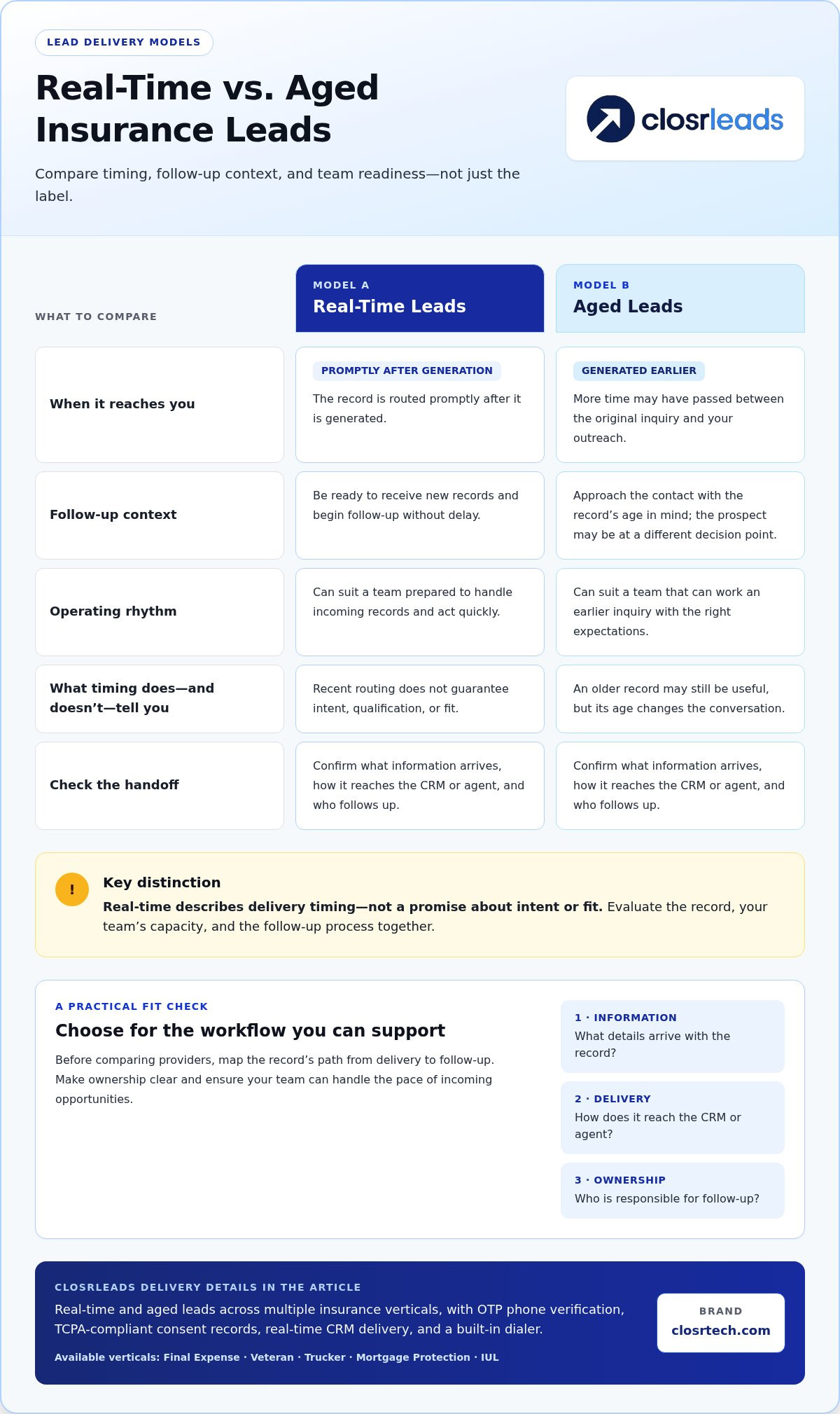
Keep the distinction clear: real-time describes delivery timing, not a promise about intent or fit. A recently routed record may still need qualification. An older record may still be useful, but its age changes the conversation. The right model depends on how your agency handles incoming opportunities and how quickly your team can act.
Real-time and aged insurance leads serve different operating rhythms
Real-time leads are routed promptly after generation. This can suit teams prepared to receive new records and begin follow-up without delay. Aged leads were generated earlier, so more time may have passed between the original inquiry and your outreach. Set expectations accordingly and approach the contact with context rather than assuming the prospect is still at the same decision point.
Timing is only one part of the handoff. Identify what information accompanies a record, how it reaches the CRM or agent, and who is responsible for acting on it. For verification specifics, the OTP verified insurance leads resource explains what phone verification adds to lead evaluation.
Insurance verticals shape the prospect context
A lead category signals the insurance topic around which a prospect’s information was gathered. It helps an agent focus the conversation, but it doesn’t establish that the prospect qualifies for a product or is ready to buy. Match the category to the products you’re licensed to discuss and the expertise your team can bring.
- Final Expense leads relate to a specific life insurance sales focus.
- Veteran leads identify a distinct audience context for an insurance conversation.
- Trucker leads are tied to insurance needs relevant to trucking.
- Mortgage Protection leads center on a mortgage protection conversation.
- IUL leads align with an indexed universal life insurance focus.
ClosrLeads offers real-time and aged leads across these verticals. Its leads are OTP phone-verified and include TCPA-compliant consent records. Real-time delivery into users’ CRMs and a built-in dialer support the handoff to follow-up. These features make the delivery process more concrete, but they don’t replace an agent’s assessment of fit. Agents exploring this category can use a Mortgage Protection leads guide to understand how that vertical relates to their offer.
Before selecting a model, map the route from inquiry to agent: what arrives, where it lands, and who takes action. This makes it easier to compare insurance lead generation companies on practical fit, not just labels. To see how lead delivery and follow-up tools fit together, explore insurance lead delivery options.
How to compare insurance lead generation companies without relying on hype
Compare what a provider does, not just what it says. Claims such as “high quality” or “high intent” need measurable context. Record practical details: the insurance vertical, lead timing, verification method, consent documentation, and delivery process. Then track what happens after a lead reaches your team. Volume alone can’t show whether agents made contact, held a relevant conversation, or moved a prospect forward.
Use the same framework for insurance lead generation companies. This example separates stated details from fields to evaluate for each provider:
| Vertical | Lead timing | Verification | Consent records | Delivery |
|---|---|---|---|---|
| Final Expense, Veteran, Trucker, Mortgage Protection, and IUL | Real-time and aged | OTP phone-verified | TCPA-compliant consent records included | Real-time delivery into users’ CRMs |
| Your target product | Record the stated timing | Record the stated method | Note what documentation accompanies each lead | Record how leads reach agents and which tools are included |
The first row reflects ClosrLeads’ stated lead and delivery details. The second is a practical comparison prompt, not a claim about another provider. Use the same fields for every option so broad marketing language doesn’t get mistaken for evidence.
Check verification, consent records, and invalid-contact terms
OTP verification confirms a phone number through a one-time passcode. It doesn’t prove that the prospect intends to buy, qualifies for coverage, or will respond to an agent. Treat verification as one quality-control detail, not a measure of sales readiness.
Before purchasing, note the lead’s vertical and age, the stated verification method, what consent documentation accompanies each record, how delivery works, and what qualifies as an invalid contact under any replacement policy. Replacement terms are provider-specific and apply only as stated. Don’t assume every vendor offers replacements or uses the same conditions. ClosrLeads provides a replacement guarantee for invalid contacts; that doesn’t establish another provider’s terms.
Evaluate vertical fit, delivery, and platform workflow
A lead category should match the product your agents are prepared and licensed to discuss. Then assess whether the timing and delivery route fit your team’s actual capacity. Real-time CRM delivery can reduce manual handoffs, but agents still need a clear owner for follow-up. A built-in dialer may support outreach in the same workflow; its value depends on how your team handles calls and records activity.
Finally, measure results at the agent level. Track leads received, successful contact attempts, conversations, and outcomes using consistent definitions. Review those measures by vertical and lead timing, not just as one combined volume total. This helps show where the process is working and where there may be a mismatch.
How agents can choose a lead provider and measure the fit
A provider can deliver what it promises and still be a poor fit if your team can’t follow up consistently. Set your operating requirements first, then run a controlled evaluation and measure what happens after each lead arrives. This gives you a more useful basis for comparing insurance lead generation companies than volume or promotional claims alone.
Set the operating requirements before comparing providers
Start with the insurance products your agency is prepared and licensed to discuss. Identify the agents who will own incoming leads, the follow-up steps they’ll use, and how your CRM will receive and assign records. Be realistic about capacity: real-time leads need a prompt handoff, while aged records need a clear outreach and status-tracking process.
- Define the target. Choose the specific vertical and lead timing that match your products, expertise, and sales process. Avoid testing several unrelated categories at once.
- Check capacity. Decide how many incoming records your team can handle without letting follow-up slip. Assign an owner for each lead and establish what happens if that person is unavailable.
- Map the workflow. Identify where leads enter your CRM, how they’re assigned, and how agents record attempts and outcomes. A manual workaround can create delays or gaps in reporting.
- Run a controlled evaluation. Start with a defined set of leads and keep the handling process consistent. Record exceptions, such as missing information or delayed assignment, instead of treating every outcome as a provider issue.
Measure lead performance with a consistent feedback loop
Track each stage separately. Record leads received, contact attempts, prospects reached, appointments set, and sales. Define each stage before the evaluation begins. For example, decide what counts as a successful contact and when an appointment is considered set. Consistent definitions make results easier to compare across agents and lead sources.
Review performance by vertical and delivery timing. Don’t blend aged records with real-time leads or combine different insurance products into one result. Set a review period, then compare the same measures across it before changing providers or follow-up steps. This helps distinguish a workflow issue from a source mismatch.
Lead-source results are only part of the picture. Agent availability, response habits, qualification, and follow-up consistency can all shape outcomes. A low appointment count, for instance, may reflect missed contact attempts or poor assignment as well as lead fit. Use your records to diagnose the process rather than assuming the source alone caused the result.
To align your next lead test with your team’s workflow, explore insurance lead options for your agency.
Why ClosrLeads fits agents seeking verified insurance leads
The comparison framework leads to a practical question: does the provider’s setup match the products you sell and the way your team follows up? ClosrLeads is an insurance-focused lead provider, not a marketing agency or brokerage. Its offering combines insurance-specific lead categories with phone verification, consent records, and tools that support delivery into an agent’s workflow.
These are concrete details agents can evaluate, not promises of a particular sales result. Results still depend on prospect fit, agent capacity, follow-up, and the rest of the sales process. The goal is a clear handoff and a lead source your team can assess using consistent measures.
Lead options for distinct insurance sales focuses
ClosrLeads offers Final Expense, Veteran, Trucker, Mortgage Protection, and IUL leads. Each category reflects a different sales focus, so choose based on the products your agents are prepared and licensed to discuss. An agent concentrating on Mortgage Protection, for example, can review product-specific guidance to assess how that category fits their approach.
Leads are OTP phone-verified, which confirms the phone number through a one-time passcode. Each lead sold also includes TCPA-compliant consent records. These details support lead evaluation, but phone verification alone doesn’t establish purchase intent or guarantee a response. For a closer look at phone verification, explore guidance on OTP verified insurance leads.
A clear next step for agents comparing providers
Use the same criteria for every provider: vertical, lead timing, verification, consent records, and delivery into your team’s workflow. ClosrLeads provides real-time and aged leads nationwide, with real-time CRM delivery and a built-in dialer. Invalid contacts are covered by a replacement guarantee. The guarantee applies to invalid contacts, not sales or conversion outcomes.
Before choosing a category, identify who will receive leads, how the CRM assigns them, and how agents will record follow-up. Then compare the stated process against those operating needs. A lead option can be relevant on paper but still create friction if your team can’t handle its timing or routing.
For agents weighing insurance lead generation companies, the decision comes down to choosing a vertical that matches your focus, a timing model your staff can work, and delivery tools that fit your process. Review lead details alongside your own contact and outcome tracking. That keeps the evaluation grounded in practical fit rather than a broad quality claim.
Explore ClosrLeads’ lead categories and platform details to see how they align with your agency’s workflow. Explore ClosrLeads insurance leads.
Turn Your Next Lead Decision Into a Stronger Process
The next step isn’t chasing a bigger lead count. It’s building an acquisition approach your agency can sustain. As your team’s priorities shift, revisit which prospects it can serve well and whether the way leads enter the workflow still makes sense. A regular review can help you adjust deliberately instead of reacting to a rough week or a persuasive claim.
Use your comparison criteria as a working standard. Keep it visible to the people who handle lead decisions, and make changes based on what your agency learns over time. That gives every conversation about insurance lead generation companies a clear purpose: finding a dependable fit for your team’s actual work, not buying on assumption.
Ready to take the next step? Explore ClosrLeads insurance leads and review the options that align with your agency’s priorities. Choose a direction based on your team’s needs, then build a process you can keep improving.
Frequently Asked Questions
What do insurance lead generation companies do?
Insurance lead generation companies supply prospect information for insurance-related sales conversations. Marketing agencies may manage campaigns, while data-list providers offer searchable contact records. Their products and handoffs vary. A list may require an agent to identify and contact prospects, while a routed inquiry arrives through a different process. Compare lead type, delivery, verification, and consent records. None guarantees contact, an appointment, or a policy sale.
How do I choose an insurance lead generation company?
Choose a provider whose lead model fits your insurance vertical and your team’s ability to follow up. Map where leads should land in your CRM, who receives them, and what verification and consent documentation your process requires. Give more weight to stated terms and measurable delivery details than broad quality claims. For a fair evaluation, define contact and sales stages in advance, then track them consistently across agents and lead sources.
Are real-time insurance leads better than aged leads?
Neither model is universally better; they differ in delivery timing and may suit different workflows. Real-time delivery can fit a team ready to receive and work new records promptly. Aged leads may suit agents with a different outreach cadence. Compare each model using the same status labels in your CRM while keeping results separate. Consider the lead’s context, verification, available agent capacity, and measured outcomes before deciding.
What does OTP-verified mean for an insurance lead?
OTP verification uses a one-time passcode as part of verifying a phone number. It provides a specific check on the number, not a broader assessment of the person’s interest or readiness to buy. An agent should still review the lead’s context and accompanying consent records, then record whether outreach reaches the prospect. Verification, lead quality, and sales outcomes are separate measures, so don’t treat one as proof of the others.
Are TCPA-compliant insurance leads guaranteed to convert?
No. Consent documentation and phone verification don’t guarantee that a prospect will answer, qualify for a product, or buy. They describe aspects of the lead and its records, not a promised sales outcome. Review the consent information supplied with each lead and follow the requirements that apply to your outreach. Keep records of attempts and outcomes so your team can assess performance without treating compliance language as a guarantee or a substitute for its own review.
What happens if an insurance lead has an invalid phone number?
Next steps depend on the provider’s stated invalid-contact policy. ClosrLeads provides a replacement guarantee for invalid contacts; that applies to invalid contacts, not other lead-quality concerns. Record invalid numbers consistently, including the lead identifier and the issue found, then follow the stated process. Clear tracking helps your team distinguish a confirmed invalid contact from a prospect who hasn’t answered or whose needs don’t match your offer.
Can insurance leads be delivered directly to an agent’s CRM?
Yes, depending on the provider’s delivery setup. ClosrLeads provides real-time lead delivery into users’ CRMs and includes a built-in dialer. Decide which agent owns each incoming lead and how that person records follow-up. A defined assignment and tracking routine helps prevent records from being overlooked. CRM delivery supports the handoff, but it doesn’t guarantee an agent will respond or reach the prospect.