Blog
Exclusive Insurance Leads: A 2026 Buying Guide for Agents
Learn how to buy exclusive insurance leads in 2026. Understand lead terms, verify quality signals, avoid false promises, and optimize your outreach today.

What if an “exclusive” lead still leaves you competing for a prospect’s attention? The label can mean different things: one agent ever, one agent per carrier, or a temporary head start before resale. If you’re buying exclusive insurance leads, treat exclusivity as a distribution condition, not proof of lead quality. A prospect can be assigned to one agent and still be difficult to reach.
Shared prospects may already have heard from other agents, while vague exclusivity claims make it difficult to know what you’re paying for. Look for clear terms, assess quality signals separately, and build a follow-up process your team can use consistently. This guide explains how exclusivity works, how to compare lead arrangements, and what phone verification and consent records can tell you. It also covers how CRM delivery and a built-in dialer can support timely outreach, while appropriate compliance practices help keep your process on track.
Key Takeaways
- Read the exclusivity terms closely. They should specify who can receive the lead and how long the restriction applies.
- Map the inquiry-to-agent process to see where the exclusivity promise takes effect, from data capture through routing.
- Compare lead age and distribution separately. Real-time or aged describes timing; exclusive or shared describes how a lead is distributed.
- Use a consistent follow-up workflow: review each record, reach out promptly, and log contact attempts and outcomes.
- OTP phone verification and consent records can support quality checks, but they don’t establish that exclusive insurance leads were sold to only one buyer.
What Are Exclusive Insurance Leads, and What Does Exclusive Really Mean?
An insurance lead begins when a consumer expresses interest and their information is captured for potential follow-up. For a general overview of the process, see What is lead generation? The word exclusive describes how that opportunity is distributed next: under the stated terms, it is assigned or sold to one buyer rather than distributed to multiple buyers.
That promise has a boundary. It may apply to a specific lead, buyer, channel, or time period, and it may include exceptions. The terms should identify exactly what is covered: which lead is exclusive, who counts as the buyer, when the restriction starts and ends, and whether reuse is allowed. Without those details, it’s difficult to assess what the label means in practice.
Exclusive means restricted distribution under defined terms. It doesn’t guarantee that a prospect will answer, remain interested, qualify for coverage, or become a client. Exclusivity is a delivery condition, not a quality score or sales outcome.
How Do Exclusive Leads Differ From Shared Insurance Leads?
Shared leads may be delivered to multiple agents, depending on the distribution terms. That can mean competing outreach: a prospect who receives calls or messages from several agents may have a different experience from one contacted by a single buyer. The timing and number of contacts depend on how the lead is distributed and how quickly each agent follows up.
Neither model fits every agent or workflow. An exclusive arrangement limits distribution as defined in its terms; a shared arrangement distributes the opportunity more broadly. Neither label, by itself, tells you whether the contact information is accurate or whether the prospect is ready to talk.
Does Exclusive Mean Real-Time, Verified, or High-Intent?
No. These terms describe different attributes. Exclusive or shared describes distribution. Real-time or aged describes when the lead is delivered relative to the inquiry. Verified describes a check on particular information, such as a phone number. High-intent refers to the prospect’s expressed interest, which still doesn’t guarantee a conversation or purchase.
For example, a recently captured lead with a verified phone number could still be shared if the provider distributes it to several agents. An exclusive lead could also be difficult to reach or no longer be relevant to the prospect. Evaluate each attribute separately, then consider how they work together. Clear definitions help you compare lead arrangements without mistaking limited distribution for a promise of quality.
How Exclusive Insurance Leads Move From Inquiry to Agent
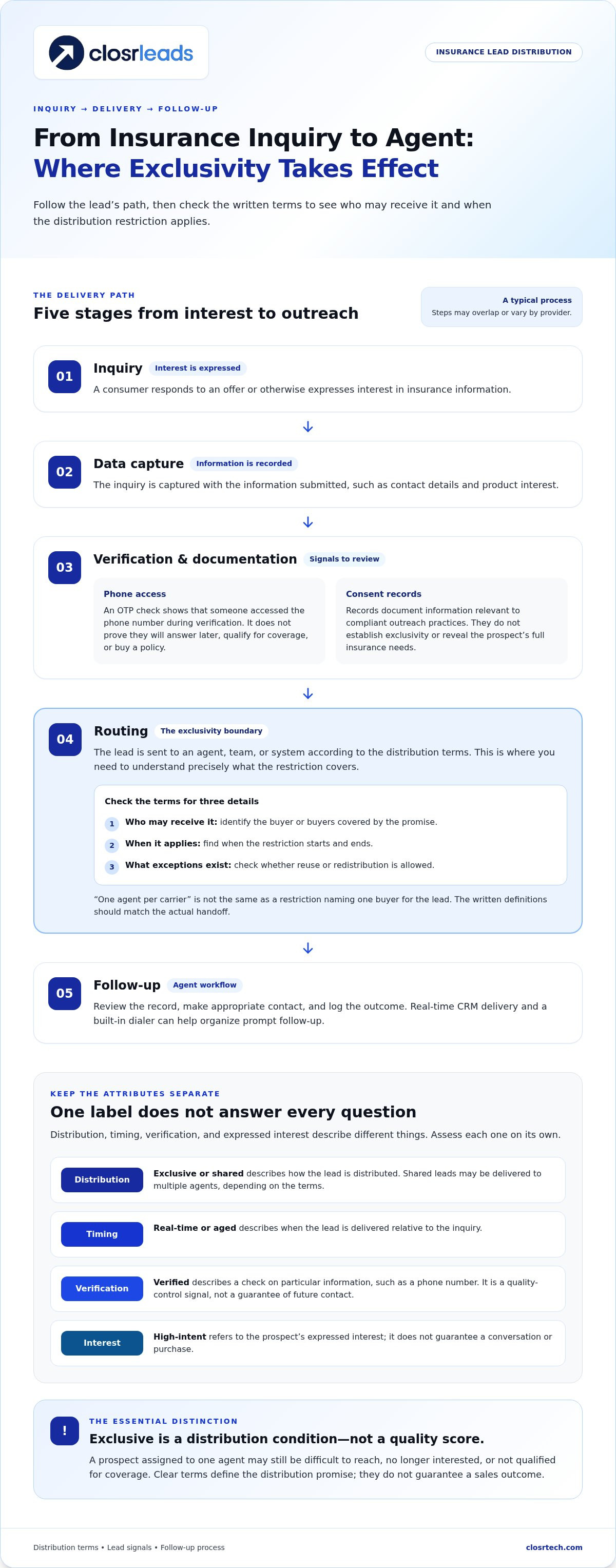
A lead passes through several steps before an agent can follow up. Mapping that path helps you identify where an exclusivity promise applies and what the delivery details establish. A typical process looks like this:
- Inquiry: A consumer responds to an offer or otherwise expresses interest in insurance information.
- Data capture: The inquiry is recorded with the information submitted, such as contact details and product interest.
- Verification and documentation: The provider may check phone access through a one-time passcode and retain records related to consent.
- Routing: The lead is sent to an agent, team, or system according to the distribution terms.
- Follow-up: The agent reviews the record, makes appropriate contact, and logs the outcome.
The steps can overlap or vary by provider. The important question is where the distribution restriction begins and ends. For exclusive insurance leads, the terms should make clear whether exclusivity applies at capture, after verification, when the lead is routed, or throughout a stated period after delivery.
Where Should Exclusivity Apply in the Lead Delivery Process?
Look for three operational details: which buyer or buyers may receive the record, when the restriction starts and ends, and whether the provider may reuse or redistribute it under any exceptions. A one-buyer statement is meaningful only within its defined scope. It doesn’t prove that the consumer has a current need, remembers submitting the inquiry, or wants to speak with an agent.
Compare the written definitions with the actual handoff. For example, exclusivity limited to one agent per carrier differs from a restriction that names one buyer for the lead. Precise terms make it easier to understand the distribution arrangement and assess whether it fits your workflow.
What Do Phone Verification and Consent Records Tell Agents?
OTP phone verification shows that someone accessed a phone number during the verification step. It’s a useful quality-control signal, but it doesn’t prove that the person will answer later, qualifies for coverage, or will buy a policy.
Consent records serve a different purpose. They document information relevant to compliant outreach practices, but they don’t establish lead exclusivity or reveal the prospect’s full insurance needs. Review the record and follow the outreach practices that apply to your business. Treat distribution, phone access, consent documentation, and expressed product interest as separate pieces of information.
Once a lead reaches your workflow, real-time CRM delivery and a built-in dialer can help organize prompt follow-up. Explore insurance lead follow-up tools as part of that process.
How to Compare Exclusive Insurance Leads With Shared Options
Compare the arrangement, not just the label. Exclusive versus shared describes distribution. Real-time versus aged describes timing. A recent lead may be shared, and an older lead may be exclusive under its terms. Neither model is automatically better. The right fit depends on your product focus, capacity to follow up, and how your agency handles incoming records.
Use the comparison below to separate stated terms from details you can review. A lead record can help you assess an opportunity, but it can’t guarantee contact or a sale.
| Factor | What to compare | Provider states / agent can observe |
|---|---|---|
| Distribution | Exclusive leads are restricted to a buyer under defined terms; shared leads may go to multiple agents. | Review the buyer-count, timing, and reuse terms. Delivery records show what reached you, but don’t by themselves prove whether others received the lead. |
| Lead age | Real-time or aged describes when the opportunity is delivered, not how many buyers receive it. | Check available inquiry and delivery timestamps, then assess whether the timing fits your follow-up workflow. |
| Verification | Verification describes a check on contact data, not exclusive distribution. | Review the stated verification method and the information shown in the lead record. For more context, see the OTP-verified insurance leads guide. |
| Consent documentation | Records can document information relevant to outreach practices. | Review the available consent information and retain records according to your process. Documentation alone doesn’t establish exclusivity or prospect intent. |
| Delivery workflow | Leads may arrive through a platform, CRM connection, or another stated process. | Review the delivery process, then check how the lead appears in your system and whether your team can act on it consistently. |
Which Lead Quality Signals Should Agents Evaluate?
Check recency, contact details, the consumer’s stated product interest, and available consent documentation as separate signals. For example, a Final Expense inquiry may identify a product interest, but that entry alone doesn’t confirm eligibility or current intent. The Final Expense leads guide offers a vertical-specific example. Use the details in each record to guide your next step, not to assume an outcome.
What Should an Exclusivity Policy Explain?
Look for plain definitions of who counts as the buyer, when the distribution restriction starts and ends, and whether reuse is allowed under any conditions. If the terms say “one buyer,” establish whether that means one agent, one agency, or another defined recipient. A clear policy makes exclusive insurance leads easier to compare with shared options and gives your team a practical basis for reviewing delivery.
How to Work an Exclusive Insurance Lead After Delivery
An exclusive lead still needs a disciplined follow-up process. Treat each delivery as a conversation to prepare for, not a guaranteed appointment. Review the record, use your agency’s approved contact process, and document what happens. A consistent workflow helps prevent fresh inquiries from getting lost between delivery and outreach.
What Should an Agent Do First After Lead Delivery?
Start by checking the inquiry details, available timestamps, stated product interest, and any consent documentation. Confirm that the record is in the right place and note details that can make your opening relevant. Then follow your agency’s approved contact process. Prompt outreach gives you a chance to respond while the inquiry is fresh, but no response-time threshold guarantees a conversation.
- Review: Check the contact details and the information the prospect submitted. Flag anything that appears incomplete or inconsistent.
- Prepare: Use the stated interest to guide a relevant, respectful opening. Don’t assume the person remembers the inquiry or is ready to buy.
- Contact: Follow your approved outreach process. If the prospect responds, listen and clarify their needs rather than jumping straight to a pitch.
- Record: Log the date, channel, outcome, and any requested next step in your CRM.
- Continue appropriately: If there’s no response, use your agency’s process for any further attempts. Stop or adjust outreach based on the prospect’s response and applicable practices.
How Can a Dialer and CRM Support Consistent Follow-Up?
A dialer can help organize calling activity and keep a lead moving through your workflow. It can’t make someone answer or confirm that a contact is ready to talk. A CRM adds continuity: record whether you connected, what the prospect said, and the next action with its timing. Clear notes help prevent duplicate or mistimed outreach, especially when more than one team member handles the record.
For a product-specific example, the mortgage protection leads guide can help you consider how inquiry details shape a relevant follow-up.
Keep the record useful and factual. “No answer, follow-up planned” is more actionable than an unsupported assumption about the prospect’s intent. Review open leads regularly, complete the next step you recorded, and update the CRM after each attempt. That discipline turns delivery into a traceable process your team can repeat.
To support an organized calling workflow, explore ClosrLeads insurance lead tools, including its built-in dialer and real-time CRM delivery.
How ClosrLeads Supports Insurance Lead Follow-Up
Good follow-up depends on more than the delivery label. Agents need usable contact information, relevant inquiry details, and a clear path from receipt to outreach. ClosrLeads brings those workflow pieces together with OTP phone-verified leads, TCPA-compliant consent records, real-time CRM delivery, and a built-in dialer.
How Verification and Delivery Fit Into the ClosrLeads Workflow
OTP phone verification checks access to a phone number during the verification process. It gives agents a useful quality-control signal when reviewing a record, but it doesn’t mean the prospect will answer, qualify, or purchase. Consent records provide separate documentation relevant to compliant outreach practices. Keep both details in context: neither establishes whether a lead was distributed to one buyer or several.
Real-time CRM delivery sends lead information into an agent’s workflow, reducing manual handoff steps. A built-in dialer can help organize calls and keep follow-up activity moving. Neither feature guarantees contact or conversion. They support the process; the agent still reviews each inquiry, follows the agency’s approved contact practices, and records outcomes clearly.
A replacement guarantee applies to invalid contacts within its stated scope. It addresses invalid-contact cases, not a prospect who doesn’t answer or decides against pursuing coverage.
What Agents Can Explore Across Insurance Lead Categories
ClosrLeads offers lead categories for distinct insurance interests, including Final Expense, Mortgage Protection, Veteran, Trucker, and IUL. Each vertical has its own audience and inquiry context. The information relevant to a Final Expense inquiry may differ from what an agent needs to review for a Trucker or IUL opportunity. Match the lead category to your product focus, then tailor your review and follow-up to the details submitted.
Lead age and distribution are separate considerations. ClosrLeads offers real-time and aged leads, while verification and consent records provide additional context for reviewing an opportunity. None of those attributes should be treated as proof of exclusivity or a promise of sales results. When assessing exclusive insurance leads, evaluate distribution terms separately from quality signals and workflow tools.
Explore ClosrLeads insurance lead options and workflow tools to review the lead categories and follow-up features that fit your agency’s process.
Choose Lead Terms That Fit Your Workflow
Understand the distribution terms before weighing the label. Exclusive insurance leads describe how an opportunity is distributed, not whether the prospect will answer, qualify, or buy. Compare that arrangement separately from lead age, phone verification, consent documentation, and stated product interest. Then match those details to your agency’s capacity and follow-up process.
Consistency matters after delivery. Review each inquiry, use your approved contact process, and record the outcome and next step. ClosrLeads offers OTP phone-verified leads with TCPA-compliant consent records, real-time CRM delivery, and a built-in dialer. These features support lead review and follow-up, but don’t guarantee contact or conversion.
ClosrLeads serves agents nationwide and has a 4.98/5 rating from agents. Ready to explore lead options and follow-up tools? Explore insurance lead options and follow-up tools. Clear terms and a reliable process can help you approach each opportunity with confidence.
Frequently Asked Questions
What are exclusive insurance leads?
Exclusive insurance leads are inquiries distributed to one buyer under the stated terms. The label describes distribution, not guaranteed contact, prospect intent, eligibility, or policy sales. Review who counts as the buyer, when the exclusivity period begins and ends, and whether the data can be reused. Then consider lead freshness, verification, consent records, and your follow-up process as separate factors.
Are exclusive insurance leads better than shared leads?
Not automatically. An exclusive arrangement can reduce the chance that several agents receive the same inquiry through that distribution arrangement, but it doesn’t ensure the lead is current, reachable, or interesting to the prospect. Shared leads may fit a different budget or sales workflow. Compare distribution terms, lead timing, available verification, and your team’s capacity to follow up. Choose the model that fits how your agency works.
How can an insurance agent verify that a lead is exclusive?
Review the written terms for who receives the inquiry, when distribution occurs, and whether the data can be reused. Check how the terms define exceptions and what records document delivery. Don’t rely on the word “exclusive” alone. Treat it as a specific distribution condition, then evaluate contact details, consent documentation, and lead timing separately. Each tells you something different about the opportunity.
Are exclusive insurance leads always delivered in real time?
No. Exclusivity describes how many buyers receive an opportunity under the stated arrangement. Real-time or aged describes when it reaches an agent relative to the inquiry. A lead can be exclusive but delivered later, or shared and delivered quickly. Compare both dimensions, then consider whether your team can follow up effectively at that point. Neither label alone tells you whether the prospect will respond.
What should an agent do when an exclusive insurance lead arrives?
Review the inquiry details, timestamps, and available consent information, then use your agency’s approved outreach process. Make your approach relevant to the prospect’s stated interest. Record each attempt and outcome in your CRM, along with a clear next action. Prompt follow-up helps you work a fresh inquiry, but no response schedule guarantees contact. Keep communication respectful and follow the practices that apply to your organization.
Does OTP phone verification mean an insurance lead is TCPA compliant?
No. OTP verification indicates that someone completed a phone-based verification step; by itself, it doesn’t establish every consent or compliance requirement. Consent records and your outreach practices matter separately. Review the documentation associated with the lead and follow current requirements and your organization’s procedures. ClosrLeads provides leads with OTP phone verification and TCPA-compliant consent records, but verification isn’t a guarantee that every call or message is permitted.