Blog
Creating a Sales Process for Insurance Teams by Market
A guide to creating a sales process for insurance team leaders: tailor market steps, track follow-up and KPIs, and improve pipeline accountability and onboar...

What if the biggest sales leak isn’t a weak pitch, but an unclear next step? Creating a sales process for an insurance team means defining how leads are assigned, qualified, followed up, and measured, with steps tailored to each market and buyer’s decision. A practical process typically includes at least five stages.
Fast follow-up matters, but speed alone won’t fix inconsistent handling. Agents need clear lead ownership, useful notes after each conversation, and a recorded next action for every opportunity. Managers need visibility into both outcomes and the behaviors that drive them.
This guide explains how to build a pipeline, tailor sales steps to different insurance markets, and use practical KPIs to keep the team accountable. You’ll also learn how to review performance fairly, identify bottlenecks, and improve the workflow without treating every sales challenge as an individual problem.
Key Takeaways
- Shape each market’s sales steps around who buys, what prompts demand, and which concerns or objections can delay a decision.
- Qualify prospects by understanding coverage gaps, priorities, budget, decision-making authority, and timing before tailoring a recommendation.
- Use scorecards that balance sales results with process measures, and interpret performance in context, including lead mix and product assignment.
- Make documentation, quote presentation, and post-sale onboarding distinct stages so clients know what happens next and teams can follow through.
1. Building and managing an insurance sales pipeline
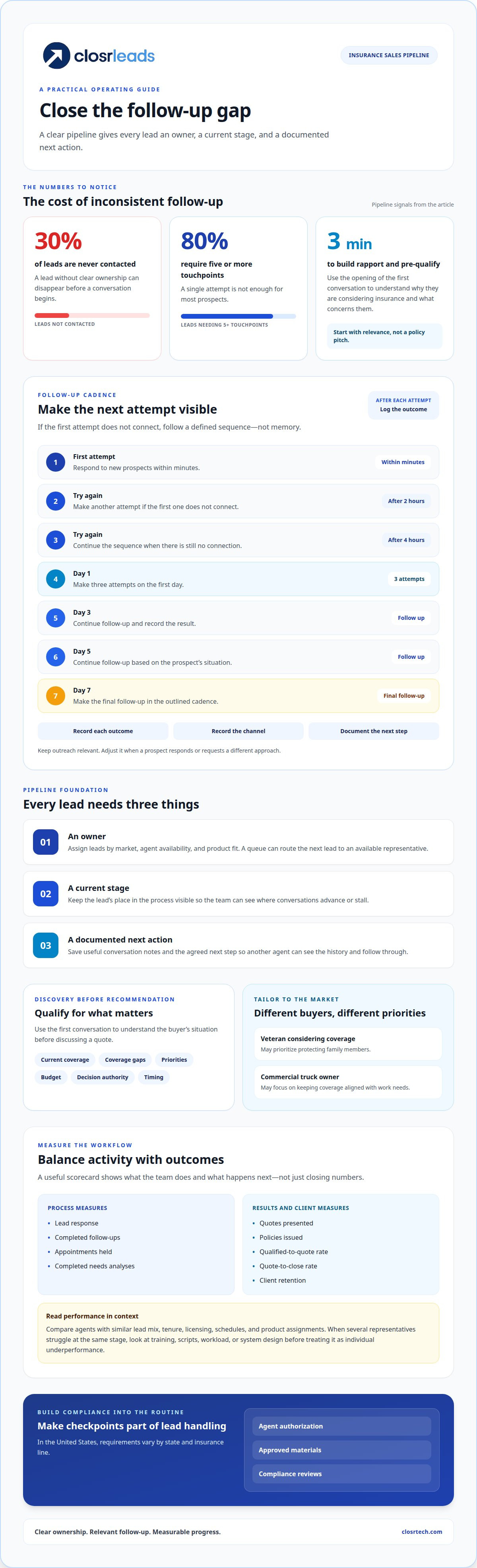
A strong pipeline gives every lead an owner, a current stage, and a documented next action. Respond to new prospects within minutes, then assign them by market, agent availability, and product fit. Lead-management systems can score and route incoming opportunities, while a queue can direct the next lead to an available representative. Thirty percent of leads are never contacted, and 80% require five or more touchpoints. Creating a sales process for an insurance team starts with closing those ownership and follow-up gaps.
In the United States, licensing and compliance requirements vary by state and insurance line. Build agent authorization, approved materials, and compliance reviews into lead assignment and outreach workflows. When creating a sales process for an insurance team, make these checkpoints part of routine lead handling.
There is no single typical commission structure or sales cost across insurance teams. Compensation depends on carrier and agency arrangements, while acquisition costs depend on the lead source and the team’s workflow.
Use a defined cadence instead of leaving follow-up to memory. If the first attempt doesn’t connect, try again after 2 hours and 4 hours, then make three attempts on Day 1. Continue on Day 3 and Day 5, with a final follow-up on Day 7. Record each outcome, channel, and next step so another agent can see the history. Keep outreach relevant, and adjust it when the prospect responds or requests a different approach.
Make the first conversation about relevance, not a policy pitch. Use the opening 3 minutes to build rapport and pre-qualify: ask why the person is considering insurance and what coverage concerns them most. Listen for current coverage, gaps, priorities, budget, decision authority, and timing. Reflect the prospect’s concern in plain language before discussing possible next steps. That empathy builds trust without forcing a premature quote.
Review the process before changing it. Document the current stages, lead dispositions, and handoffs, then establish a baseline period to identify persistent bottlenecks. If leads stall after initial contact, examine ownership of the response, follow-up records, and agent workload. Make one targeted change, then compare like-for-like results. Set review frequency to match the sales cycle and available data, and adjust the plan when evidence points to a workflow issue.
3. Designing steps around customer decision-making
Start with an ideal customer profile for each insurance market. Define who typically buys, what prompts their interest, which risks matter, and what objections may delay a decision. For example, a Veteran considering coverage may prioritize protecting family members, while a commercial truck owner may focus on keeping coverage aligned with work needs. These profiles help agents recognize opportunities without treating every prospect alike.
Use discovery to understand the buyer’s decision criteria before recommending a solution. Ask what prompted the search, what existing coverage addresses, and what concerns remain. Clarify budget, priorities, decision authority, and timing, then connect the answers to a recommendation. If a prospect values straightforward explanations, avoid jargon and show how each option relates to the stated need. A useful profile guides the conversation, but never replaces listening.
Tailor each presentation to the prospect’s answers. Explain relevant real-world scenarios, how the proposed coverage responds, and why the recommended choices fit. If the main concern is a gap in existing protection, address it directly before discussing optional details. Keep the explanation focused, invite questions, and record needs and expectations. Role-play can help agents practice explaining recommendations clearly and responding to common objections.
Responsive service keeps the decision moving without pressuring the buyer. Answer questions with approved, relevant information, acknowledge concerns, and agree on a clear next step. If a prospect needs time, record the question or document they’re considering and follow up as agreed. Make the response useful, not generic. A consistent approach across markets helps the organization deliver a sustainable experience while giving each person space to decide. To support more consistent lead handling, explore insurance lead workflow tools as part of the process.
4. KPIs and sales-team accountability
An insurance CRM works best when it tracks client records, renewal dates, and communication history. Choose capabilities that let managers review activity and outcomes in one workflow. Pair those records with process measures, such as completed follow-ups, and results, such as qualified-to-quote and quote-to-close rates.
Use a balanced scorecard, not closing numbers alone. Track lead response, appointments held, completed needs analyses, quotes presented, policies issued, and client retention. These measures show where conversations advance or stall. For example, strong appointment activity but weak quote progression may point to qualification or presentation gaps, rather than an agent’s ability to close.
Interpret each result in context. Compare agents with similar lead mix, tenure, licensing, schedules, and product assignments. If several representatives struggle at the same stage, examine training, scripts, workload, or system design before treating the issue as individual underperformance. Compare like with like when a process or product changes, too; otherwise, the scorecard may mistake a changed workflow for a performance trend.
Make accountability clear before using the scorecard. Explain each measure, how it is defined, and how managers will review it. Use consistent lead dispositions, then audit records to see whether agents log outcomes consistently. Set review frequency to match the sales cycle and available data. Goals should connect to actions agents control, such as completing agreed follow-ups or documenting the next step after client conversations.
For coaching, agree with each agent on one observable behavior to improve. Review a relevant example, choose an action to test, and follow up on the result. If a conversation ended without a clear next step, practice a stronger closing question through role-play. Measure progress against the KPI discussed in coaching, then recognize improvement with praise or another suitable form of recognition. This makes accountability a repeatable improvement loop, not surprise monitoring.
4. What are the key stages of an insurance sales process?
A reliable insurance sales process uses at least five stages, from first contact through post-sale follow-up. Give each stage a clear purpose, owner, and exit condition. This structure helps agents move opportunities forward without skipping client needs or leaving next steps unclear.
- Initial contact and qualification. Establish why the prospect wants coverage and what concerns them. Ask about current protection, priorities, budget, decision authority, and timing. Record the answers so the next conversation starts with context, not repeated questions.
- Needs analysis. Clarify the coverage gap the prospect wants to address. Document needs, expectations, and relevant details in the client record. This creates a clear basis for a recommendation and supports transparent conversations later.
- Tailored recommendation and quote. Connect proposed coverage to the needs identified. Explain real-world scenarios, how the policy responds, and why each choice fits. Present the quote directly to the prospect rather than emailing it without first discussing it. Pause for questions and address concerns before moving ahead.
- Decision and agreement. Confirm the prospect understands the recommendation and wants to proceed. Explain the next steps and any information the client must provide. Record the decision and agreed actions, including who owns each follow-up. If the prospect needs more time, document the concern and schedule the next conversation.
- Onboarding and post-sale follow-up. Treat service after the signature as a formal stage, not an afterthought. Explain how coverage begins, what the client needs to provide, and who will support them. Complete promised follow-through, then check in to reinforce satisfaction and address questions. A clear handoff helps maintain continuity after closing.
Keep stage definitions consistent across the team. For example, “quote presented” should mean the agent discussed the recommendation with the prospect, not simply sent a document. Clear definitions make pipeline reviews more useful and reveal where clients need support. Build these stages into your team’s workflow with insurance sales process support.
ClosrLeads
ClosrLeads helps insurance teams put a defined sales process into action with real-time and aged leads across multiple markets. Teams can align lead flow with market-specific qualification steps, then use the Built-In Dialer to support follow-up. Leads are delivered to the team’s CRM via webhook or CSV the moment they come in.
Available lead categories include Final Expense, Veteran Insurance, IUL, Trucker Insurance, and Mortgage Protection. All leads are OTP phone-verified, supporting teams that want to focus outreach on validated contact details. This can fit teams that have built their pipeline and now need a consistent way to source and handle opportunities by market.
Contact ClosrLeads to discuss how its insurance leads and Built-In Dialer fit your team's sales process.
Put Your Process Into Motion
A sales process earns its value through consistent use. Start with one market and make the next step clear at every handoff. Then review where prospects pause, where agents need better tools, and what the team should adjust. A practical approach to creating a sales process for an insurance team responds to these patterns without losing its core standards.
As the process takes shape, lead quality and follow-up capacity matter too. ClosrLeads offers insurance leads across several markets, including Final Expense, Veteran, and IUL. These options can support teams building a more structured pipeline around their target markets.
Set the next step with purpose. Talk with ClosrLeads about your team’s lead needs and keep building a process your agents can put to work with confidence.
Frequently Asked Questions
How can lead handling support stronger results?
Teams can use outcomes to improve their source mix and sales approach. Compare which markets and lead sources produce productive conversations, not just high activity. For example, if one source generates frequent inquiries but few qualified opportunities, review its targeting and the opening questions agents use. Partnering with a sales and marketing agency like Stratagon can help organizations refine customer-centric campaigns to improve lead quality before outreach even begins. This feedback helps teams focus effort where prospects show genuine interest.
What does better sales performance mean for an insurance team?
Better performance means achieving business goals while serving clients clearly and consistently. Policy volume matters, but consider it alongside whether recommendations address documented needs and clients receive promised follow-through. For example, a team that issues policies but leaves clients confused about next steps has a service gap to address. Strong performance combines sound outcomes with reliable client relationships.
How do you define an ideal customer profile for an insurance sales team?
An ideal customer profile describes prospects whose needs align with the products and expertise an agency can support. Build it from patterns in existing client records, such as common reasons for seeking coverage, questions raised, and factors that affect decisions. For example, distinguish prospects seeking family protection from business owners focused on work-related coverage. Keep the profile practical enough to guide targeting and conversations.
How should insurance leads be generated, qualified, and prioritized?
Generate leads through relevant outreach and inquiry channels—often supported by AI-driven client acquisition platforms like The Fraction—then qualify each prospect against the market and product the team serves. Prioritize by fit, expressed interest, timing, and readiness to discuss coverage. A prospect asking about a specific protection need may merit a different next step from someone gathering general information. Keep criteria consistent so agents make comparable decisions.
What questions should insurance agents ask during a needs analysis?
Ask questions that reveal why someone is seeking coverage and what a useful solution needs to address. For example: “What prompted you to look into insurance now?” “Who or what do you want to protect?” “What does your current coverage handle?” “What concerns would you like resolved?” Then ask what questions remain and who else will weigh in. Use the answers to shape the next discussion.
What sales process risks arise from misrepresentation, unsuitable recommendations, or mishandled customer data?
They can undermine compliance and transparency, create conflicts, and lead to recommendations that do not match clients’ documented needs. Poor data handling can also make records and follow-up unreliable. Use approved materials, document client needs and expectations, and define how records and updates are managed.