Blog
Best Place to Buy Insurance Leads in 2026: A Practical Guide
Discover the best place to buy insurance leads in 2026. Compare lead types, TCPA compliance, and verification methods to increase your conversion rates.

The freshest lead isn’t automatically the best buy. If your team can’t reach it promptly, or the contact details and consent records don’t hold up, even a promising prospect can turn into wasted effort. Finding the best place to buy insurance leads means matching lead freshness and verification to your target market, sales process, and follow-up capacity.
The challenge is comparing lead types and provider claims without judging value by volume alone. A source that fits one agent’s workflow may overwhelm another. Look for prospects that align with your insurance vertical, then make sure you have a clear process for timely, organized follow-up.
This guide covers what to assess before you invest, from real-time versus aged leads to contact validation, documented consent, and CRM fit. You’ll also see how ClosrLeads’ OTP phone-verified leads, TCPA-compliant consent records, and built-in dialer support lead handling across insurance verticals. The goal is to choose based on fit and follow-through, not guesswork.
Key Takeaways
- The best place to buy insurance leads is the source that fits your target vertical, preferred lead format, and available follow-up resources.
- Compare real-time and aged leads by freshness and handling needs, then distinguish shared and exclusive distribution models.
- Assess providers on vertical fit, verification, consent records, delivery, and their policy for invalid contacts, not just headline claims.
- Use cost per bound policy to evaluate lead value over time. It is a measurement tool, not a guaranteed result or universal benchmark.
- ClosrLeads offers OTP phone-verified leads across Final Expense, Veteran, Trucker, Mortgage Protection, and IUL, with a built-in dialer to support lead handling.
What makes a place the best place to buy insurance leads?
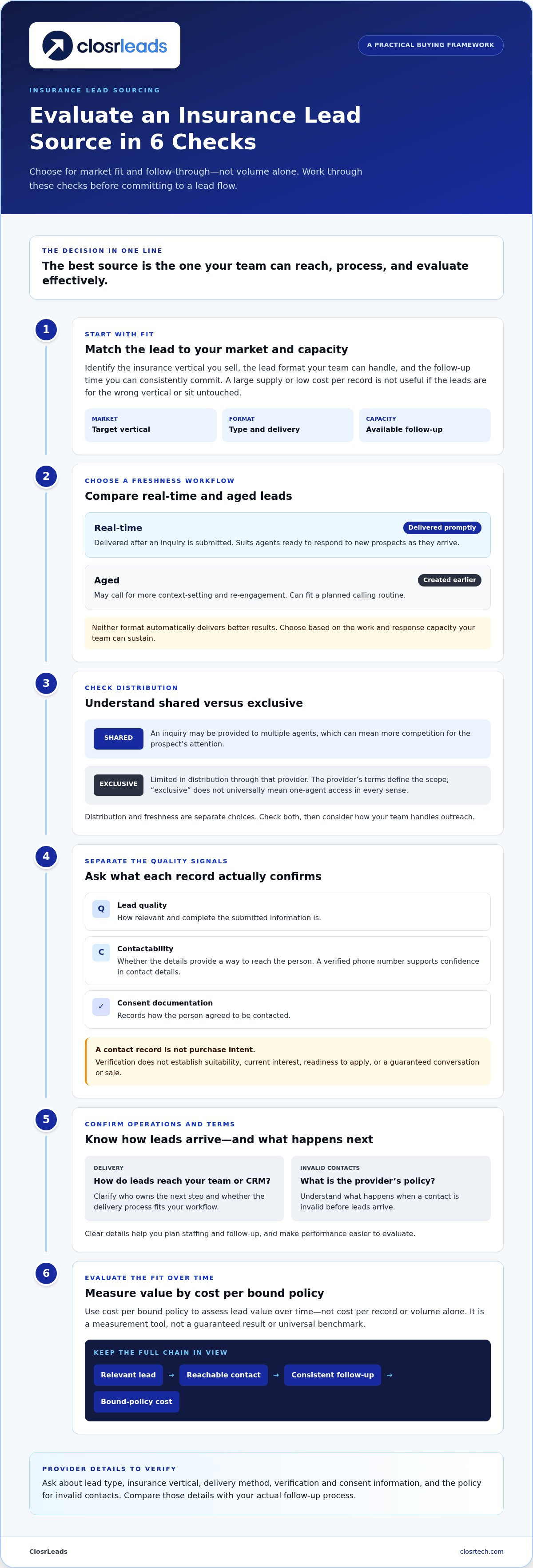
The best place to buy insurance leads is the source that fits your target market, lead format, and follow-up capacity. A large supply may look attractive, and a low cost per record may seem efficient. Neither matters if the leads focus on the wrong vertical, arrive in a format your team can’t handle, or sit untouched in a backlog.
Evaluate the source on distinct measures. Lead quality describes how relevant and complete the submitted information is. Contactability concerns whether the details give you a way to reach the person. Consent documentation records how the person agreed to be contacted. None of these proves the prospect is ready to buy. A lead is a contact record, not a completed application or bound policy.
Insurance products address different risks and needs. For a brief foundation, see Understanding the Fundamentals of Insurance. That context can help you assess whether a lead’s stated interest aligns with the coverage you sell. A verified phone number supports outreach, but it can’t establish suitability or guarantee a conversation. No lead source or format guarantees a sale, either. Product knowledge, timing, and consistent follow-up still matter.
What does a good insurance lead source provide?
A useful source explains the basics before you commit: lead type, insurance vertical, delivery method, and available quality information. It should also clarify how delivery works and what happens when a contact is invalid. These details help you plan staffing and follow-up before leads arrive. Clear terms also make performance easier to evaluate.
- Lead type: Find out whether records are real-time or aged and how they’re distributed.
- Vertical: Match the prospect’s stated interest to the insurance product you sell.
- Delivery: Understand how leads reach your team or CRM and who owns the next step.
- Quality information: Review what verification and consent records accompany each lead.
Keep the distinctions clear. A phone-verified record supports confidence in the contact details; it doesn’t mean the person is qualified, interested now, or ready to complete an application. Treat each as a separate signal. That way, a basic data check isn’t mistaken for purchase intent.
Which agents benefit from comparing sources?
Independent agents and established agencies can both benefit. An independent agent testing a new vertical may need a manageable flow that fits the time available for calls and appointments. A larger team may have more follow-up capacity, but still needs delivery and routing that fit its workflow. Compare sources with your actual process, not an imagined maximum volume.
There is no universal provider ranking. A source that works for a team with dedicated callers may be a poor match for a solo agent handling every step. Set your target vertical and define how quickly and consistently you can follow up. Then compare lead formats against those limits. The right fit is the one your operation can work effectively and evaluate over time.
Real-time, aged, shared, or exclusive: match insurance lead type to your workflow
Lead format shapes what happens after a prospect shows interest. Real-time leads call for prompt follow-up. Aged leads need a deliberate re-engagement approach. Shared and exclusive describe how an inquiry is distributed, not how recently it was submitted. These are separate choices. The right combination depends on your team’s response capacity and prospecting cadence.
How do real-time and aged insurance leads differ?
Real-time leads are delivered promptly after a prospect submits an inquiry, so they suit agents who can respond quickly. Aged leads were created earlier, so agents generally need to reintroduce the conversation and establish whether the prospect is still interested. Neither format automatically delivers better results. Compare the work each requires with the time and process you can consistently commit.
| Lead format | Freshness | Workflow trade-off |
|---|---|---|
| Real-time | Delivered promptly after an inquiry | Requires a team ready to act on new prospects as they arrive |
| Aged | Created earlier; the inquiry is no longer new | Allows planned outreach, but may call for more context-setting and re-engagement |
For example, an agent who blocks time to handle new inquiries may prefer real-time delivery. Someone with a scheduled calling block may find aged records easier to fit into a routine. Treat format as a workflow decision, not a promise of conversion. Selling insurance also involves requirements beyond lead acquisition. For a specific example, eCFR insurance sales disclosure requirements apply to certain depository institutions, rather than setting a general rule for lead formats.
How do shared and exclusive leads change the sales process?
Shared and exclusive describe distribution. A shared inquiry can be provided to multiple agents, which may mean more competition for the prospect’s attention. An exclusive lead is limited in distribution through that provider, but “exclusive” doesn’t universally mean one-agent access in every sense. The provider’s terms define the scope.
Before choosing, consider how your team handles outreach when other agents may also contact the prospect. Shared distribution may suit a process designed for steady prospecting, while exclusive distribution may fit a workflow built around individual follow-up. Neither removes the need for timely, organized contact. Match distribution terms to your team’s capacity, then track how each format performs in your sales process.
ClosrLeads offers real-time and aged leads across insurance verticals. Explore ClosrLeads lead options to compare formats and consider which better fits your team’s follow-up rhythm.
How to compare insurance lead providers beyond price and promises
Compare the operating details, not just the sales pitch. The best place to buy insurance leads should match your vertical and workflow while giving you enough information to evaluate each record and manage what happens after delivery. Build a side-by-side comparison around these points:
- Vertical availability: Does the source cover the insurance products your team sells?
- Freshness and format: Are leads real-time or aged, and how are they distributed?
- Verification: What contact information is checked, and what does that check establish?
- Consent records: What documentation accompanies a lead, and how can your team retain it?
- Delivery: How do records reach agents, and does the method fit your CRM and follow-up process?
- Invalid-contact policy: What remedy applies when contact details are invalid, and how is the issue handled?
These criteria help distinguish different market models without treating providers as interchangeable. ActiveProspect’s extract names QuoteWizard, EverQuote, QuinStreet, SmartFinancial, NextGen Leads, and Datalot. They are examples of companies in the lead marketplace, not a guarantee that their offerings or processes are the same. ClosrLeads is another option, with leads across Final Expense, Veteran, Trucker, Mortgage Protection, and IUL. Its leads are OTP phone-verified and supplied with TCPA-compliant consent records. A built-in dialer supports lead handling, while real-time delivery into users’ CRMs supports the next workflow step.
What evidence should agents look for in lead quality and consent?
Look for specific descriptions, not broad labels. OTP verification checks access to a phone number; it doesn’t establish that the person intends to buy, qualifies for coverage, or will answer your call. Consent records document the consumer’s permission as captured by the source. Review and retain those records within your own process. A vendor’s claims don’t remove your responsibility to follow requirements that apply to your outreach.
How should you compare the value of different sources?
Track the path from purchase to outcome. Count qualified conversations and bound policies, then consider the total acquisition and handling effort required to reach them. A low cost per record may still require substantial agent time. A source that takes more effort may not suit a team with limited follow-up capacity. Judge the numbers in context.
Cost per bound policy can help organize that analysis: divide the total lead acquisition and handling cost for a source by the policies bound from those leads. It’s a measurement framework, not a promised result or universal benchmark. Compare like with like by tracking each lead type and source over consistent measurement periods, and record follow-up effort the same way each time. That gives you a practical basis for deciding where to invest without assuming any provider or format delivers a fixed return.
A practical checklist for buying insurance leads without wasting follow-up capacity
A lead purchase only works if your team can act on it and learn from the results. Set the process before placing an order. This checklist keeps the decision tied to your sales capacity, from choosing a vertical to reviewing outcomes.
- Define the vertical. Choose the insurance product and target market your team is prepared to serve. A focused test makes it easier to assess the source than mixing unrelated lead types.
- Set your capacity. Identify who owns new leads, how much follow-up time is available, and how many prospects the team can work without creating a backlog. Set a manageable initial test based on those resources, not an arbitrary lead count.
- Select the format. Match real-time or aged leads to your response speed and prospecting cadence. Decide whether incoming records need prompt attention or fit a planned outreach block.
- Review quality information. Understand what contact verification means, what consent documentation comes with the lead, how delivery works, and what the provider’s stated policy says about invalid contacts.
- Track outcomes. Record results by source and lead type, then use the data and your team’s capacity to guide the next buying decision.
How should agents prepare their team before buying?
Assign ownership before leads arrive. Confirm who receives incoming records and how promptly follow-up can begin, especially with a real-time format. Set CRM fields for source, lead age, vertical, consent records, and disposition so agents capture the same information. Align call capacity and cadence with delivery. A built-in dialer can support lead handling, but your team still needs a clear process for working each prospect.
How can a small test inform the next buying decision?
Choose a defined evaluation period that gives the team time to work the test consistently. Compare like with like by keeping lead type and follow-up approach distinct in reporting. Track contact attempts, successful contacts, conversations, appointments, applications, and bound policies as separate stages. This shows where prospects progress or drop off, without mistaking a phone connection for a sale.
Review replacement eligibility separately from sales performance. If a contact appears invalid, document the issue and compare it with the provider’s stated invalid-contact policy, including the process for submitting and reviewing a claim. ClosrLeads states that its replacement guarantee applies to invalid contacts. Keep records that help assess that specific issue; don’t treat the policy as a remedy for a prospect who simply doesn’t purchase.
Use the results to adjust only when the evidence supports it. If follow-up is timely and the test produces useful conversations, consider whether your team can handle more volume. If records are difficult to reach or the workflow is strained, address that bottleneck before expanding. Explore ClosrLeads insurance lead options and align your next test with a process your team can sustain.
Why agents choose ClosrLeads for verified insurance leads
ClosrLeads is an option for agents comparing lead providers by vertical fit, verification, and workflow. It offers real-time and aged leads across Final Expense, Veteran, Trucker, Mortgage Protection, and IUL. Each lead is OTP phone-verified and includes TCPA-compliant consent records, giving agents contact and consent information to work with as they manage follow-up.
That combination can support day-to-day lead handling. Verification supports confidence in a phone number, while consent records document contact and permission details. Neither tells you whether a prospect will answer or purchase. Fit still depends on the product you sell, the lead format you choose, and your team’s ability to follow through.
What is included in the ClosrLeads workflow?
Real-time leads are delivered directly into users’ CRMs, connecting acquisition with the next step in the sales process. The built-in dialer gives agents a tool for handling purchased leads within their workflow. These features support organization and outreach; they don’t guarantee a conversation, application, or sale.
ClosrLeads also provides a replacement guarantee for invalid contacts. That policy applies to invalid contacts only. It isn’t a sales or conversion guarantee, and an unanswered call or a prospect who decides not to buy isn’t the same as an invalid contact. Keep the stated policy in view when reviewing a contact issue.
Which ClosrLeads lead vertical may fit your agency?
Start with the business you’re prepared to write. The available verticals give agents distinct areas to consider:
- Final Expense: For agents focused on final expense coverage. Choose this vertical when it aligns with your product offering and prospecting approach.
- Veteran: For agencies building outreach around veteran insurance prospects.
- Trucker: For agents whose target market includes people in the trucking sector.
- Mortgage Protection: For agents focusing on coverage connected to mortgage protection needs.
- IUL: For agencies seeking prospects in the indexed universal life insurance vertical.
Then match the format to your follow-up capacity. If your team is set up to handle incoming records promptly, real-time delivery may fit. If you prefer scheduled outreach, aged leads may suit a planned prospecting routine. ClosrLeads offers both formats, so agents can weigh freshness alongside vertical and handling needs rather than choosing by volume alone.
The best place to buy insurance leads is the source that aligns with your target market and the process you can sustain. Compare ClosrLeads’ lead verticals, verification, CRM delivery, and dialer with your agency’s workflow, then choose a format that fits your plan. Explore ClosrLeads and choose your lead type.
Make your next lead decision a measurable one
Turn your next purchase into a focused test, not a leap of faith. Choose one question your team needs answered, such as whether a lead format fits its follow-up rhythm or brings enough qualified conversations to merit continued investment. Give agents a consistent way to record outcomes, then use what they learn to refine the next decision.
The best place to buy insurance leads is the source that earns a role in your process through measurable fit, not bold promises. Review your team’s capacity, decide what you want to learn, and make the next step deliberate. Progress comes from building a repeatable system, one informed decision at a time.
Explore ClosrLeads insurance leads and take the next step toward a more focused lead strategy.
Frequently Asked Questions
Is buying insurance leads worth it for an independent agent?
It can be worthwhile if the source reaches your target market and you have a consistent follow-up process. The best place to buy insurance leads for one agent may not suit another, so judge results using your own sales records. Track attempts, reached prospects, meaningful conversations, applications, and bound policies by source. For example, if calls connect but few prospects proceed, review product fit and conversation outcomes before increasing lead volume. No purchase guarantees a sale.
How many insurance leads should an agent buy at a time?
There’s no single quantity that works for every agent. Start with a test your team can follow up on consistently, based on available calling time, CRM processes, and lead format. Plan around the hours agents can actually dedicate to outreach, not the maximum number a vendor can deliver. Track the test before adjusting volume. A larger order won’t fix missed follow-ups or unclear ownership of incoming prospects.
How much should an insurance agent spend on leads?
Set a spending limit that fits your agency budget and review it against your own acquisition results. Don’t choose a source based only on its per-lead figure. Include the staff time and other effort required to work the records, then compare that investment with qualified conversations and bound policies. Keep past performance in perspective: results can change as your market, process, and prospect mix change, so historical outcomes don’t promise future returns.
Does OTP phone verification mean a prospect is ready to buy insurance?
No. OTP verification indicates that someone had access to the phone number used in the verification process. It doesn’t show that the person intends to purchase, meets a product’s eligibility criteria, or is ready to apply. Treat it as one data point, then consider the inquiry details and consent documentation as you prepare outreach. Your conversation helps establish the prospect’s current needs. Follow your established procedures for handling and documenting contact.
Can an insurance agency buy leads for more than one insurance vertical?
Yes. An agency can work across multiple verticals if it has the product knowledge, staffing, and follow-up processes to support each one. ClosrLeads offers leads for Final Expense, Veteran, Trucker, Mortgage Protection, and IUL. Keep each vertical’s results separate in your reporting. For example, compare conversations and applications from one line with that line’s own lead activity, rather than blending them into an agency-wide average that hides differences.
What should an agent do when a purchased lead has invalid contact information?
Document the problem promptly and follow the provider’s stated process for reporting invalid contacts. Keep the lead record and delivery details together so you can submit relevant information for review. ClosrLeads provides a replacement guarantee for invalid contacts. It doesn’t cover a valid contact who declines to respond or chooses not to purchase a policy. Record those outcomes separately so your quality reporting stays accurate.