Blog
The True Cost of Final Expense Leads in 2026: ROI vs. Price
Stop overpaying for bad leads. Our 2026 guide breaks down the true final expense leads cost, focusing on ROI over price to boost your sales and contact rates.

The cheapest lead on your spreadsheet is likely the most expensive mistake in your CRM. If you're only looking at the upfront final expense leads cost, you're missing the metrics that actually drive profit. Chasing disconnected numbers and dealing with opaque pricing from vendors wastes more than just money. It kills your momentum. You need a lead source that scales without increasing your fraud risk or triggering TCPA compliance alarms.
It's frustrating to watch your lead churn rates climb while your contact rates stall. You want a predictable cost-per-acquisition that lets you focus on closing instead of cleaning up bad data. This guide will show you how to master the economics of acquisition. You'll discover how to lower your cost-per-sale using verified, high-intent data that actually picks up the phone.
We'll analyze the balance between ROI and price in the current 2026 market. You'll see why OTP phone-verified leads are the only way to ensure your dialer stays hot. It's time to stop gambling on unvetted data and start building a scalable sales floor.
Key Takeaways
- Benchmark your 2026 spend against the shifting pricing landscape for direct mail and digital leads. Know exactly what a fair price looks like in today's competitive market.
- Stop overpaying for low-intent traffic. Learn how to align your final expense leads cost with specific search intent to ensure you're paying for buyers, not browsers.
- Calculate the true ROI math between $50 real-time leads and $1 aged data. Determine which strategy scales your specific sales floor without draining your budget.
- Identify the red flags of "recycled" data and non-compliant vendors. Protect your agency from the massive hidden costs of TCPA litigation and lead fraud.
- Maximize your contact rates using OTP verification and integrated dialers. Drastically reduce your effective acquisition cost by reaching prospects while they're still hot.
Benchmarking Final Expense Lead Costs in 2026
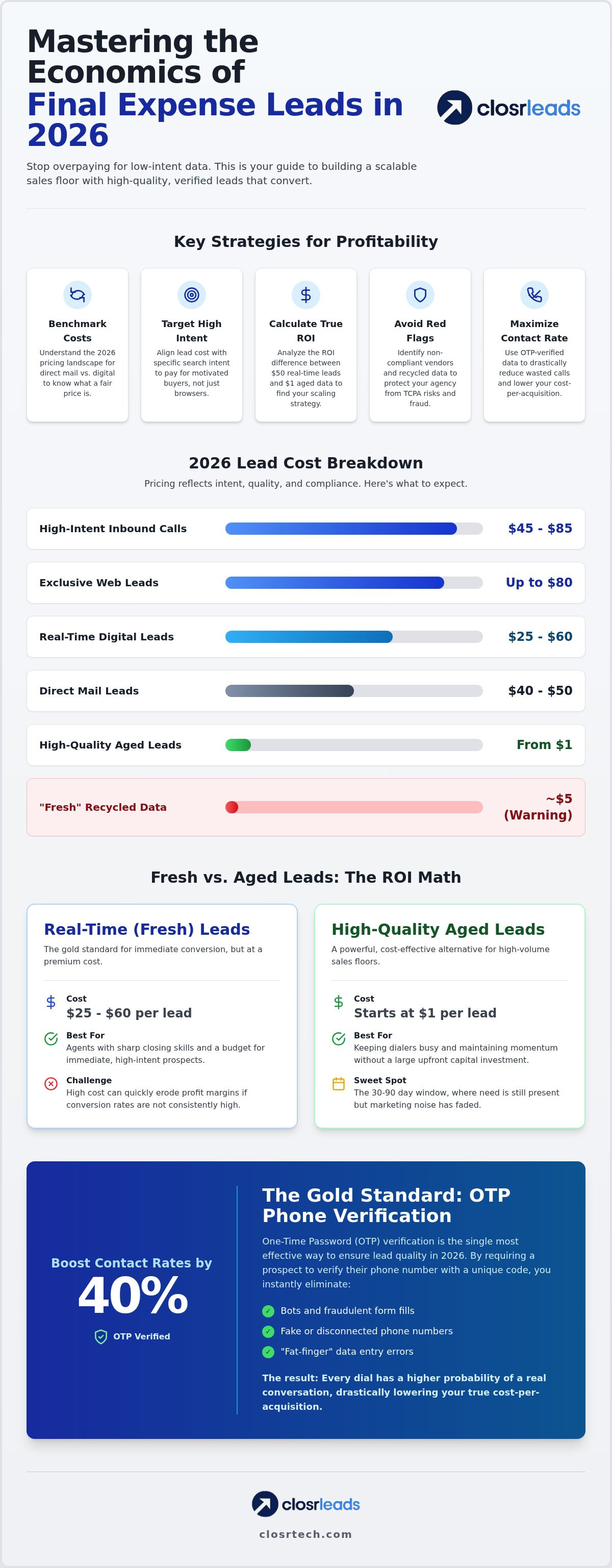
The 2026 market doesn't care about your 2023 budget. Carrier competition has surged, and the FCC's crackdown on the "lead generator loophole" has fundamentally changed how final expense insurance leads are generated. You're seeing a more regulated, more expensive landscape. High-intent inbound calls now range from $45 to $85, while exclusive web leads can hit $80. If a vendor offers you "fresh" leads for $5, run. That data is recycled junk that will burn your time and your reputation.
Understanding the final expense leads cost requires looking at the national averages. Direct mail remains a staple at $40 to $50 per lead, but the slow turnaround can stall your momentum. Digital leads offer speed, but they demand immediate action. The price floor is higher than ever because compliance documentation now adds a significant overhead to every record. You aren't just paying for a name; you're paying for the proof of consent that keeps you out of court.
Real-Time vs. Aged Lead Pricing
Real-time leads are the gold standard for immediate conversion. You're paying for the "speed-to-contact" advantage. Expect to invest $25 to $60 for high-intent digital leads that haven't been touched by another agent. They're fresh. They're ready. But they're also expensive. If your closing skills aren't sharp, these costs can eat your margins before you even cut a check.
Aged leads offer a powerful alternative for high-volume sales floors. ClosrLeads provides high-quality aged data starting at just $1. The "sweet spot" is the 30 to 90 day window. These prospects still have the need, but the initial marketing noise has died down. You get a lower entry price with enough intent to stay profitable. It's the most efficient way to keep your dialer running without a massive upfront capital burn.
The Impact of Exclusivity on Your Budget
Exclusivity is a premium feature, not a standard one. In 2026, an exclusive lead means it hasn't been sold to anyone else, period. This usually commands a 3x price premium over shared leads. Shared leads are sold to 2 or 3 agents simultaneously. They're cheaper, but they turn your sales process into a frantic race. If you aren't the first to call, you've lost the money. Shared data works for aggressive teams with high-speed dialers, but it's a trap for slower operations.
Calculate your maximum allowable cost based on your commissions. With average annual premiums between $800 and $1,200, you need a predictable final expense leads cost that leaves room for profit. Don't just buy the cheapest list. Buy the data that gives you the highest contact rate. That's where real efficiency lives. High contact rates mean fewer wasted hours and a much lower cost-per-acquisition at the end of the month.
Key Variables That Dictate Your Lead Acquisition Price
Lead pricing isn't arbitrary. It's a calculated reflection of intent, risk, and data depth. When you look at your final expense leads cost, you're seeing the market's valuation of a prospect's readiness to buy. A generic "Senior Life" query is often just a window shopper. A search for "Burial Insurance" indicates a high-intent buyer. You will pay a premium for that intent, but the higher conversion rate usually justifies the spend. You aren't just buying a name; you're buying a head start.
Data richness also moves the needle. Leads that include verified income, health status, and beneficiary information save your agents fifteen minutes of discovery on every call. This pre-vetted data adds to the upfront price but slashes your total time-per-sale. Compliance is the other major factor. Adhering to Digital Marketing Compliance Guidelines requires rigorous record-keeping. Audit-ready consent records might add $2 to $5 to the lead price, but they protect you from catastrophic TCPA litigation risks that could sink your agency.
The Value of OTP Phone Verification
One-Time Password (OTP) verification is the 2026 gold standard for lead quality. It requires the prospect to enter a unique code sent to their mobile device before the lead is generated. This process instantly filters out bots, fake numbers, and "fat-finger" errors. Standard web leads are often riddled with disconnected lines. OTP ensures the person on the other end is real and reachable. This is why verified leads consistently deliver contact rates 40% higher than unvetted form fills. Every dial has a higher probability of a conversation. If you want to stop wasting time on "ghost" prospects, switching to OTP phone-verified leads is the fastest way to stabilize your sales floor.
Demographic and Geographic Weighting
The 65-75 age bracket remains the most competitive and expensive demographic. These prospects are in the prime planning phase and convert at significantly higher rates than younger cohorts. If you add specific filters for health or income, expect the per-lead price to climb further. Filtering is a trade-off between volume and precision. To keep your average final expense leads cost manageable, avoid hyper-local targeting in high-competition "hot zones." A national strategy allows you to tap into lower-cost regions while maintaining high volume. Scaling across the country dilutes the competition and keeps your cost-per-acquisition predictable. Don't fight for the same three zip codes as every other agent in the industry.
Fresh vs. Aged Leads: Analyzing the ROI Math
Stop guessing and start calculating. The debate between fresh and aged data usually misses the point: Cost Per Sale (CPS). Real-time leads demand a high upfront investment, often around $50 per record. With a 10-15% close rate, you're looking at a high-velocity operation that prioritizes agent time. Aged leads, priced between $1 and $5, require massive volume and a 1-3% close rate. The math is clear. One gives you immediate gratification; the other builds a long-term profit machine through sheer persistence.
Let's look at a $1,000 spend comparison to see how the numbers play out on a typical sales floor:
- Fresh Leads: 20 leads at $50 each. At a 10% close rate, you write 2 policies. Your lead cost per sale is $500.
- Aged Leads: 500 leads at $2 each. At a 1% close rate, you write 5 policies. Your lead cost per sale is $200.
Aged leads often yield a higher total policy count for the same dollar spent, but they consume more labor. A hybrid model is the most sustainable strategy for scaling an agency. Use real-time data to keep your top closers fed and use aged data to ensure your dialer never goes cold during off-peak hours. This balance stabilizes your final expense leads cost while keeping your agents productive every hour they're on the clock.
Calculating Your Cost Per Sale (CPS)
Profitability isn't about the individual final expense leads cost. It's about the final CPS. Use this formula: (Total Lead Spend + Labor Cost) / Total Policies Written. If your labor costs are high, the $50 fresh lead might actually be cheaper in the long run because it requires less "dial time" to hit a conversion. However, if you have a hungry team and a high-speed dialer, using aged final expense leads to fill the gaps in your schedule keeps your overhead low while maximizing your floor's output.
The Replacement Guarantee Factor
Quality control is your biggest lever for lowering your effective acquisition price. A replacement guarantee for invalid contacts effectively slashes your acquisition price by 15-20%. At ClosrLeads, we believe you should never pay for a wrong number or a disconnected line. If the data is bad, we replace it. Period. Track your credit requests diligently. If your vendor isn't delivering on their quality promises, you're subsidizing their failure. Demand transparency and accountability to protect your margins and keep your cost-per-acquisition within a profitable range.
Avoiding the Hidden Costs of Compliance and Fraud
Cheap leads are a financial trap. When you prioritize a low upfront final expense leads cost over data integrity, you're inviting catastrophe into your agency. TCPA litigation is the most expensive hidden cost in this industry. A single non-compliant call can result in fines that wipe out an entire year’s profit. Fraudulent vendors often skip the rigorous consent logging required by federal law, leaving you to hold the bag when a consumer files a complaint. If a vendor doesn't provide a physical address or clear TCPA logs, you aren't buying data; you're buying a lawsuit.
Lead reselling is another silent profit killer. If a lead has been sold ten times before it hits your desk, you're the tenth person to be yelled at by a frustrated senior. This destroys agent morale. Calling garbage data increases staff turnover faster than any other factor. If your team spends eight hours a day getting screamed at by people who never signed up for insurance, they’ll be looking for a new job by Friday. High agent churn is a massive operational expense that never shows up on a lead invoice.
Ensuring TCPA Compliance in 2026
In 2026, a "Consent Record" is your only shield. You need a verifiable log for every single lead that includes the timestamp, IP address, and the exact language the consumer agreed to. While the 11th Circuit Court of Appeals struck down the federal "One-to-One Consent" rule in early 2025, carriers have stepped in to fill the gap. Most major insurance carriers now demand strict consent documentation before they’ll even process a policy. As of April 2025, you must also honor opt-out requests within ten business days. ClosrLeads protects your license by providing full, audit-ready TCPA-compliant records for every lead we deliver. Don't gamble your career on a vendor who cuts corners with compliance.
Identifying High-Intent vs. Low-Intent Data
Low-intent data is often disguised as a bargain. Incentivized leads, generated by promising free gift cards or "state benefits" that don't exist, lead to $0 in commission. These prospects want the gift, not the coverage. You'll spend hours on the phone only to realize they have no intention of buying. Search-generated leads are superior because the consumer actively looked for help. They have a problem, and they're looking for your solution. OTP verification acts as the ultimate filter here. It ensures the prospect is serious enough to verify their identity before talking to you. It’s time to stop chasing "click-bait" and start investing in OTP phone-verified leads that actually convert into bankable premiums.
Maximizing Your Sales Floor Efficiency with Verified Data
Speed is your only real leverage. In the 2026 market, the window for conversion is shrinking. If you contact a fresh lead within five minutes, your conversion probability increases by 391%. That isn't just a minor improvement; it's a total transformation of your ROI. Every minute you wait, your final expense leads cost effectively doubles as the prospect's intent cools and your competitors move in. ClosrLeads eliminates the lag. We provide the high-intent data and the tools to strike while the iron is hot. Efficiency isn't a luxury. It's a survival requirement.
Automating your follow-up is the next step in floor optimization. You can't afford to have your best closers manually chasing aged leads. You need a system that works the data in the background. By the time an agent picks up the phone, the prospect should already be warmed up by your automated sequences. This keeps your agents focused on high-value conversations rather than dead-end dials. Scaling requires a shift from manual effort to technological dominance.
Direct-to-CRM Lead Delivery
Manual data entry is a relic of slow, failing agencies. It wastes 10 to 15 minutes per lead. By the time your agent finishes typing, the prospect has already moved on to another task. Direct-to-CRM delivery ensures that the second a lead is verified, it’s in your agent's hands. This prevents lead "decay" and ensures you're maximizing every dollar of your investment. Our system integrates seamlessly with your existing workflow. You can scale your operations without adding administrative bloat. Focus on the close, not the paperwork. Real-time delivery is the difference between a winning week and a wasted budget.
Leveraging the Built-In Dialer
Your technology dictates your profitability. A high-volume built-in dialer is the only way to work $1 aged leads with a positive return. You need to churn through volume to find the gold. If you're dialing manually, your labor costs will destroy your margins. Our integrated system allows you to manage your daily budget with surgical precision. Set your limits on real-time spend to capture the hottest prospects, then immediately pivot to supplementing with aged data to keep the floor busy. This hybrid approach keeps your final expense leads cost low while keeping your production high.
ClosrLeads is the authoritative "All-in-One" solution for high-performance sales teams. We don't just sell data; we provide a performance ecosystem. You get OTP phone-verified leads, TCPA-compliant records, and the tools to work them at scale. It’s time to stop chasing bad data and start dominating your market. Scale your agency today with ClosrLeads verified data.
Master Your Acquisition Strategy and Scale
Stop obsessing over the sticker price. Real profitability depends on how much of your data converts into bankable commission. The 2026 market rewards agents who prioritize high-intent, verified data over cheap, recycled lists. You've seen the math. Whether you're running fresh leads or working high-volume aged data, your final expense leads cost is only one part of the ROI equation. Efficiency wins. Verification wins. The real winners eliminate friction through technology and ironclad verification.
Success requires a partner who understands the stakes. You need a system that filters out bots and protects your license with audit-ready TCPA logs. With OTP phone-verified leads and a replacement guarantee for invalid contacts, you can finally stop gambling on unvetted data. No more wrong numbers. No more dead air. Fuel your sales floor with records that actually pick up the phone. Leverage aged leads starting at just $1 to keep your dialer hot. You have the blueprint. Now, take the lead and dominate.
Start closing more deals with OTP-verified Final Expense leads today
Frequently Asked Questions
How much do final expense leads cost on average in 2026?
The average final expense leads cost in 2026 depends heavily on the lead source and the level of intent. High-intent inbound calls and exclusive real-time leads command the highest premiums, often ranging from $45 to $85 across the industry. Direct mail remains a mid-range staple. While market prices fluctuate based on carrier competition, the real metric is your cost-per-acquisition. Premium, verified data keeps this number lower by avoiding the waste found in recycled lists.
Are aged final expense leads actually worth the lower price?
Aged leads are an essential tool for scaling any agency profitably. They offer a low-barrier entry point, with records starting at just $1. While the close rate is naturally lower than fresh leads, the sheer volume allows you to build a massive pipeline without a huge capital outlay. They're perfect for training new agents or keeping your built-in dialer active during slower hours. When worked with persistence, the ROI on aged data often outperforms expensive real-time leads.
What makes a final expense lead "high-intent" vs. "low-intent"?
High-intent leads come from prospects actively searching for burial or final expense solutions. They have a specific problem and they're looking for a quote. Low-intent leads are often the result of "click-bait" ads or free gift offers where the prospect is more interested in the incentive than the insurance coverage. OTP verification is the ultimate filter for intent. It ensures the person is real and willing to take an extra step to get information.
Does ClosrLeads offer a guarantee if the lead information is incorrect?
ClosrLeads provides a replacement guarantee for invalid contacts. You shouldn't have to pay for wrong numbers or disconnected lines. If you encounter a lead with invalid contact information, we replace it to protect your investment. This guarantee ensures that your final expense leads cost reflects actual opportunities rather than dead-end data. We stand behind the quality of our OTP-verified records to keep your sales floor productive and your agents focused on closing.
How does OTP verification help lower my cost per sale?
OTP verification slashes your cost per sale by eliminating "ghost" leads and bots. It ensures every record in your CRM has a verified, reachable phone number. This results in contact rates that are 40% higher than standard web leads. Higher contact rates mean your agents spend less time dialing and more time closing. By removing the friction of bad data, you drastically reduce the labor costs and wasted time associated with every policy written.
What is the minimum budget recommended for a new final expense agent?
New agents should start with a budget that allows for a mix of volume and quality. Since aged leads start at just $1, you can build a significant calling list with a modest initial investment. We recommend starting with enough volume to keep your dialer running for at least four hours a day. This allows you to sharpen your closing skills on aged data before scaling up to more expensive real-time leads as your commissions grow.
How often should I call an aged final expense lead to get a return?
Persistence is the key to working aged data successfully. You should aim for a multi-touch approach over the first few weeks. Because these prospects have already shown interest, they often just need the right timing to re-engage with an agent. Using a high-volume dialer allows you to automate this follow-up without manual effort. Frequent, consistent touches ensure you're the first person they talk to when they're finally ready to make a decision.
Can I filter final expense leads by specific health conditions or income?
Yes, you can apply filters to target specific demographics, health statuses, or income levels. Filtering allows you to focus on the prospects most likely to qualify for specific carrier products. While hyper-specific filters increase the individual final expense leads cost, they also increase your total efficiency. You spend less time underwriting on the fly and more time presenting solutions. It is a strategic trade-off between lead volume and agent closing speed.