Blog
Scaling an Independent Insurance Agency in 2026: A Practical Growth Plan
Learn key strategies for scaling an independent insurance agency 2026. Fix bottlenecks, optimize capacity, and build a sustainable 90-day growth plan now.

Adding more leads or another producer can make a growing agency less efficient, not more profitable. If follow-up is already slipping or service work is piling up, extra volume will magnify the bottleneck. That’s the central challenge of scaling an independent insurance agency 2026: deciding what to fix before you push for more growth.
When results feel inconsistent, several options can seem equally plausible. Should you hire a producer, invest in technology, test a new lead source, or explore a network? The right move depends on where your operation is constrained, not on which tactic sounds fastest.
This practical plan will help you pinpoint that constraint using measurable indicators, then compare organic growth, partnerships, and outside resources against your agency’s capacity. You’ll also map out a manageable 90-day plan with clear owners, milestones, and review points. The goal isn’t growth at any cost. It’s building an agency that can handle more business without sacrificing follow-up, service, or control.
Key Takeaways
- Identify the constraint limiting growth by tracking how prospects move from first contact through placement and ongoing service.
- Set a clear owner and measurable service standard for every handoff before increasing lead volume.
- Compare hiring, agency networks or FMOs, and selective outsourcing based on control, implementation time, workload, integration, and accountability.
- Use a 90-day plan to test one focused growth move, assign responsibility, and review leading and lagging measures.
- Make scaling an independent insurance agency 2026 sustainable by solving the diagnosed bottleneck, then checking capacity before expanding again.
Scaling an Independent Insurance Agency in 2026 Starts with the Right Bottleneck
Growth pressure is real. You want more business, but not at the cost of overloaded producers, service delays, or cash flow strain. The first move in scaling an independent insurance agency 2026 isn’t automatically hiring or buying more leads. It’s finding the point where progress is getting stuck.
Start by understanding how opportunities move through the business. Independent insurance brokers help clients find coverage across insurance providers, unlike captive agents who represent a specific insurer. That distinction shapes the agency’s work, as described in this overview of the role of an insurance broker. More options for clients can also mean more steps for producers and service staff. Make those steps visible before adding volume.
Sustainable agency scaling is repeatable growth supported by enough capacity to follow up promptly and maintain service quality. A busy pipeline can look like success while hiding slow contact, stalled applications, or a mounting renewal workload.
Which agency growth signals should owners review first?
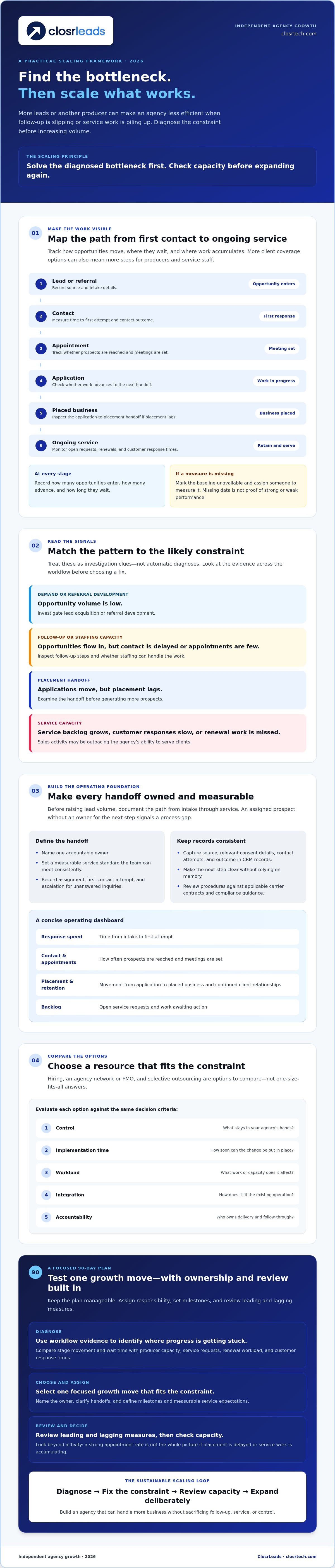
Map the journey from lead or referral to contact, appointment, application, placed business, and ongoing service. For each stage, record how many opportunities enter, how many advance, and how long they wait. Compare those figures with producer capacity, open service requests, renewal workload, and customer response times. Look for where opportunities stall or work accumulates, not just where activity is highest.
Separate verified information from assumptions. If response time isn’t tracked, mark that baseline as unavailable and assign someone to measure it. A missing number is a visibility problem, not proof that performance is strong or weak.
Is the problem demand, capacity, or execution?
Use the pattern in your indicators to decide what to investigate first. Low opportunity volume may point toward lead acquisition or referral development. Strong opportunity flow paired with delayed contact or few appointments may indicate a follow-up process or staffing constraint. If applications are moving but placement is lagging, inspect that handoff before generating more prospects.
Operations matter too. A growing service backlog, slow customer responses, or missed renewal work can signal that sales activity is outpacing the agency’s ability to serve clients. Don’t treat every symptom as a demand problem. Match the fix to the evidence, then check whether the next stage can handle the added work. That’s how owners make a focused decision instead of stacking new initiatives on top of an unresolved constraint.
Build the Operating Foundation Before Increasing Agency Lead Volume
More prospects won’t fix a workflow that loses track of them. Before raising lead volume, document the full path from intake to contact, quoting, application, placement, and ongoing service. Make every handoff visible. If a prospect is assigned but no one owns the next step, the process has a gap, not a lead problem.
For each handoff, name one accountable owner and define a measurable service standard. That could include recording when a new prospect is assigned, who makes the first contact attempt, and how an unanswered inquiry is escalated. Set standards your team can meet consistently, then compare actual performance with the target. The Big 'I' Agency Universe Study can provide industry context, but your own workflow data should guide operating decisions.
How should an agency standardize lead follow-up?
Write down the intake fields, assignment rules, response expectations, and escalation steps. Use CRM records to capture the source, relevant consent details, contact attempts, and outcome. Keep records consistent so a producer or manager can see what happened and what should happen next without relying on memory. Review procedures against applicable carrier contracts and compliance guidance, and verify legal interpretations with qualified sources.
Keep the operating dashboard concise. Track:
- Response speed: time from intake to first attempt.
- Contact and appointment rates: how often prospects are reached and meetings are set.
- Placement and retention: movement from application to placed business, then continued client relationships.
- Backlog: open service requests and work awaiting action.
Review trends alongside the handoffs that produce them. A strong appointment rate doesn’t tell the whole story if placement is delayed or service work is accumulating. As you plan scaling an independent insurance agency 2026, this dashboard gives you a way to judge readiness before adding demand.
When can technology or outside lead sources help?
Adopt a tool only after naming the manual task or visibility gap it should address. Check whether it fits your workflow, including how information reaches your CRM and who owns the next action. For an outside lead source, assess delivery timing, OTP verification, consent records, and the terms for replacing invalid contacts. These checks help you evaluate fit without assuming any source will produce a particular sales result.
If lead acquisition is the confirmed constraint, explore lead delivery and follow-up tools as one possible support for your process. For a closer look at verification, see this guide to OTP verified insurance leads. Technology can support a defined workflow. It can’t replace clear ownership or consistent follow-up.
Compare Hiring, Agency Networks, and Outsourcing Before You Scale
Once you know what’s constraining the agency, compare ways to add that capability. An employee, a network or FMO, and an outside vendor solve different problems. Start with the work you need done, the control you must retain, and the capacity you have to manage the change. For scaling an independent insurance agency 2026, the best option is the one that fits the diagnosed need and your operating model.
Use this comparison to frame the decision. “Time to implement” depends on the role, agreement, or integration involved, so validate it for your situation.
| Option | Control | Time to implement | Recurring workload | Integration | Accountability |
|---|---|---|---|---|---|
| Internal hire | High over daily work and client experience | Recruiting and onboarding required | Ongoing supervision and management | Can be shaped around agency processes | Managed directly by agency leadership |
| Network or FMO | Shared or defined by the agreement | Depends on contracting and setup | Requires relationship and agreement management | Check carrier access, placement support, and tools | Responsibilities must be clear in the contract |
| Selective outsourcing | Focused on the agreed task | Depends on scope and workflow fit | Vendor coordination and quality checks continue | Confirm data flow and handoffs | Define deliverables, review points, and escalation |
When does building capability inside the agency make sense?
Consider hiring when recurring work is clear, measurable, and substantial enough to support a defined role. Internal ownership can make sense when client relationships, service standards, or agency-specific processes demand close control. But a new hire needs onboarding, supervision, and management time. Confirm that someone can provide that support before assuming the role will immediately free up capacity.
When should an agency consider a network or external vendor?
Assess networks for relevant carrier access, placement support, technology, and agreement terms. Compare that support with your carrier needs and product mix, then verify contractual fit before committing. Evaluate each external vendor against the specific bottleneck, integration requirements, data handling, and accountability if a handoff fails.
Keep provider types distinct. A network or FMO may support carrier access or placement, a software vendor supplies technology, and a lead provider supplies prospects. For one vertical-specific example, review this final expense lead strategy. It addresses lead acquisition, not every operational need in an agency. Choose based on fit, not labels.
Create a 90-Day Agency Scaling Plan with Clear Measures
A 90-day plan creates momentum without turning growth into a pile of simultaneous projects. Divide the work into three phases: establish a baseline, pilot one change, then review the evidence. Adjust the pace to your agency’s capacity. The sequence matters more than forcing every task into a fixed calendar.
Measure operational capacity before scaling acquisition, or new demand may expose the bottlenecks you need to fix. Assign one accountable owner to each initiative. Choose a small number of leading measures, such as response speed or follow-up completion, and lagging measures, such as appointments, placed business, or retention. Keep definitions consistent so the team can compare results clearly.
What belongs in the first phase of the growth roadmap?
Start by recording current pipeline stages, response performance, producer workload, service backlog, and relevant service indicators. Mark missing information as unknown and assign someone to establish that baseline. Then select one constraint to address and write down why it takes priority, using observed data rather than instinct alone.
Set a review cadence that fits the work, such as a brief weekly check and a more deliberate phase-end review. Before the pilot begins, define what evidence would justify continuing, adjusting, or stopping it.
How should an agency assess a growth pilot?
Test one change at a time. Compare the pilot with its baseline using the same metric definitions and reporting period. Review the full operating picture together: lead quality, follow-up completion, producer capacity, and customer service effects. A change that raises activity but strains service or leaves follow-up incomplete needs adjustment, not automatic expansion.
For example, if acquisition is the proven constraint, a pilot might test a relevant lead source while keeping assignment and follow-up rules stable. Name the owner, record the workflow, and review results at the planned checkpoints. This makes it easier to distinguish the effect of the change from other process adjustments.
Once your baseline is clear, compare acquisition options that match the agency’s needs, including lead type, delivery, and follow-up workflow. Explore insurance lead options as one potential part of that evaluation, not a substitute for the full scaling plan.
This measured approach keeps scaling an independent insurance agency 2026 focused: prove a change against the baseline, protect service capacity, and expand only when the evidence supports the next step.
Choose the Next Growth Move That Fits Your Independent Agency
The next move should match the constraint you’ve documented, not the trend getting the most attention. Fix that constraint first. Then reassess producer capacity, service workload, and follow-up performance before expanding again. That’s the practical decision rule for scaling an independent insurance agency 2026: diagnose, address, measure, and only then add more volume.
Before committing to a change, run through this checklist:
- Fit: Does the option address the specific bottleneck, and does it suit your agency’s target vertical?
- Ownership: Is one internal person accountable for the decision and ongoing results?
- Workflow: Are assignment, follow-up, and escalation steps clear?
- Data: Can you track source, contact attempts, outcomes, and service effects?
- Review: Have you checked contract terms, applicable compliance responsibilities, integration needs, and exit conditions?
- Outcomes: Have you defined what success looks like in measurable terms, without assuming a particular sales result?
How can an agency select a lead acquisition partner?
If lead acquisition or timely follow-up is the documented constraint, assess partners on more than volume. Ask how leads are sourced, delivered, verified, and documented. Review replacement terms, confirm CRM workflow fit, and be realistic about whether producers can follow up promptly. Compare options against your team’s capacity and target vertical. For example, an agency focused on final expense can assess a final expense lead strategy as a vertical-specific resource, not as a full agency growth plan.
What should owners do before committing to a growth change?
Confirm the proposed change addresses the diagnosed bottleneck and has a named internal owner. Read the agreement closely. Check how data moves into your workflow, what responsibilities remain with your agency, and how either party can end the arrangement. If the change is a lead source, ask whether its delivery and verification details fit your process and whether the team can act on the prospects consistently.
When lead acquisition is the right next step, review the available options against your workflow and capacity. Explore ClosrLeads lead options and platform capabilities as one resource for that evaluation. Choose deliberately, set clear measures, and reassess before you scale further.
Make Your Next Growth Move With Confidence
Sustainable growth starts with an honest diagnosis. Identify the constraint, strengthen the handoff or capacity holding the agency back, and measure one focused change before expanding. That’s the practical approach to scaling an independent insurance agency 2026 without letting new volume outrun follow-up or service.
If lead acquisition is the proven bottleneck, compare options against your target vertical, team capacity, and workflow. ClosrLeads offers real-time and aged insurance leads across multiple verticals, including Final Expense, Veteran, Trucker, Mortgage Protection, and IUL. Leads are OTP phone-verified and include TCPA-compliant consent records. The platform includes a built-in dialer and real-time delivery into users’ CRM systems. ClosrLeads also provides a replacement guarantee for invalid contacts. Review applicable consent requirements with qualified guidance. These tools can support your process, but they don’t guarantee sales outcomes.
Explore ClosrLeads lead options and platform capabilities to see whether they fit your agency’s documented needs. Choose deliberately, track what changes, and keep building on what the evidence supports. Your next stage of growth starts with a clear plan and a team ready to execute it.
Frequently Asked Questions
How can I scale an independent insurance agency in 2026 without hiring too quickly?
Diagnose the agency’s main bottleneck before adding staff or sales volume. Track where prospects stall, how much work producers and service staff carry, and whether follow-up or renewals are slipping. If a process issue is the cause, improve the workflow first. If recurring work is clear and sufficient to support a defined role, hiring may make sense. Scaling an independent insurance agency 2026 should be paced to real capacity, not assumptions.
What is the first step in growing an independent insurance agency?
Establish a reliable baseline of how the agency operates today. Map the path from prospect intake through contact, appointments, applications, placed business, and ongoing service. Record what you know about response times, movement between stages, staff workload, and backlogs. Mark missing data as unknown and assign someone to collect it. With that picture in hand, choose one constraint to address and document why it comes first.
Should an independent insurance agency join a network or grow on its own?
Neither route is best for every agency. Compare a network’s carrier access, placement support, technology, and agreement terms with the agency’s needs and the control it wants to retain. Growing independently may suit an agency that can build the required capabilities internally. Before joining, review contractual obligations and confirm that access and support fit your product mix. Compare the full operating implications, not just the headline benefits.
When should an insurance agency add more leads to its pipeline?
Add leads when the agency has confirmed that acquisition is the constraint and can handle the next steps consistently. Check whether prospects are assigned promptly, contact attempts are completed, and producers have room to work new opportunities. Review service backlogs and renewal workload too. If response is slow or client service is strained, fix that capacity or process issue first. More volume won’t solve a follow-up problem.
Can a CRM help an independent insurance agency scale?
Yes, if it improves visibility and supports a consistent workflow. Use the agency’s CRM to record lead source, assignment, contact attempts, outcomes, and the next action, then check whether information moves cleanly between sales and service. A CRM won’t replace clear ownership or prompt follow-up. ClosrLeads provides real-time CRM delivery for its leads and includes a built-in dialer, which can support an agency’s existing follow-up process.
How should an agency measure whether a growth strategy is working?
Compare the strategy with a baseline using the same definitions and reporting period. Track a few leading indicators, such as response speed and follow-up completion, alongside outcomes such as appointments, placed business, retention, and service workload. Assign one owner to review the measures at planned checkpoints. Consider the whole operating picture: a change that increases activity but worsens backlogs may need adjustment before expansion.
What should I check before choosing an insurance lead provider?
Ask how leads are sourced, delivered, verified, and documented. Review what consent records are provided, how leads fit your CRM workflow, and what the provider’s invalid-contact replacement terms say. Confirm that your team has capacity to follow up and that the lead types match your target vertical. Have appropriate compliance guidance review applicable requirements. A provider’s verification process doesn’t guarantee contact, placement, or sales results.