Blog
Qualified Final Expense Prospects: How Agents Identify Real Opportunities
Learn how to identify qualified final expense prospects, verify key lead details, and build a streamlined follow-up process that boosts insurance sales.

What if a prospect can be worth pursuing without being a guaranteed sale? That distinction matters when inaccurate contact details burn calling time, or a person’s initial interest gets mistaken for a genuine fit. Qualified final expense prospects are verifiable opportunities, not promises of contact, coverage approval, or a closed policy. The goal is to assess each lead consistently, using the information available rather than assumptions.
Agents need a clear way to decide who to follow up with, what to verify, and when to move on. OTP phone verification can increase confidence that a number is valid, but it can’t ensure someone will answer. Consent records, timely lead delivery, and a built-in dialer can support a more consistent follow-up process, while keeping lead quality separate from underwriting and sales outcomes.
This article breaks down the signals that make a prospect worth pursuing, the questions that help assess fit respectfully, and a practical workflow for prioritizing follow-up. You’ll learn to spot real opportunities faster without confusing a qualified lead with a guaranteed policy sale.
Key Takeaways
- Separate a marketing lead, an interested prospect, an application, and an approved policy so each stage is assessed on its own evidence.
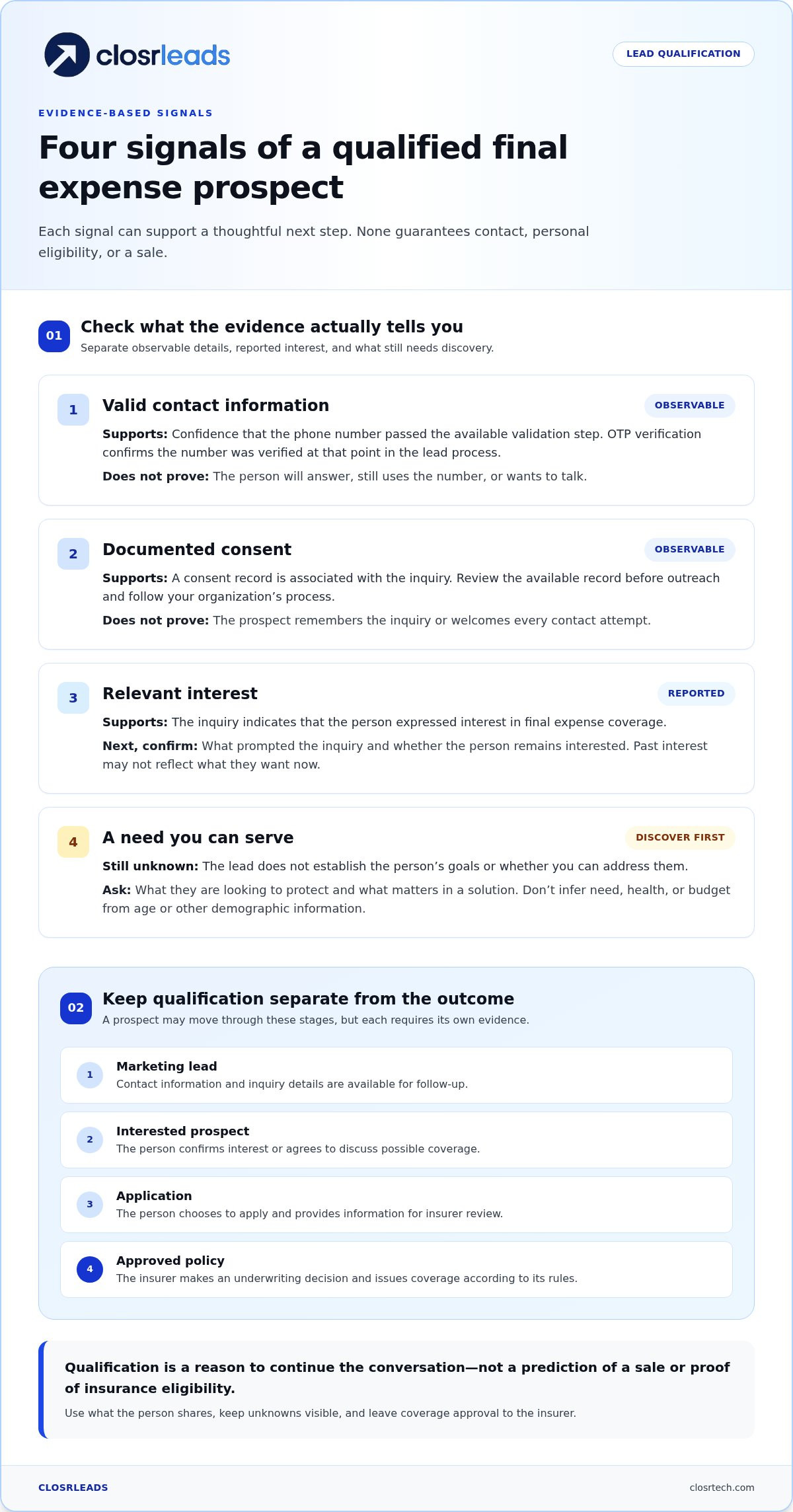
- Use four distinct signals to evaluate qualified final expense prospects: valid contact information, documented consent, relevant interest, and a need you can serve.
- Track what’s verified, what’s reported, and what remains unknown, then choose a follow-up action that closes the right information gap.
- Start first contact with a clear introduction and permission to talk. Use open-ended questions, and let the prospect pause or decline.
- Build a repeatable workflow around lead details and follow-up tools while keeping qualification separate from contact, underwriting, and closing outcomes.
What Makes a Final Expense Prospect Qualified, and What It Does Not Mean
A qualified final expense prospect shows evidence of possible fit and engagement. That evidence can justify a respectful next step, but it doesn’t predict a sale or establish insurance eligibility. Keep the stages separate: a lead record starts the process; a conversation can reveal interest; an application supplies information for an insurer’s review; and only the relevant insurer can approve coverage under its underwriting rules.
Lead qualification indicates a reason to continue the conversation; policy approval depends on the insurer’s underwriting decision.
Lead quality, prospect fit, and underwriting are different stages
A lead record can tell you how to attempt contact and what prompted the inquiry. A valid phone number supports confidence that the details are usable, while a record of expressed interest gives context for an opening conversation. Neither proves that the person is available, still interested, or looking for a policy that fits what you can offer.
Keep these four stages distinct:
- Marketing lead: Contact information and inquiry details are available for follow-up.
- Interested prospect: The person confirms interest or agrees to discuss possible coverage.
- Application: The person chooses to apply and provides information for the insurer’s review.
- Approved policy: The insurer makes an underwriting decision and issues coverage according to its rules.
A lead record cannot replace a needs conversation or application. Age, location, or another demographic detail alone can’t establish health, budget, product fit, or eligibility. Ask, listen, and record what the person actually shares. Don’t fill gaps with assumptions.
Why a qualified prospect is not a guaranteed customer
Important details remain unresolved until direct discussion and, where appropriate, an application. The prospect may have a different coverage goal than you expected, may decide the timing isn’t right, or may not want to continue. Their circumstances and preferences matter. Even when contact details are valid, a call may go unanswered; a person’s interest can also change between submitting an inquiry and speaking with an agent.
Consider a lead who indicates interest in final expense coverage. You reach them and learn they were exploring options for a family member, not seeking coverage for themselves. The inquiry was real, but the original record didn’t establish who needed coverage or what the next step should be. A short, respectful conversation clarifies that. If the person’s needs appear aligned, you can discuss options and explain the application process. If not, qualification has still done its job: it helped you identify the right path without treating interest as a commitment.
Use “qualified” to describe the evidence you have, not the outcome you hope for. That distinction keeps follow-up focused, accurate, and respectful, while leaving application review and approval where they belong: with the insurer.
Four Evidence-Based Signals of Qualified Final Expense Prospects
Qualification gets stronger when you separate what the lead record shows from what the person reports and what still needs to be learned. Use these four signals as a disciplined starting point, not a shortcut to assumptions. A signal can support follow-up without proving current intent, personal eligibility, or a future sale.
- Valid contact information, observable: A phone number has passed the available validation step. OTP phone verification supports confidence that the number was verified, but it can’t tell you whether the person will answer, whether they still use the number, or whether they want to talk.
- Documented consent, observable: The lead record includes a consent record associated with the inquiry. Check the record available to you before outreach and follow your organization’s process for handling it. A record is evidence to review, not a reason to assume the prospect remembers the inquiry or welcomes every contact attempt.
- Relevant interest, reported: The inquiry indicates that the person expressed interest in final expense coverage. Treat that as the starting point for a conversation. Confirm directly what prompted the inquiry and whether the person remains interested; a past expression of interest may not reflect what they want now.
- Serviceable need, still unknown until discovery: The lead may point toward a coverage conversation, but it doesn’t establish the person’s goals or whether you can address them. Ask what they’re looking to protect and what matters in a solution. Don’t infer need, health, or budget from age or other demographic information.
Contactability and consent records
Verification validates a phone number at a point in the lead process. It doesn’t guarantee a live answer, identify who will pick up, or confirm permission beyond the details recorded. Before reaching out, review the consent information attached to the lead and keep it with your workflow records. ClosrLeads provides OTP phone-verified leads with TCPA-compliant consent records; those records support informed follow-up but don’t establish that a prospect is ready to speak.
Interest and service fit without demographic assumptions
Start with the person’s stated request, not a profile-based guess. If an inquiry mentions final expense coverage, ask what prompted it and what they hope to accomplish. Then assess whether the need they describe fits the products and support you can provide. Age, health, and budget belong in respectful discovery, not in assumptions drawn from a lead record. For broader context on how lead details inform follow-up, review this guide to final expense leads.
Keep each signal distinct in your notes: verified detail, reported interest, or open question. That simple discipline makes qualified final expense prospects easier to assess consistently and helps prevent a promising record from being mistaken for an approved policy. To keep follow-up organized, explore tools for managing lead follow-up.
How to Assess a Final Expense Lead Before Prioritizing Follow-Up
A quick, consistent review helps you decide what to do next without turning incomplete data into assumptions. Check the lead record first. Separate details you can verify from information that needs a conversation, then assign a workflow priority based on evidence and your capacity.
Source type alone cannot prove that an individual final expense prospect is qualified. Whether a lead came through a particular channel doesn’t tell you if its contact details are usable, what the person wants, or whether their needs fit your services. Assess the record in front of you.
A practical lead-record review
Review only information provided with the lead and authorized for your use. Check administrative details, such as whether contact information is present and whether a consent record is available. Don’t use those checks to guess at health, budget, or coverage needs. Flag anything missing or conflicting. Save questions about goals, preferences, and current interest for a direct conversation.
| Signal | Evidence available | Unknowns | Next action |
|---|---|---|---|
| Contact details | Phone number is present and verification information is available. | Whether the person will answer or still uses that number. | Review the available details, then follow your outreach process. |
| Recorded consent | A consent record accompanies the lead. | Whether the person recalls the inquiry or is ready to talk. | Review the record before outreach and follow your established procedures. |
| Stated interest | The inquiry indicates interest in final expense coverage. | Whether interest remains and what prompted the request. | Use the inquiry as context; confirm interest directly. |
| Missing information | A detail is blank, unclear, or inconsistent. | The correct information and whether the need fits your services. | Flag the gap. Resolve administrative issues first or ask respectfully during a conversation. |
Prioritization is not a verdict on the prospect
Use high, medium, and low as operational labels, not judgments about a person or predictions of a sale. Make the criteria visible to everyone who handles leads, and update the label when new evidence comes in.
- High priority: Contact details and the available consent record are present, and the inquiry gives a clear reason for timely follow-up. This means the record is ready for the next appropriate action, not that the person will answer or qualify for a policy.
- Medium priority: The record has some useful evidence, but interest or a key detail needs clarification. Schedule follow-up according to your capacity and process.
- Low priority for now: Contact details are missing or conflicting, or an administrative question needs resolution before outreach. Flag the issue instead of filling the gap with a guess.
Set priorities around your actual follow-up commitments. A lead marked high can wait if your workflow is full; a medium-priority record may move up after the prospect confirms interest. These labels help organize attention. They don’t measure a person’s worth, establish underwriting eligibility, or prove that one lead source will perform better than another.
A Respectful First-Contact Framework for Qualifying Final Expense Prospects
A first call should establish context before it asks for personal details. Keep the goal simple: confirm who you’re speaking with, explain the inquiry accurately, ask whether they’re available, and learn what they want help with. This pace respects the prospect’s choice and gives you better information than assumptions ever will.
- Identify yourself. Give your name and the organization you represent. Speak clearly and allow the person a moment to place the call. Don’t imply an existing relationship if you haven’t spoken before.
- Explain the inquiry. Refer only to accurate details available in the lead and consent record. For example: “I’m following up because you submitted an inquiry about final expense coverage.” If the record doesn’t support that explanation, don’t guess at what prompted it.
- Confirm willingness to talk. Ask, “Is now a good time to talk?” or “Would you prefer to speak another time?” If they decline or seem unsure, acknowledge their choice and follow the appropriate process. A verified number doesn’t mean the person is ready to answer or continue.
- Discover needs. With permission, ask an open question such as, “What information about coverage would be most useful to you?” Let the prospect guide the discussion. Don’t open with assumptions about funeral plans, health, or finances.
The order matters. Context first. Permission next. Discovery only when the person is willing. That keeps the call focused and gives prospects room to pause, decline, or correct the information that led to the outreach.
Once the person is comfortable continuing, explore timing and coverage questions gently. Try, “What prompted you to look into this now?” or “What would you like a policy to help with?” In many cases, prospects are navigating final expenses for the first time and may reference guidance from providers like Sunnyside Cremation and Funeral to understand where to begin with funeral or cremation costs before deciding on coverage. If age, health, or budget becomes relevant, explain why you’re asking and let the prospect decide what they’re comfortable sharing. Avoid turning an answer into a conclusion about eligibility. The insurer evaluates applications under its own underwriting rules.
Close by reflecting the prospect’s stated goal and agreeing on a practical next step. For instance, summarize the information they requested, then ask whether they’d like to continue the discussion or arrange a follow-up. Record only relevant answers and the agreed action in your workflow. Keep notes factual, concise, and useful to the next interaction.
Verification supports the contact process, not a promise of conversation or intent. For more on what OTP verification can establish, see this guide to OTP-verified insurance leads. Apply the same distinction on every call: use verified details for context, then let the prospect’s answers shape the conversation. That’s how agents identify qualified final expense prospects without pressuring people or treating a lead record as a complete picture.
Build a more consistent follow-up workflow with lead follow-up tools.
How ClosrLeads Helps Agents Work Qualified Final Expense Prospects
Qualification is an agent’s evidence-based assessment, not a promise that a person will answer, apply, or receive coverage. ClosrLeads supports the work around that assessment with final expense leads that are OTP phone-verified and include TCPA-compliant consent records. Those details give agents a clearer starting point for organized follow-up while leaving interest, need, and underwriting eligibility to be established through the appropriate steps.
Turn verified lead information into an organized follow-up workflow
ClosrLeads delivers leads in real time into users’ CRM systems. That can help agents bring a new record into their existing workflow, review its details, and plan an appropriate follow-up. The platform’s built-in dialer gives agents a tool for working purchased leads within the lead-handling process. Use the available contact and consent information as context, then let the prospect’s response guide the conversation.
Each feature supports a specific part of the process:
- OTP phone verification supports confidence that the number was validated. It doesn’t guarantee the person will answer, recognize the inquiry, or want to talk.
- TCPA-compliant consent records provide information agents can review as they prepare for outreach. Keep the record connected to your lead workflow and follow your organization’s procedures.
- Real-time CRM delivery helps move lead information into the agent’s system for follow-up and tracking.
- The built-in dialer supports agents as they work purchased leads. It doesn’t establish prospect interest or determine policy eligibility.
Keep the distinctions clear. Verification is about the phone number, not the person’s intent. A lead record can organize the next step, but only direct discussion can clarify the prospect’s current interest and needs. An application and the insurer’s underwriting decision remain separate stages. No feature can turn qualification into a guaranteed answer, application, sale, or approval.
Choose a next step based on your agency’s follow-up capacity
Before increasing lead flow, consider whether your team has time to review records, make outreach attempts, and document outcomes according to its process. Match the volume you purchase to your available follow-up capacity. Then use consistent workflow labels to keep new, contacted, and unresolved records organized. The right setup is one agents can manage reliably, not simply the largest flow of leads.
ClosrLeads’ replacement guarantee applies to invalid contacts. It’s a defined safeguard for that issue, not a promise of contact, a sale, or insurance approval. Keep that scope clear when evaluating lead quality and results.
Ready to build a more organized process for working qualified final expense prospects? Explore ClosrLeads and see how its lead features can support your follow-up workflow.
Turn Your Qualification Process Into a Lasting Advantage
Your next opportunity is to make qualification a repeatable standard, not a gut call. Review your follow-up history to see where records stall: contact details need attention, interest has changed, or the stated need falls outside what you can address. Use those observations to refine your review criteria and conversation approach. Keep the categories clear: what the lead record showed, what the prospect told you, and what the insurer decided. That discipline can help you assess qualified final expense prospects more consistently while protecting your time and the prospect’s trust.
Choose a lead flow your team can handle well, then strengthen the process as you learn from real interactions. A reliable qualification routine won’t control every outcome, but it can help you focus attention where a respectful next step makes sense. Explore ClosrLeads final expense leads and take the next step toward a more organized approach. Keep your standards clear, your follow-up thoughtful, and your momentum moving forward.
Frequently Asked Questions
What makes a final expense prospect qualified?
A prospect is qualified for follow-up when the available information supports a reasonable next conversation, not when it predicts a policy sale. Look for a usable contact record, a documented inquiry, and interest that the person confirms directly. Then clarify whether their stated goal matches what you can discuss. For example, someone asking about coverage for a relative may need a different next step than someone exploring coverage for themselves.
Does a phone-verified final expense lead guarantee the prospect will answer?
No. Phone verification supports confidence that the number was validated, but it can’t establish who will answer or whether the person is available. A number may be shared, temporarily inaccessible, or simply unanswered. If someone picks up, identify yourself and confirm you’re speaking with the intended person before discussing the inquiry. Treat verification as a contact-data signal, not proof of identity, current interest, or permission to continue a conversation.
Can a qualified final expense prospect still be declined for coverage?
Yes. Qualification for an agent’s follow-up is separate from an insurer’s decision about coverage. An applicant may not meet a particular insurer’s product requirements, or the insurer may need more information to assess the application. The agent can help the person understand the application process, but shouldn’t present a prospect’s interest or preliminary answers as an approval. Only the relevant insurer determines eligibility under its underwriting rules.
How should an agent qualify a final expense prospect on the first call?
Start with a concise introduction and an accurate reason for calling, then ask whether the person has time to talk. If they agree, try, “What would you like to understand about final expense coverage?” Their answer can reveal whether they want general information, help comparing options, or a later conversation. Ask one question at a time, avoid pressing for sensitive details, and confirm the next step before ending the call.
Are older adults automatically qualified for final expense insurance?
No. Age alone doesn’t establish that someone is eligible, interested, or a fit for a particular policy. Insurers set their own application and underwriting criteria, and those can vary by product. An older adult may want information without being ready to apply; another person may have questions that call for further discussion. Ask what the individual is seeking, and leave eligibility decisions to the insurer reviewing an application.
What is the difference between a qualified prospect and a qualified lead?
The terms don’t have one universal meaning across agencies, so define them in your workflow. One useful distinction is that a lead is a record available for outreach, while a prospect is a person whose situation and interest have been discussed enough to identify a relevant next step. Neither label means an application is complete or a policy is approved. Clear internal definitions help agents hand off records consistently.
What should agents check before following up on a final expense lead?
Review the contact details, inquiry context, available consent record, and any prior notes or contact outcomes you’re authorized to use. Look for missing or conflicting information, such as a name that doesn’t match an earlier record. Resolve administrative gaps through your established process rather than guessing. Also check your workflow for prior requests to pause or stop contact, and make sure the planned outreach follows your organization’s procedures.