Blog
OTP verified insurance leads for agents seeking faster follow-up
Learn how OTP verified insurance leads help agents confirm phone access and prioritize timely follow-up, while understanding what verification can’t prove.

Fast follow-up starts with a reachable phone number, not just a submitted form. OTP verified insurance leads use a one-time passcode to confirm that a prospect can access the phone number they provided. This gives agents a practical signal for prioritizing outreach, though phone verification alone does not prove purchase intent or guarantee a sale.
Speed matters when someone has just requested insurance information, and a stale or mistyped number can stall the first conversation. This article explains how OTP verification supports faster follow-up, what it can and can’t tell you about a prospect, and which insurance verticals are suited to rapid outreach. You’ll also learn what to look for in the lead process, including how phone validation fits with lead delivery and follow-up tools. The aim is straightforward: help you decide whether verified contact details can make your outreach more focused and timely.
Key Takeaways
- Use phone verification to confirm a prospect can access the number they provided, then prioritize timely outreach.
- Combine a verified number with the prospect’s request and insurance needs to assess follow-up priority; verification alone doesn’t establish intent.
- Match your outreach approach to the insurance vertical and the prospect’s reason for seeking coverage.
- Explore available lead types and tools, including Final Expense, Veteran Insurance, and IUL leads with a built-in dialer.
Why is OTP phone verification critical for speed-to-lead success?
Phone OTP checks confirm access to a submitted number before outreach. They help agents prioritize contact, but do not prove intent or guarantee a sale.
One-Time-Passcode Phone Checks
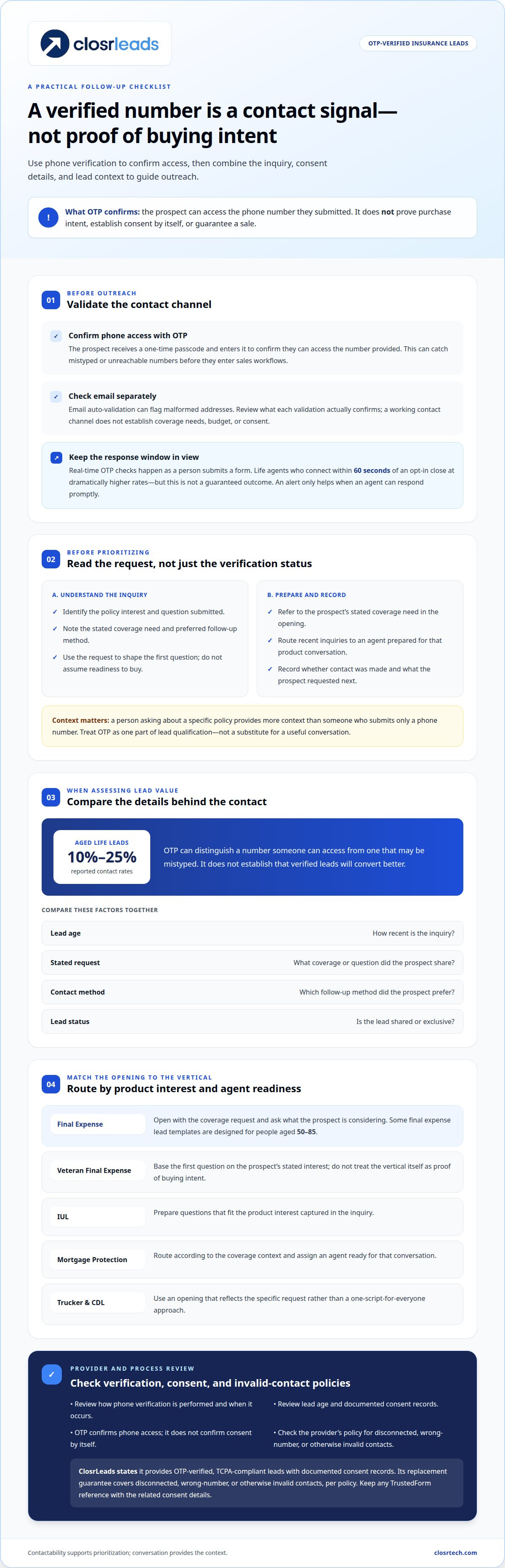
For a life insurance lead, the prospect receives a one-time passcode and enters it to confirm access to the phone number provided. That step can help agencies catch mistyped or unreachable numbers before delivery enters sales workflows. Pair phone checks with email auto-validation to flag malformed addresses. Review what each validation confirms: a working contact channel is useful, but it doesn’t establish coverage needs, budget, or consent.
Real-Time Phone Validation
Real-time OTP verification checks a number as a person submits a form, giving agents a fresher opportunity to respond. Life insurance agents who connect within 60 seconds of an opt-in close at dramatically higher rates. Treat that as a reason to streamline lead capture, routing, and call readiness, not as a guaranteed result. An instant alert only helps if the agent can respond promptly and discuss the requested coverage.
Contact Rates and Lead Comparisons
Aged life insurance leads have contact rates of 10%-25%. OTP verification can distinguish a number someone can access from one that may be mistyped, but it doesn’t establish that verified leads will convert better. Compare lead age, the prospect’s stated request, contact method, and whether the lead is shared or exclusive. Those details shape follow-up priority and help agents assess the real value of an opportunity.
Provider, Consent, and Lead Risks
When evaluating insurance leads, review the verification process, lead age, consent records, and invalid-contact policy. OTP confirms access to a phone number, not consent by itself. ClosrLeads provides OTP-verified, TCPA-compliant leads with documented consent records. Its replacement guarantee covers disconnected, wrong-number, or otherwise invalid contacts, per policy. After delivery, follow up promptly, refer to the person’s request, confirm their coverage interest, and record the outcome.
High-intent insurance prospects
A verified number is a contact signal, not proof of buying intent. Insurance agents should also read the prospect’s request, stated coverage needs, and preferred follow-up method. Someone asking about a specific policy has given more context than someone who submits only a phone number. Use those details to decide what the first conversation should address.
Start with the form response. A final expense inquiry gives agents a clear opening: confirm the request, ask what coverage the prospect is considering, and listen to their priorities. A Veteran Final Expense inquiry or a request about another product calls for a different conversation. Match your first question to the prospect’s stated interest.
Consent and context matter alongside contactability. Review the inquiry details and make sure your outreach reflects the person’s request. An OTP-verified phone number does not show what the person wants, whether they are ready to buy, or what coverage suits them. Treat it as one part of lead qualification, not a substitute for a useful conversation.
Lead volume works best when agents have a clear process for sorting inquiries by product interest, age, and contact details. Route a recent coverage inquiry to an agent ready to respond, and flag incomplete forms for review. Track contact attempts and outcomes to understand which lead sources produce relevant conversations.
- Read the request: Identify the policy interest and question submitted.
- Prepare the opening: Refer to the prospect’s stated coverage need.
- Record the outcome: Note whether the person connected and what they requested next.
These steps help distinguish reachable contacts from likely buyers without overstating what verification means. Assess lead quality through real conversations, rather than treating OTP completion as a promise of purchase. Use the results to refine follow-up priorities and match lead volume to your team’s capacity.
Insurance verticals for rapid follow-up
Rapid outreach works best when the opening fits the insurance inquiry. A final expense lead calls for questions about the prospect’s coverage goals and reason for exploring life insurance. A Trucker & CDL request needs a different opening. Match your message to the product interest captured in the form instead of using one script for every prospect.
Final expense leads can suit focused follow-up because the request centers on a specific coverage need. Some final expense lead templates are designed for people aged 50-85. Agents can use the form details to shape an opening, then ask what the prospect wants to understand. That keeps outreach relevant without assuming the person is ready to buy.
Other verticals also call for tailored conversations. A Veteran Final Expense inquiry should prompt an opening based on the prospect’s stated interest, while an IUL lead may call for questions about that product. Mortgage Protection and Trucker & CDL leads involve different coverage contexts. Sort each lead by vertical before assigning it to an agent or adding it to a dialer queue.
Use intent and workflow together. First, review the requested product and contact details. Next, route the lead to an agent prepared for that conversation. Then record the response and follow-up outcome. If a record includes a TrustedForm reference, keep it with the related consent details. That gives agencies a concrete process for managing outreach and evaluating conversions across the pipeline.
- Final expense: Open with the coverage request, not an assumed buying decision.
- Veteran Insurance: Use the inquiry details to guide the first question.
- IUL, mortgage protection, or trucker insurance: Route by product interest and agent readiness.
A focused funnel helps agents act on relevant signals instead of chasing volume alone. Compare outcomes by vertical, lead details, and follow-up steps to see where conversations develop and where an opening script may need adjustment. Keep the process consistent, but let each prospect’s request guide the conversation.
What types of insurance leads are available with OTP verification?
Phone verification can support outreach across different insurance categories. The right lead type depends on the coverage requests your team handles and the conversations agents are prepared to have. Sort leads by product interest before assignment, so each prospect reaches an agent equipped to discuss that topic.
Final Expense, Veteran Final Expense, IUL, Trucker & CDL, and Mortgage Protection are distinct lead categories, each with a different starting point for conversation. A Final Expense inquiry may call for questions about the coverage the person wants to explore. A Trucker & CDL request needs an opening tied to that interest. OTP confirms access to the submitted phone number, not which product fits the person.
- Final expense: Use the prospect’s request to open a focused life insurance conversation.
- Veteran Insurance: Refer to the stated interest, then ask what information the prospect wants.
- IUL: Keep the first conversation centered on the requested product and the person’s questions.
- Trucker insurance: Route the inquiry to an agent prepared to discuss that coverage category.
- Mortgage protection: Connect the first question to the prospect’s reason for requesting information.
Before selecting a category, map each lead type to your sales workflow. Identify which agents handle each product, what details they need, and how the first follow-up should begin. Then track responses by category. For example, compare how often agents connect with each type of inquiry and whether the request gives them enough context to continue the conversation. OTP completion is not proof that someone is ready to buy.
Choose based on product fit, team capacity, and the conversations you want to develop. To explore insurance lead options, start with the vertical that matches your agents’ focus and follow-up process.
ClosrLeads: Final Expense Leads
ClosrLeads offers Final Expense Leads for agents building a focused life insurance pipeline. Choose real-time or aged leads to match your outreach approach and follow-up capacity. Each lead is OTP phone-verified, and invalid contacts are covered by a replacement guarantee.
For agents working across multiple audiences, Veteran Insurance Leads and IUL Leads provide additional options. A built-in dialer delivers leads directly into your CRM system, supporting a practical handoff from delivery to follow-up. This setup suits teams ready to organize incoming prospects and act on their stated interest.
Explore ClosrLeads when your agency wants verified contact details and a defined process for managing life insurance inquiries. Visit closrtech.com to learn more about Final Expense leads.
Build a Follow-Up Process Your Team Can Sustain
Make verified contact details part of a clear operating plan. Decide who receives each inquiry, how agents record conversations, and when an unresolved request returns for follow-up. This structure helps your team use OTP verified insurance leads deliberately, without treating a confirmed phone number as proof of readiness or intent to purchase.
Match lead categories to the conversations your agents are equipped to handle. ClosrLeads offers Final Expense, Veteran Final Expense, and IUL leads. Choose the categories that fit your team’s focus, then align assignment and follow-up with each prospect’s stated interest. A consistent process gives agents a practical way to turn inquiries into relevant conversations.
Ready to consider the next step for your agency? Contact ClosrLeads about insurance leads and explore the options that fit your team. Build a process that keeps your outreach focused and gives every prospect a clear, thoughtful next conversation.
Frequently Asked Questions
What makes insurance leads suitable for immediate follow up?
A lead is easier to work when its product request, contact details, and follow-up context are clear. For example, an agent receiving a Mortgage Protection inquiry can prepare a relevant opening instead of guessing the prospect’s interest. Before calling, review the submitted details and documented consent, then route the inquiry to someone prepared to discuss that coverage.
Where can I get leads to sell life insurance?
You can obtain life insurance leads organized by product interest. ClosrLeads offers Final Expense, Veteran Final Expense, and IUL leads. Compare these categories with the policies you sell and the conversations your team handles. A focused match helps agents start with the prospect’s stated request instead of a generic opening.
What are OTP-verified insurance leads?
OTP verified insurance leads are insurance inquiries where the submitted phone number has been confirmed through a one-time passcode. The process indicates that the person completing the form could access that number. It does not establish the person’s identity, prove interest in buying coverage, or show which policy is suitable. Treat verification as a contact-quality signal, then assess the inquiry itself.
How does OTP verification work for insurance leads?
The form requests a phone number and sends a temporary passcode to it. The person enters the code to complete verification. A practical workflow records the verification result alongside the inquiry, so agents can distinguish completed checks from unverified submissions. Then review the requested product and documented consent before choosing the right follow-up conversation.