Blog
Mtg Leads Pricing for Mortgage Campaigns
Learn how mtg leads pricing varies by freshness, exclusivity, targeting, and volume—and match your mortgage campaign budget to your team's follow-up capacity.

There is no single price for a mortgage campaign. The cost of mtg leads depends on factors such as lead age, whether a record is exclusive or shared, targeting and qualification criteria, and the volume your team can handle. These choices shape both upfront spending and how quickly agents need to follow up.
That trade-off matters: a lower-cost shared lead may go to several buyers, while an exclusive lead is reserved for one. Fresh and aged leads also call for different follow-up plans. If you’re setting a campaign budget, look beyond the headline rate. Compare the delivery terms, qualification criteria, and the workload your team can support. This guide explains how those factors affect a campaign and helps you match lead type and budget to your team’s workflow.
Key Takeaways
- Match lead freshness to your team’s follow-up capacity and campaign goals.
- Weigh exclusive delivery against shared distribution, including how many buyers may receive the same prospect.
- Build your budget around targeting, qualification, delivery, and the volume your sales team can work.
- Use the article’s supplier-selection factors to identify a lead source that fits your mortgage campaign workflow.
Where can I buy MTG leads in the United States?
Mortgage professionals in the United States can buy prospect leads from specialized providers. The right source depends on the campaign, lead age, and how many buyers receive each record. Before ordering, define the mortgage product, target geography, delivery preference, and your team’s follow-up capacity. These details help you avoid buying a list your agents cannot work effectively.
Start by identifying the lead age your sales process can support. Fresh or real-time mortgage leads are 0-7 days old. Near-aged leads are 30-85 days old, while aged leads are 86-365+ days old. Ask a supplier to identify the age category clearly. A team that can respond quickly may prefer fresh inquiries; a team with a longer nurture process may consider older records.
Next, clarify what the prospect expressed interest in. A mortgage campaign might focus on home financing, refinancing, or mortgage protection. These needs are not interchangeable: a lead generated for one purpose may not fit another conversation, even when the contact details are accurate. Specify the intended product and audience before ordering so the campaign has a clear target.
Delivery terms matter just as much as age. Exclusive leads are assigned to one buyer, while shared mortgage leads may be sold simultaneously to 2-5 or more buyers. That difference changes the sales environment. With shared delivery, prospects may receive calls from several agents. With exclusive delivery, the buyer has less direct competition for that inquiry. Neither format guarantees a sale, so align the model with your team’s capacity and follow-up approach.
What to clarify before buying
Use a short buying brief to define the campaign. Give the supplier the information needed to set it up:
- Mortgage purpose: identify the product or inquiry type your agents handle.
- Target area: name the states or locations your team can serve.
- Lead age: choose fresh, near-aged, or aged records based on your workflow.
- Distribution: establish whether the campaign uses exclusive or shared leads.
- Follow-up plan: estimate how quickly your team can contact and work each inquiry.
A clear brief helps prevent mismatches. If your team serves a limited area, define that boundary before delivery. If you’re buying aged leads, plan follow-up that accounts for the time since the original inquiry. Specific requirements also make it easier to assess whether an offer fits your campaign.
Ask how the supplier defines lead age, distribution, and the prospect’s original intent. Get clear definitions in writing before committing. “Fresh” is meaningful only when the age window is stated. Confirm how shared distribution works and whether geographic or product filters apply. These details make offers easier to compare than headline descriptions alone.
Regulatory context also matters for mortgage campaigns involving credit inquiries. The Homebuyers Privacy Protection Act (H.R. 2808) was signed into law on September 5, 2025, and took effect on March 5, 2026. Trigger leads were legal under current FCRA provisions as of early 2026. Because lead generation methods can differ, ask how the supplier sources the records and what consent or inquiry context applies. Keep this discussion focused on the actual lead type being purchased.
Match order size to your team’s actual capacity. A large batch can overwhelm agents when follow-up time is limited. A smaller campaign can be a practical way to assess lead age, targeting, and distribution. Track results by category, then use them to refine your next order. A sound decision starts with clearly defined prospects and delivery terms, plus a team ready to respond.
When comparing providers, keep the campaign brief and delivery terms clear, and include the broader policy context in your review. The Homebuyers Privacy Protection Act has gained significant Congressional support. That fact alone does not explain a supplier’s lead practices or order terms, so ask how records are sourced and delivered. Keep the discussion focused on your intended mortgage purpose, target area, lead age, distribution model, and follow-up plan. Comparing offers against the same requirements helps you judge whether a campaign fits your workflow.
Leads cost
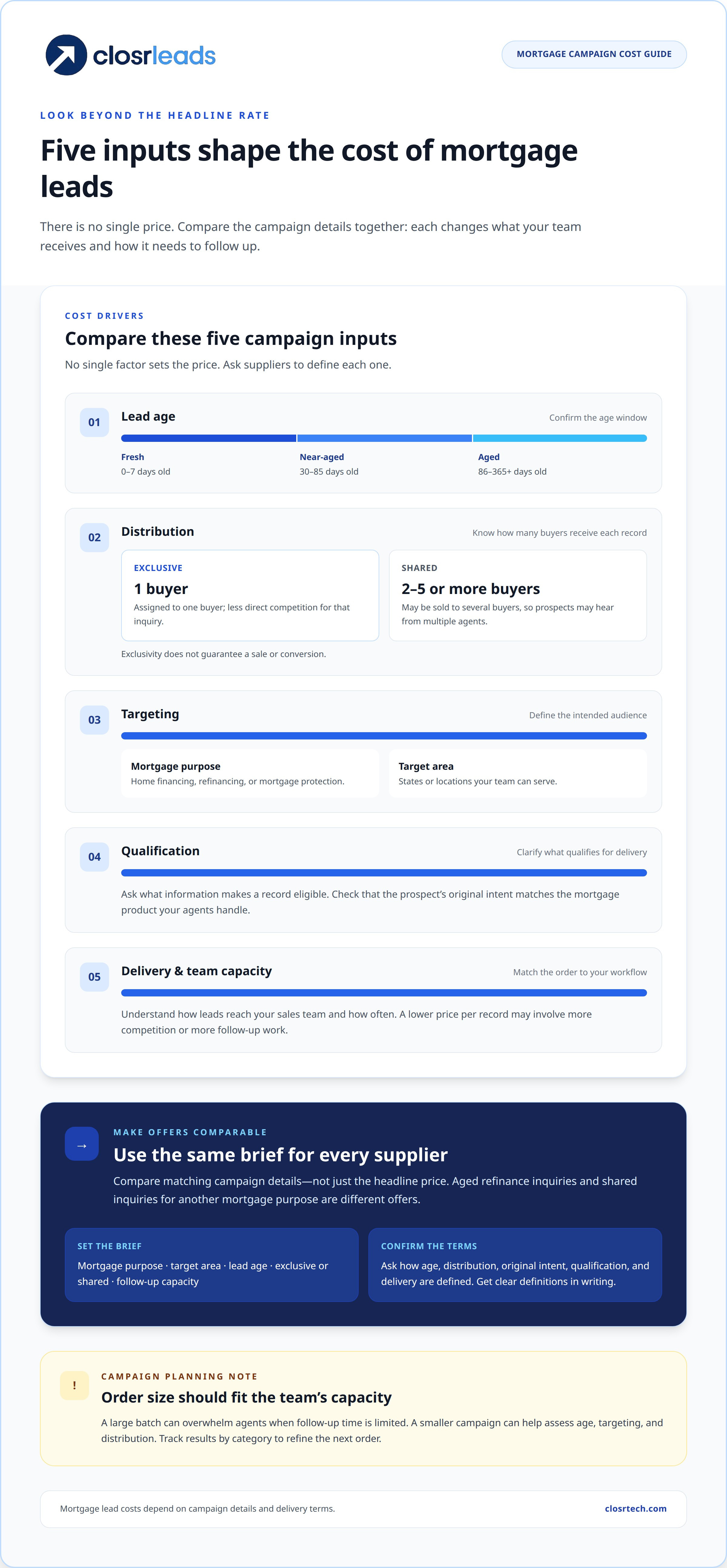
Mortgage lead pricing depends on what the campaign delivers, not just the number of records. Freshness, exclusivity, targeting, qualification, and delivery method can all affect a quote. Compare these details before deciding whether an offer costs more. A lower price per record may mean more competition or more follow-up work.
Lead age is one cost driver. Fresh mortgage inquiries are 0-7 days old, near-aged leads are 30-85 days old, and aged leads are 86-365+ days old. These categories represent different follow-up conditions. A recently submitted inquiry may need fast handling, while an older record may require a more sustained outreach plan. The supplier’s age definition matters because labels alone don’t explain how recent the inquiry is.
Distribution also shapes the value of an order. Shared mortgage leads may go to 2-5 or more buyers, while exclusive leads are sold to one buyer. More buyer competition can affect the time agents have to reach a prospect. Exclusivity may therefore change the offer’s price, but it does not promise a conversion. Compare delivery terms alongside the lead’s age and intended mortgage purpose.
Compare the cost behind the headline
Ask suppliers to describe each campaign using the same criteria. A practical comparison includes:
- Age: distinguish fresh, near-aged, and aged records.
- Distribution: establish whether each record is exclusive or shared.
- Targeting: define the intended mortgage product and geographic area.
- Qualification: clarify what information makes a record eligible for delivery.
- Delivery: understand how leads reach the sales team and how often.
An offer for exclusive refinance inquiries, for example, is not directly comparable to one for shared, aged inquiries about a different mortgage purpose. These labels describe different campaign inputs. Price comparisons are more useful when the offers have matching details. Otherwise, the lower-priced option may simply have a different audience, age profile, or distribution arrangement.
Build your campaign budget around the full sales workflow. The lead charge is only one part of the decision. Agent time, contact attempts, qualification conversations, and loan progression all affect the outcome. Once prospects are engaged, using tools like DocChaser to automate mortgage document collection can reduce administrative overhead and free up broker capacity. Track spending against qualified conversations and closed business, not just the number of records received. This broader view helps you determine whether the campaign fits your team’s capacity.
For aged mortgage leads 30-85 days old, an illustrative lead-to-close conversion range is 1-3%. Treat that range as context for evaluating a campaign, not as a forecast for your team. Results depend on factors such as targeting, outreach execution, and the prospect’s current needs. A campaign review should compare actual outcomes with the lead type and process used.
Set a useful performance benchmark
Use the same reporting period for each campaign. Record how many leads arrive, how many agents reach, how many conversations qualify, and how many progress to closing. Keep age and distribution categories separate, since combining them can hide which source or workflow performs better. Review the results before adjusting budget, targeting, or follow-up capacity.
Before approving an order, get a clear description of each lead category and delivery condition. Confirm the campaign’s mortgage purpose, age range, buyer distribution, and geographic targeting. Then assess whether agents can handle the expected flow. If volume exceeds your team’s capacity, prospects may wait longer for follow-up. A well-matched volume gives agents room to respond consistently.
Use those measures to guide your next budget decision. If qualified conversations are strong but closings remain limited, review the sales process before changing lead sources. If records do not match your target audience, revisit targeting and qualification criteria. This step-by-step review connects spending to campaign inputs and outcomes, helping mortgage teams make more informed adjustments to future orders.
ClosrLeads
ClosrLeads helps insurance agents source leads across several insurance categories and manage follow-up through its Built-In Dialer. If your campaign planning also includes Final Expense, Veteran Insurance, or IUL prospects, these offerings can support that broader pipeline. The dialer delivers leads directly into users’ CRM systems, helping keep incoming records connected to the sales workflow.
Use the pricing and distribution factors above to define your mortgage campaign requirements. For other insurance lead needs, ClosrLeads offers Final Expense, Veteran, and IUL leads. Its insurance lead offerings are distinct from mortgage campaign services, so evaluate mortgage targeting and delivery terms on their own.
Contact ClosrLeads to discuss your insurance lead needs.
Make your next campaign decision with purpose
Turn your campaign priorities into a clear lead plan. Decide which audience your team can serve, what follow-up it can sustain, and how you’ll measure performance. This keeps planning practical and helps distinguish mortgage inquiries from related insurance opportunities.
For agents building an insurance pipeline alongside mortgage work, ClosrLeads offers Final Expense Leads, Veteran Insurance Leads, and IUL Leads. These are distinct insurance categories, not a substitute for evaluating mortgage campaign requirements. Keep that distinction clear as you plan your next move.
Ready to discuss your needs? Contact ClosrLeads about mtg leads and take the next step with a focused plan.
Frequently Asked Questions
What does MTG leads mean?
MTG leads are mortgage-related prospect inquiries that sales teams can follow up on. “MTG” is shorthand for mortgage. A record may support a conversation about a mortgage product, but it does not mean the person has been approved for a loan or will proceed. Agents can sort inquiries by campaign purpose and route prospects to the appropriate sales workflow.
How much do MTG leads cost?
The cost depends on lead type, targeting, delivery terms, and order volume. To plan spending, decide how many inquiries your team can work, then multiply the supplier’s per-lead quote by that quantity. Request a quote for your intended campaign rather than relying on a broad market estimate, and compare offers with matching specifications before choosing.