Blog
Insurance leads with high conversion rates: shared or exclusive
Discover how to find insurance leads with high conversion rates. Compare shared vs exclusive leads, analyze sales funnel stages, and boost your closing rate.

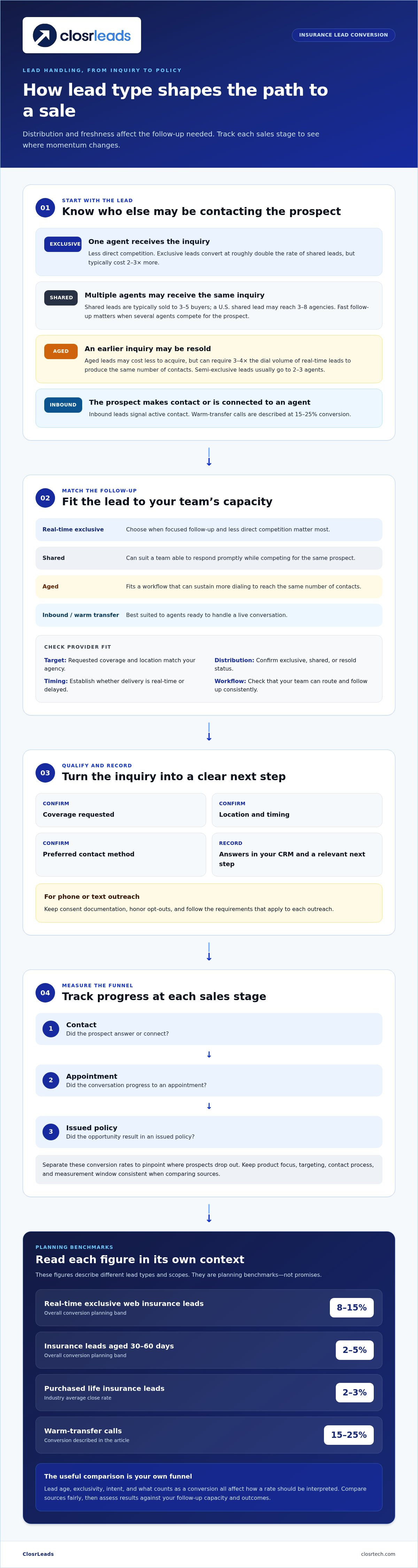
A strong close rate depends on the lead, but the benchmark shifts sharply by type: real-time exclusive web insurance leads have an 8-15% overall conversion planning band, compared with 2-5% for leads aged 30-60 days. For purchased life insurance leads overall, the industry average close rate is 2-3%. Those figures put insurance leads with high conversion rates in context: lead age and exclusivity matter, but so does what you count as a conversion.
It’s easy to focus on the final sale. Yet contact, appointment, and issued-policy rates show where a lead process is working or losing momentum. A shared lead can reach several agents, while an exclusive lead gives one agent the opportunity to follow up without the same competition.
This article explains shared and exclusive leads, how to measure conversion at each sales stage, and how lead types differ. You’ll learn how to interpret your results, compare sources fairly, and choose leads that fit your workflow without treating a planning benchmark as a promise.
Key Takeaways
- Compare shared, exclusive, aged, and inbound leads by distribution, freshness, competition, and the follow-up effort each requires.
- For a niche or regional agency, prioritize alignment between the lead’s insurance vertical, location, and your sales process.
- Track contact, appointment, and issued-policy conversion separately to pinpoint where prospects drop out.
- Use vertical-specific benchmarks to set expectations, then assess performance against your own lead and follow-up results.
- Choose a lead source that fits your team’s capacity to respond and follow up consistently, not just the headline conversion rate.
What is the difference between shared and exclusive insurance leads?
A shared lead is sold to multiple agents, while an exclusive lead is sold to one agent. Aged leads have been available for longer; inbound leads come from prospects who contact an agent directly or request a connection. These distinctions affect competition, contact timing, and the follow-up needed to start a conversation.
In the United States, referrals, paid search, social media, and marketplaces can attract prospects with different levels of intent. Referrals begin with an existing relationship, paid search can capture active queries, and social media can build interest. For teams looking to develop direct digital channels, creative partners such as I Search Marketing can help shape online branding and campaign strategy. Marketplaces may distribute inquiries to multiple sellers.
Agents who contact leads by phone or text should treat TCPA requirements and consent records as essential parts of lead handling. Keep consent documentation, honor opt-outs, and follow the requirements that apply to each outreach.
There is no single average cost per lead that applies across auto, home, life, and health insurance campaigns. Cost varies with the vertical, targeting, lead age, exclusivity, and acquisition channel.
Qualify a lead by confirming the requested coverage, location, timing, and preferred contact method. Record the answers in your CRM and set a relevant next step, such as discussing a life insurance quote.
Lead quality, intent, and recency influence whether a prospect answers and progresses toward a policy. A real-time inquiry can be easier to reach than aged leads, which may require 3-4 times the dial volume to produce the same number of contacts.
Duplicate records, invalid contact details, and unclear consent can waste time or create compliance risks. Check for duplicates, review contact and consent information, and establish a clear process for handling invalid records.
Distribution is the first major difference. Shared insurance leads are typically sold simultaneously to three to five buyers, while a shared lead in the United States may reach three to eight agencies. Semi-exclusive leads usually go to two or three agents. That creates competition for the same prospect, especially when several agents follow up quickly.
With a true exclusive lead, one agent receives the inquiry. Exclusive leads convert at roughly double the rate of shared leads, but typically cost 2-3x more. Aged insurance leads are resold after the original inquiry; they may cost less to acquire, but require 3-4 times the dial volume of real-time leads to produce the same number of contacts.
| Lead type | Distribution | Freshness or intent | Conversion consideration |
|---|---|---|---|
| Real-time exclusive | One agent | Recent inquiry | Less direct competition |
| Shared | Multiple agents or agencies | Often recent inquiry | Fast follow-up matters |
| Aged | May be resold | Earlier inquiry | More dialing is typically needed |
| Inbound or warm transfer | Connected to an agent | Active contact | Warm-transfer calls are described at 15-25% conversion |
For insurance lead generation, choose by target and capacity: select real-time exclusive leads when focused follow-up matters most, shared leads when your team can compete promptly, and aged leads when it can sustain more dialing. Inbound calls suit agents ready to handle a live conversation; no single method guarantees the highest result.
Choosing providers for niche or regional agencies
A provider should match the agency’s target, not just its lead volume. A regional team serving a defined area needs inquiries tied to that coverage footprint. A niche agency needs prospects seeking the insurance type its agents can discuss. A mismatch creates extra qualification work before a useful sales conversation even begins.
Start with the audience and product. A life insurance agency focused on a specific customer group should prioritize leads whose request and location align with that focus. For example, an agency serving a limited territory should avoid broad targeting that generates inquiries outside its practical reach. Clear targeting helps buyers assess whether each insurance lead fits their actual sales operation.
Next, compare lead-generation methods against your team’s capacity. Exclusive leads reduce direct competition for the same inquiry, but exclusivity alone doesn’t establish fit. Shared leads may suit insurance agents with the staff and workflow to respond promptly. A small regional team that can’t handle several simultaneous inquiries may prefer a tighter, better-matched flow over volume that overwhelms follow-up.
Use these checks when comparing providers:
- Target alignment: Match the lead’s requested coverage and location to the agency’s focus.
- Distribution: Clarify whether leads are exclusive, shared, or resold as aged leads.
- Timing: Determine whether delivery is real-time or delayed, because recency affects contact opportunities.
- Qualification: Review what information accompanies the inquiry, such as the prospect’s coverage interest and preferred contact details.
- Workflow fit: Confirm that the team can route, track, and follow up on leads consistently.
Then run a controlled comparison. Keep the product focus, targeting, contact process, and measurement window consistent across sources. Track contacts, appointments, and issued policies separately. More inquiries do not necessarily mean more qualified conversations, so compare results per lead and against the workload required to follow up.
Geography changes the value of a lead. A prospect outside an agency’s target area may be unusable, even with strong intent. Niche coverage also demands clear matching: a broad life insurance inquiry may not fit an agent focused on a specialized market. Map each provider’s targeting to the agency’s actual customer profile before expanding buying.
For agencies refining their insurance lead generation approach, the practical choice is the provider whose targeting, distribution, and delivery process match the team’s capacity. Prioritize fit first, then use measured results to adjust exclusivity and volume.
Contact, appointment, and issued-policy conversion rates
A conversion rate is useful only when its starting point and outcome are clearly defined. Track contacts, appointments, and issued policies separately to identify where prospects drop out.
Contact-to-Appointment Conversion
Contact-to-appointment conversion measures how often reached prospects book a meeting. Calculate it by dividing booked appointments by successful contacts, then compare results across lead sources and verticals. This differs from the issued-policy rate, which measures a later outcome in the sales process.
Lead quality and response speed affect this stage. Responding to a purchased lead within five minutes increases contact rates by 400% compared with responding after 30 minutes. Record attempts, successful conversations, and booked appointments separately; otherwise, a weak connection rate can look like a weak appointment pitch.
Keep the denominator consistent. For example, compare appointments with successful contacts, not with all purchased leads. Preset-appointment insurance leads have a 14-25% overall conversion planning band, but that benchmark starts with a different lead experience than an ordinary web inquiry.
Lead Source ROI and Close Rate
To measure acquisition cost and close rate by source, track its spend, leads, and issued policies. Calculate cost per acquisition as source spend divided by issued policies, and close rate as issued policies divided by leads. To calculate ROI, compare attributable revenue with total acquisition costs. Use the same definitions for every source.
This final-stage measure differs from contact and appointment rates because it counts issued policies. Experienced agents following a tight follow-up process can expect a 7-12% issued rate from real-time exclusive leads. For direct mail final expense leads, the planning benchmark is 15-25% issued. These figures describe different sources and verticals, so don’t rank them as identical campaigns.
Separate lead quality from sales execution. If prospects answer but do not book, review qualification and appointment-setting. If appointments happen but policies do not issue, examine product fit, the discussion, and follow-up. Report each stage by source and cohort instead of blending every lead into one conversion rate.
Use a consistent tracking window and label leads by source, age, and distribution type. Compare like with like, such as real-time leads for the same vertical and sales workflow. This helps reveal whether results changed because of the source, agent process, or follow-up timing.
- Contact rate: successful contacts divided by leads received.
- Appointment rate: booked appointments divided by successful contacts.
- Issued rate: issued policies divided by leads received.
This breakdown makes conversion rates actionable. Sources may report different stages, so define the denominator before comparing results. Measure the full funnel, then focus on the specific step where prospects drop out.
Conversion benchmarks by insurance vertical
Insurance conversion benchmarks shift by product, lead type, and funnel stage. Compare the same outcome across each vertical, such as issued policies per purchased lead. A contact rate cannot be compared directly with a close rate. Use these 2026 planning bands to set a practical baseline, then track your own pipeline.
| Insurance vertical or lead type | Overall conversion planning band |
|---|---|
| Medicare Supplement | 6-12% |
| Final expense | 5-10% |
| Home insurance | 5-11% |
| Purchased life insurance leads, industry average close rate | 2-3% |
| Aged final expense leads | 1-3% |
| Shared final expense web leads | 3-5% |
| Exclusive final expense web leads | 8-12% |
These ranges aren’t interchangeable. The 2-3% industry average applies to purchased life insurance leads overall, while final expense figures distinguish lead distribution and age. For final expense, the 8-12% band for exclusive web leads sits above the 3-5% shared-web band and the 1-3% aged-lead range.
Lead type matters when comparing results. A shared lead may reach multiple agents, while an exclusive inquiry goes to one. Aged leads have been available longer and may already have received outreach. Match product, lead type, and funnel endpoint before deciding which source performs best.
Response speed also affects the pipeline. Agents contacting a purchased lead within five minutes can increase contact rates by 400% compared with waiting 30 minutes. That figure concerns contact, not issued policies. Keep response time in your reporting so lead quality and follow-up execution don’t get blurred together.
Build a simple vertical scorecard. Record source, product, distribution type, time to first attempt, contacts, appointments, and issued policies. Review each cohort over the same period. This shows whether a low close rate begins with poor contact, weak appointment conversion, or later-stage attrition.
- Match the denominator: Calculate issued policies against purchased leads when assessing close rate.
- Compare equivalent cohorts: Separate shared leads from exclusive leads within each vertical.
- Optimize one factor: Adjust response timing or follow-up process, then review the next cohort.
Use benchmarks as a starting point, not a substitute for your own acquisition data. A final expense agent can compare shared and exclusive cohorts directly, while a Medicare Supplement team should track its own vertical separately. Consistent definitions make each change measurable.
Which insurance lead sources have the highest conversion rates in the U.S?
Inbound warm-transfer calls lead the available source benchmarks, with a 15-25% conversion range. Final expense live transfers and inbound calls have a typical close rate of 20-33%. These results make connected conversations worth comparing with web inquiries. For agents seeking insurance leads with high conversion rates, first define whether conversion means contact, appointment, or issued policy.
Shared insurance web leads typically convert at 8-12%. That source-level planning range differs from shared final expense web leads, which have a typical close rate of 3-5%. Vertical and measurement method matter. An overall source benchmark and a product-specific close rate aren’t direct substitutes.
Insurance search ads average a 5.10% conversion rate, while insurance display ads average 1.19%. These figures contrast active search behavior with ad exposure, but don’t measure the same journey as an inbound call. Compare campaigns using the same endpoint, such as appointments booked or policies issued.
Live-transfer performance also depends on the vertical. Final expense calls have a 20-33% typical close rate, a benchmark specific to that product and source. Don’t apply it automatically to life, home, or health inquiries. Match each source to the product, prospect intent, and sales workflow before setting targets.
Exclusive leads can also perform strongly. One reported estimate places average sales at one per six exclusive leads, compared with one per five live-transfer leads. These reported estimates aren’t a universal ranking. Lead age, contact quality, agent response, and the definition of “sale” can change the comparison. Insurance leads with high conversion rates still need to be assessed against a consistent outcome.
Use a consistent evaluation process for each source:
- Label the source: Separate search ads, shared web leads, exclusive inquiries, and inbound calls.
- Define conversion: Track contacts, appointments, and issued policies as distinct outcomes.
- Compare equivalent groups: Keep the vertical and follow-up process consistent.
- Review acquisition results: Compare issued policies and cost per acquisition, not just lead volume.
For example, if you compare search leads with warm transfers, track issued policies for both groups. A higher contact rate alone does not show better acquisition performance if fewer policies are issued.
The right source depends on your agency’s capacity. Warm transfers require agents ready for live conversations; web leads call for timely outreach and structured follow-up. Choose a source your team can work consistently, then use measured outcomes to refine your mix and identify which insurance leads with high conversion rates fit your process.
Insurance search ads average a 5.10% conversion rate. Compare channels using the same conversion endpoint and equivalent groups, and for agencies seeking to elevate their own organic inbound performance through advanced SEO and digital marketing, firms like Right-Door offer expertise in modern search optimization.
ClosrLeads: Final Expense Leads
ClosrLeads provides Final Expense Leads for agents building a focused pipeline in that vertical. Its leads are OTP phone-verified, and invalid contacts are covered by a replacement guarantee. Agents can also choose Veteran Insurance Leads or IUL Leads when those markets better match their sales focus.
For teams that need to act quickly, the Built-In Dialer delivers leads into users’ CRM systems for immediate follow-up. Real-time and aged lead options support different outreach workflows, while phone verification helps agents prioritize their call lists. The right fit depends on your target market and how your team handles incoming inquiries.
Explore ClosrLeads options for your insurance sales process at closrtech.com.
Turn Your Next Lead Decision Into a Stronger Pipeline
Building a dependable pipeline from insurance leads with high conversion rates takes more than selecting a lead type. Set your target audience, define what counts as a qualified opportunity, and agree on how your team will record outcomes before your next buying cycle.
Use those records to make your next decision more precise. Look for patterns in which prospects progress, where conversations stall, and what your team can handle consistently. Keep each test focused so you can learn from sales activity rather than assumptions.
ClosrLeads can be the next step when you’re ready to put a targeted lead plan into practice. Contact ClosrLeads about insurance leads and explore a path that fits your sales goals. Keep refining your process, and give every promising opportunity a focused follow-up.
Frequently Asked Questions
What is a good conversion rate for purchased insurance leads?
For purchased life insurance leads, a useful baseline is a 2-3% close rate. Judge that figure only against a clearly defined outcome, such as issued policies divided by leads purchased. A contact or appointment rate measures an earlier stage, not a closed sale. For example, an agent booking more appointments hasn’t necessarily improved policy conversion unless issued policies rise too.
Are aged insurance leads worth buying?
They can fit an agent’s plan when the team has time for deliberate outreach and follow-up. Aged leads suit pipeline building better than urgent, immediate-contact campaigns because prospects may have already received calls. Organize them by vertical and lead age, then track contact attempts and issued policies by batch. That reveals whether the lower-intent segment deserves continued attention in your sales process.
Do conversion rates vary by state?
Yes, state-level results can differ because audience composition, local demand, competition, and an agency’s target market affect lead fit. Compare cohorts within the same state and insurance vertical before changing your acquisition plan. For example, separate final expense inquiries by geography and source, then assess appointments and issued policies independently. That keeps a strong result in one market from masking weaker performance elsewhere.
How do live transfer conversion rates compare to web leads?
Live transfers often convert better because the prospect is connected directly with an agent, rather than waiting for a callback. Inbound warm-transfer calls have a 15-25% conversion range, while shared insurance web leads typically convert at 8-12%. Compare the same endpoint for both sources. A connected call and an issued policy are different outcomes, so define “conversion” before evaluating results.
How quickly should I contact a new lead?
Contact a new inquiry within five minutes whenever your workflow allows. Insurance agents commonly use that as a response benchmark, and prompt outreach gives you a better chance to reach prospects while their request is still current. Route incoming leads to an available agent, record the first attempt, and set a follow-up task if there’s no answer. Consistent speed makes source comparisons more meaningful.
What’s the best lead source for final expense insurance agents?
Final expense live-transfer or inbound calls have a typical close rate of 20-33%, making them a strong option for agents ready to handle connected conversations. Exclusive final expense web leads suit teams that prefer to initiate outreach, while shared leads require a process for competing promptly. Choose based on your call-handling capacity and measure issued policies, not just initial contact.
Which Insurance Lead Generation Company Should You Choose?
Choose a company whose lead types fit your target vertical and sales workflow. ClosrLeads offers Final Expense Leads, Veteran Insurance Leads, and IUL Leads. Its leads are OTP phone-verified and TCPA-compliant, with documented consent records. For practical evaluation, tag leads by product and source in your CRM, then compare contact and policy outcomes using the same definitions across each group.
What are average conversion rates for insurance leads by product type?
Planning bands differ by product: Medicare Supplement leads are 6-12%, final expense leads are 5-10%, and home insurance leads are 5-11%. These are overall conversion planning ranges, not identical measures for every lead source. Final expense results also vary by distribution and age. Keep product, lead type, and outcome consistent when comparing your own acquisition cohorts.