Blog
Insurance leads nationwide: company and product offerings
Find high-converting insurance leads nationwide. Explore carrier offerings, exclusive vs. shared leads, and top strategies to scale your insurance pipeline.
Navigating the insurance industry requires a clear understanding of major providers, especially when sourcing high-intent insurance leads nationwide. As a prominent U.S. property and casualty insurer, understanding a carrier's background helps agents and brokers better target their marketing efforts. This article focuses on the company profile and insurance offerings of Nationwide, highlighting how platforms like ClosrLeads can help you connect with qualified prospects.
A company’s national reach encompasses a vast network of policyholders, and insurers do not all sell the exact same types of coverage. This guide explains the background of Nationwide, what kind of insurer it is, and which insurance products it offers across the United States. It also contextualizes the company’s place in the industry, including its notable position in farm and ranch insurance.
Key Takeaways
- Distinguish Nationwide the insurer from the nationwide lead market: the company is headquartered in Columbus, Ohio, and operates as a property and casualty insurer.
- Learn how insurance lead categories differ, and match the lead type to the coverage you sell and the prospects you want to reach.
- Weigh exclusive leads against shared leads by considering competition, lead access, and how your team follows up.
- Assess lead quality by looking at source details, phone verification, consent records, and how leads are delivered to your workflow.
- See how Final Expense, Veteran Insurance, and IUL leads, alongside a built-in dialer, can support an agent’s prospecting process.
What types of insurance leads are available nationwide?
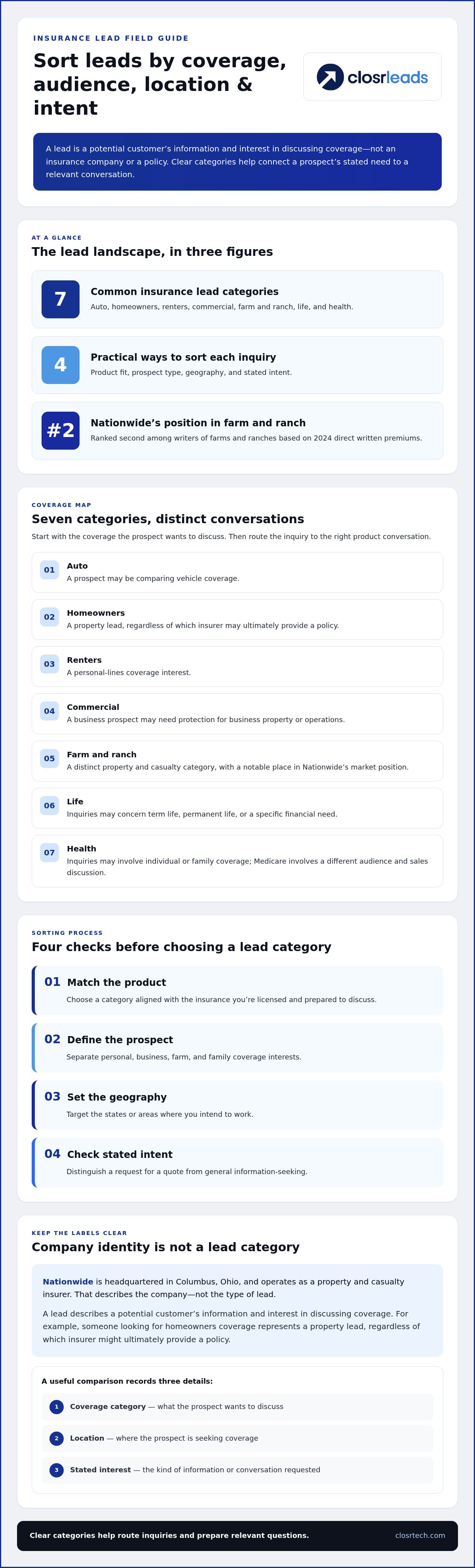
Insurance leads are organized by the coverage a prospect wants to discuss. Common categories include auto, homeowners, renters, commercial, farm and ranch, life, and health insurance. Each category leads to a different sales conversation: an auto prospect may be comparing vehicle coverage, while a small-business owner may need protection for business property. Agents looking for insurance leads nationwide can focus their search by product, prospect location, and stated interest.
Keep the insurer’s identity separate from the lead category. Nationwide is headquartered in Columbus, Ohio, and operates as a property and casualty insurer. That describes the company, not a type of lead. A lead is a potential customer’s information and interest in discussing coverage. Someone looking for homeowners coverage, for example, represents a property lead, regardless of which insurer might ultimately provide a policy.
Property and casualty leads can cover personal or business needs. Personal lines commonly include auto, homeowners, and renters coverage. Commercial prospects may be exploring coverage for a business, its property, or its operations—situations where property owners often rely on claims advocates like Integrity Adjusters & Associates when disaster strikes. Farm and ranch insurance is another distinct category. Nationwide ranked second among writers of farms and ranches based on 2024 direct written premiums, a fact that illustrates this specialty’s presence in the broader insurance market.
Life insurance leads can also be grouped by the coverage under consideration. A prospect may be exploring term life, permanent life, or coverage for a specific financial need. Health-related inquiries may concern individual or family coverage, while Medicare inquiries involve a different audience and sales discussion. These labels help agents sort inquiries before outreach, but they do not establish eligibility or determine whether a policy is suitable.
Use a practical sorting process before choosing a lead category:
- Match the product: Choose a category aligned with the insurance you’re licensed and prepared to discuss.
- Define the prospect: Separate personal, business, farm, and family coverage interests.
- Set the geography: Target the states or areas where you intend to work.
- Check the stated intent: Distinguish a request for a quote from general information-seeking.
These distinctions matter because a broad label can conceal very different needs. A commercial property inquiry is not the same conversation as a household auto inquiry. Likewise, a life insurance prospect exploring long-term coverage may need different follow-up from someone focused on temporary protection. Clear categories help agents route inquiries, prepare relevant questions, and prioritize outreach without treating every prospect alike.
For a useful comparison, record each lead’s coverage category, location, and stated interest. Then compare those details with your product focus and sales process. This turns a broad stream of insurance prospects into a more organized pipeline. The right category connects the prospect’s stated need with a coverage discussion you can handle.
Which companies sell nationwide insurance leads?
Insurance leads come from several types of sellers, not just insurance carriers. Independent lead-generation companies collect consumer inquiries and make them available to agents. Lead marketplaces aggregate offers from multiple sources, while publishers and media companies may generate inquiries through comparison pages, quote forms, or educational content. Each model affects how an agent should assess a lead’s origin and intended use.
A direct-generation vendor collects inquiries through its own advertising or forms. An aggregator may distribute leads collected by outside publishers. The distinction matters: when a consumer submits a request on a comparison page, the form’s wording and disclosures help explain what contact the consumer expected. Find out which source produced the inquiry and whether the seller collected it directly or acts as an intermediary.
Some sellers focus on one insurance line; others cover several categories, such as life, auto, home, or commercial insurance. A specialist may offer targeting fields tailored to one product, while a broader marketplace may make it easier to compare categories in one place. An agent focused on life coverage, for example, should look for clear product-intent details, not just a general request for insurance information.
A seller’s nationwide availability does not necessarily mean it offers leads in every state or for every product. Geographic reach can depend on acquisition sources, targeting options, and the agent’s intended market. Before buying, identify the states you serve and the product category you want. Then compare those needs with the seller’s actual filters and delivery options.
Use this short evaluation sequence when comparing sellers:
- Identify the source: Find out whether the company collects inquiries directly or resells leads from publishers.
- Review the form: Examine what a consumer sees before submitting information and what contact they request.
- Match the audience: Compare the lead’s product interest and location with your sales focus.
- Clarify distribution: Determine whether leads are exclusive or shared, and how quickly they are delivered.
- Check the data fields: Confirm that records include useful details for routing and follow-up.
These checks separate a recognizable brand from a transparent lead source. A company name alone doesn’t explain how a prospect entered the pipeline. The source, form, targeting, and distribution model give agents more useful context. For a practical starting point, compare insurance lead options against your product focus and target states.
Nationwide ranks second among companies based in Central Ohio. Fortune ranks U.S.-based companies using annual revenue for their respective fiscal years. For insurance companies, its revenue calculation includes premium and annuity income, investment income, and capital gains or losses. This corporate ranking and its revenue basis help distinguish company scale from lead availability. The ranking does not show whether a company generates or resells inquiries, or offers leads across the states and insurance categories an agent needs. To assess a provider, examine its source, product focus, geographic coverage, and distribution practices rather than inferring them from its size or ranking.
How do exclusive and shared insurance leads compare?
An exclusive lead is assigned to one agent or agency, while a shared lead may be sent to multiple buyers. That difference shapes the first conversation. With an exclusive inquiry, one agent can respond without competing with other recipients of the same record. With a shared inquiry, several agents may contact the prospect, so prompt, relevant follow-up matters.
Exclusive distribution can suit agents who want control over the initial outreach. An agent handling a mortgage protection inquiry, for example, can tailor the opening to the prospect’s stated interest. With fewer competing calls, the exchange may feel more focused. However, exclusive distribution alone does not prove that a lead is accurate, interested, or a fit for the agent’s products.
Shared distribution can give agents access to prospects without relying on a single agent’s follow-up process. It may fit a team that can respond quickly and manage competition. For instance, several agents receiving the same final expense inquiry could each make contact. The prospect may then hear similar questions from different callers, making clear identification and respectful communication essential.
Neither model guarantees a sale. Results depend on factors such as prospect intent, the information provided, agent availability, and how well the conversation matches the request. A shared lead may work for an agent with a disciplined response process; an exclusive lead may suit an agent who prioritizes a single point of contact.
Compare the models with your own workflow before choosing one. Use a consistent evaluation process rather than relying on the label alone:
- Check distribution terms: Establish whether a record goes to one buyer or multiple buyers.
- Match response capacity: Choose a model your team can handle without delaying follow-up.
- Review prospect context: Look for the requested product and the reason for the inquiry.
- Set a tracking method: Record contact attempts, conversations, and outcomes by lead type.
- Compare performance: Review results for exclusive and shared leads separately.
For a nationwide campaign, compare performance by state and insurance category. Shared auto inquiries, for instance, may perform differently from exclusive life inquiries. Track the product, location, distribution type, and follow-up method together. This helps you identify which model suits your actual sales process instead of assuming one format works equally well everywhere.
Before accepting a lead, understand what “exclusive” or “shared” means in the seller’s terms. Confirm how distribution works, what information comes with each record, and how delivery fits your follow-up routine. These details make the comparison useful. Choose the model that matches prospect access with your capacity to respond and handle the inquiry.
How can agents evaluate insurance lead quality and verify lead sources
Lead quality depends on fit, not just a label such as “fresh” or “verified.” Compare each record with the insurance you sell, the states where you are licensed, and the prospect’s stated interest. A Veteran Insurance inquiry, for example, should identify a relevant coverage interest rather than only a general request for insurance information. A Trucker Insurance inquiry should match the product you intend to discuss.
Next, examine how the lead was generated. Review the form or advertisement that collected the prospect’s details. Note the company or publisher, the product requested, and the contact methods described. If a seller distributes inquiries from partner sources, ask for the original source and how the inquiry moved from submission to delivery. A clear source trail helps you understand the prospect’s expectations.
Phone verification is one useful quality signal, but it has limits. An OTP phone check can help confirm that someone had access to the number during verification. It does not establish insurance eligibility, purchase intent, or consent for every possible contact method. Treat phone validation as one factor in your review, not proof that every detail is accurate.
Use a repeatable intake review for each batch:
- Match the lead: Compare product interest, location, and your target market.
- Inspect the source: Record the originating form, publisher, and seller.
- Review the record: Check that contact details and stated preferences are usable.
- Track distribution: Note whether the record was exclusive or shared.
- Log outcomes: Record attempted contact, reached prospects, and incorrect details.
Use the same CRM fields for every source. Tag each record with its product category, source name, delivery date, and outcome, for example. Consistent records make comparisons meaningful: repeated wrong numbers from one source become visible, while clear product interests can help agents prepare relevant opening questions.
Assess quality against your sales process, not a single successful conversation. Review connection outcomes and prospect fit by source and product category, separating a valid phone number from a useful opportunity. Someone may answer but have requested a different product; another record may fit your market but need later follow-up. These distinctions help agents evaluate value fairly.
Retain the source and consent details associated with each inquiry, and limit outreach to the permissions and channels that apply. Use a Veteran Insurance lead’s stated interest to shape a focused conversation. Route a Trucker Insurance inquiry to an agent prepared to handle that product. Clear records support better decisions at every handoff.
What federal and state laws apply to buying and contacting insurance leads
Insurance lead campaigns can involve federal and state requirements for marketing calls, texts, consent, and consumer information. The requirements to review depend on the contact method, the prospect’s location, and how the inquiry was collected. A phone inquiry and a text campaign can raise different compliance questions. Account for those distinctions before buying or contacting leads.
Start with the lead’s consent record. Review the form, the language shown to the consumer, the submission date, and the contact methods described. For example, a request for an insurance quote should be tied to the form that collected the prospect’s details. A seller’s general claim that a lead is permission-based does not replace records showing what the consumer saw and agreed to.
Next, map the states included in your campaign. State requirements may affect telemarketing, privacy, call recording, and solicitation practices. A campaign reaching residents in multiple states needs a process to identify each prospect’s location and apply the relevant review. Keep state-specific guidance with your scripts and procedures instead of relying on one national template for every contact.
Before launch, use this review sequence:
- Define the outreach: Record whether agents will call, text, email, or use another channel.
- Check consent evidence: Retain the source form and its disclosures for each lead.
- Review suppression steps: Document how the team handles do-not-contact requests.
- Match the location: Route prospects by state and apply the corresponding procedures.
- Train the team: Make sure agents follow approved scripts and record contact outcomes.
Buying a lead does not transfer every compliance responsibility away from the agent or agency. Agents still need to follow their organization’s outreach process and respect a prospect’s request to stop contact. Keep records linking each inquiry to its source, consent details, assigned agent, and contact history. That audit trail supports consistent review when questions arise.
For a multi-state campaign, assign someone to review scripts, lead-source records, and state-specific procedures before launch. Revisit those materials when the campaign changes its channel, product, or target geography. A script prepared for calls may not fit text outreach, and targeting a new state can require another compliance review. Clear ownership makes these checks part of the buying workflow, not an afterthought.
Use these steps to evaluate lead handling before a campaign begins, then preserve records for each inquiry. Strong documentation connects the source, permission, location, and outreach in one trackable process.
ClosrLeads: Final Expense Leads
ClosrLeads offers Final Expense Leads for agents building a focused pipeline in that insurance category. It also offers Veteran Insurance Leads and IUL Leads, giving agents options aligned with different prospect interests. OTP phone-verified leads can support contact validation, while the Built-In Dialer helps agents manage follow-up and deliver leads into their CRM systems.
Consider these offerings when your sales process centers on the listed products and you want lead delivery connected with outreach tools. Keep your targeting, lead-source records, and contact practices aligned with your own compliance procedures. The dialer can help organize execution, but agents remain responsible for how they contact prospects.
To explore lead options for your workflow, visit ClosrLeads online.
Turn Your Lead Strategy Into a Repeatable Process
Make the next step operational: set a clear standard for what makes a lead useful to your team, then apply it consistently across campaigns. A focused strategy for insurance leads nationwide connects each prospect with the right product, agent, and follow-up process. Keep the workflow simple enough for agents to use every day.
Use information from each conversation to improve future decisions. If a prospect’s request does not match the assigned product, record the mismatch. If source details help an agent start a relevant discussion, preserve them in your process. Over time, this gives your team a clearer basis for adjusting targeting and outreach.
Choose lead categories that fit your sales focus, and make source review part of routine campaign management. If you’re ready to explore lead options for your team, contact ClosrLeads about insurance leads. Start with a clear objective, give your agents a workable process, and build from what you learn.
Frequently Asked Questions
What are nationwide insurance leads?
Nationwide insurance leads are prospect inquiries available across multiple states, rather than leads limited to one local market. The phrase describes geographic reach, not an affiliation with Nationwide, the insurer. Agents can assess whether inquiries match their target states and the coverage they handle. An agent focused on life insurance, for example, can prioritize prospects interested in life coverage in markets where the agent is prepared to work.