Blog
Insurance Leads for Fast Closing: A 2026 Buyer’s Guide
Discover how to buy insurance leads for fast closing in 2026. Evaluate freshness, verify phone records, ensure consent, and build an efficient sales workflow.
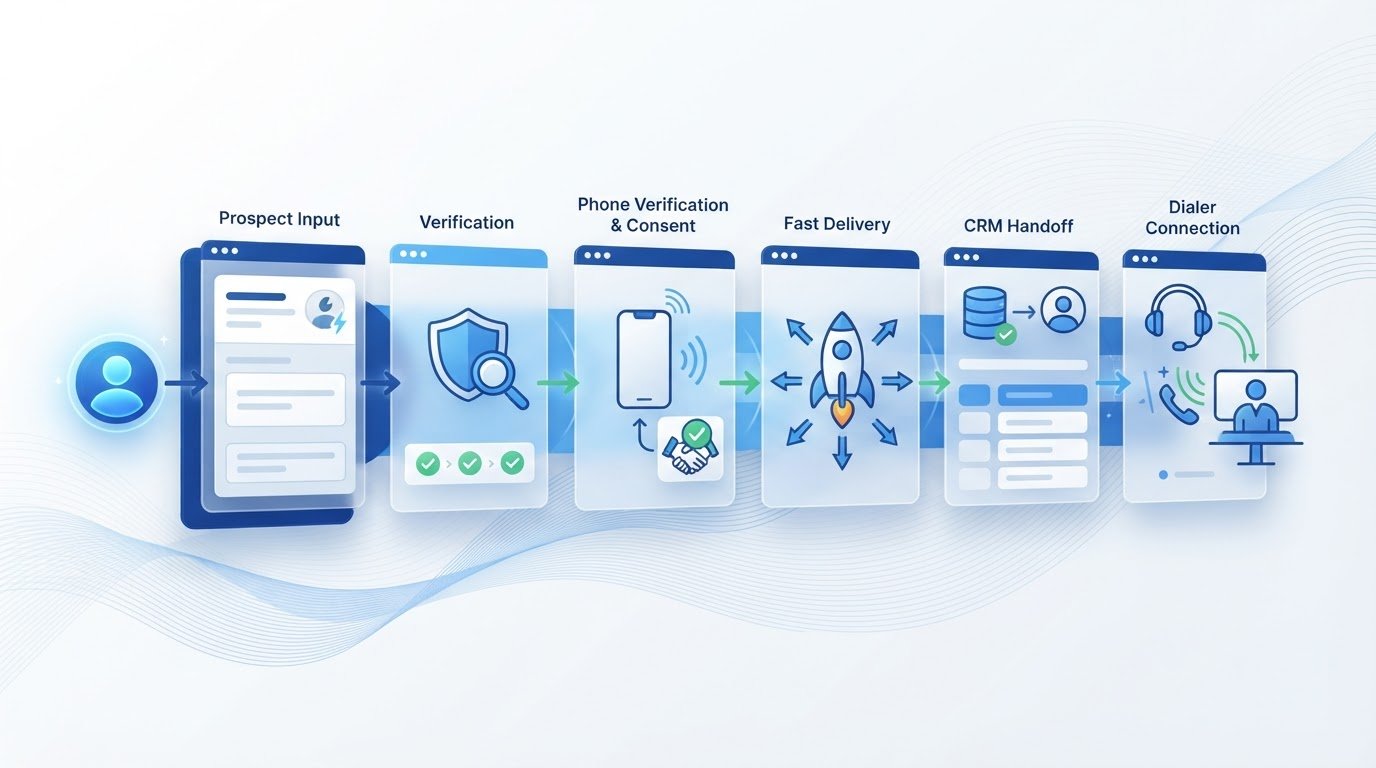
A fast close rarely starts with a clever script. It starts with reaching a real prospect while their interest is active. That’s why insurance leads for fast closing need more than quick delivery: agents should be able to assess freshness, verify contact details, and review the consent records behind each lead before calling.
It’s frustrating to lose calling time to stale records, invalid numbers, or quality claims that are hard to compare. The right lead format can help, but only if it fits your sales process and your team can act on it promptly. A verified phone number supports focused outreach; it doesn’t guarantee a conversation or a sale.
This guide explains what to check before choosing a provider, including lead freshness, phone verification, consent documentation, and delivery options. You’ll compare formats, consider Final Expense, Veteran, Trucker, Mortgage Protection, and IUL leads, and build a practical handoff from delivery to dialing and CRM follow-up. The goal is a repeatable process that removes friction between receiving a lead and making the first call.
Key Takeaways
- Assess whether prospect intent, reachable contact details, and your team’s response process align before prioritizing a lead for outreach.
- Use a consistent checklist to compare insurance leads for fast closing, including freshness, phone verification, consent records, and delivery method.
- Choose between real-time and aged leads based on your niche, licensed products, follow-up capacity, and sales workflow.
- Build a clear handoff that assigns each new lead, reviews its records, logs contact attempts, and sets the next action.
- Score providers on transparency and workflow fit. ClosrLeads offers OTP phone-verified leads, consent records, and a built-in dialer, without promising sales outcomes.
What makes insurance leads better suited to fast closing?
Insurance leads for fast closing combine a prospect’s current interest, reachable contact details, and an agent who can follow up promptly. All three matter. A recent inquiry can lose momentum if it sits untouched. A verified number may still go unanswered. And quick contact is useful only when the agent can have a relevant conversation and qualify the prospect.
That’s the difference between lead delivery and lead readiness. A provider controls how and when a record is delivered. The agent controls staffing, first contact, qualification, and the next step. This is one part of lead generation: turning interest into an opportunity for a sales conversation, not a guaranteed sale.
Imagine a lead arriving while an agent is on another call. Real-time delivery creates an opportunity, but without a clear routing or callback process, the record can still wait. Before choosing a delivery option, decide who receives new leads, who covers when that person is busy, and how quickly your team can review and act on each record.
How does lead freshness affect first contact?
A shorter gap between an inquiry and the first call can help an agent respond while the prospect still remembers why they reached out. The conversation can begin with relevant context rather than a cold introduction. But “real-time” describes the delivery process, not guaranteed availability, immediate contact, or a prospect’s willingness to answer.
Capacity makes the difference. If no agent is free, fast delivery may simply put a lead in a queue. Set a response target your team can consistently meet, then decide who owns new records when the primary caller is busy. A realistic process is more useful than a fast promise nobody can keep.
What does a verified insurance lead actually confirm?
OTP phone verification checks that the supplied number can receive a one-time code during verification. It can help screen out incorrect or unusable numbers. It doesn’t prove the person wants to buy, qualifies for coverage, or will answer when an agent calls. Treat verification as a contact-quality check, not a prediction of conversion.
Consent records are another part of the evaluation. Review what the provider documents and how those records are delivered. Keep them accessible within your established process, and make sure your outreach follows applicable requirements. Verification and documentation support informed follow-up, but agents still need to assess the prospect’s needs and determine whether there’s a fit.
Which insurance lead features should agents evaluate before buying?
Compare more than a provider’s headline claim. A practical buying checklist covers five points: when the lead was generated, what phone verification confirms, which consent records accompany it, whether the insurance vertical fits your business, and how the lead reaches your team. The best match depends on what your agents can handle and how they contact, qualify, and track prospects.
Verification improves confidence in contact data, not certainty about closing. Use that distinction to separate provider capabilities from outcomes your team controls:
| Evaluate | Provider capability to check | Agent-controlled outcome |
|---|---|---|
| Freshness | When the inquiry was generated and when it is delivered | How quickly your team can respond |
| Phone verification | What the check confirms and how it’s linked to the lead | Whether the number is called appropriately and the prospect is qualified |
| Consent records | What documentation is supplied and how it can be accessed | How records are reviewed, retained, and used in your outreach process |
| Vertical and delivery | Whether the lead type and delivery method fit your needs | Whether the right agent receives and works the lead |
How should agents compare real-time and aged leads?
Real-time leads are newly delivered inquiries; aged leads were generated earlier. Compare them against your follow-up capacity, outreach approach, and the context of the original inquiry. A team ready to act as leads arrive may value real-time delivery. A team with a planned process for working older records may prefer aged leads. Don’t assume one format always converts better without comparable evidence for your market and process.
Why check OTP verification and consent records?
Ask the provider what an OTP check confirms, when it occurs, and how the result is associated with each record. Then inspect the consent documentation: what information comes with delivery, and how can your team retrieve it later? Provider compliance claims are useful to evaluate, but they don’t replace your own legal review or outreach practices. The Federal Trade Commission’s guidance on the Telemarketing Sales Rule is one reference for understanding telemarketing obligations.
Does CRM delivery make follow-up faster?
Check whether lead details reach the right user in your existing workflow, with enough information to review and act without avoidable re-entry. Test the handoff, not just the feature description. ClosrLeads offers real-time CRM delivery and a built-in dialer, which may reduce workflow friction for teams that can use those features. Review the lead delivery workflow to see how the setup aligns with your process.
Which lead type fits your insurance niche and sales workflow?
Start with the business you’re equipped to write. Match the vertical to your licensed products, product knowledge, target audience, and follow-up capacity. A lead that arrives quickly is not a strong fit if the assigned agent can’t confidently discuss the coverage or handle the inquiry.
Timing matters, too, but real-time and aged leads serve different workflows. Newly delivered inquiries may suit a team ready to respond as they arrive. Previously generated prospects may fit a process built around scheduled, persistent outreach. Compare the lead’s age and context with your available calling time. Don’t choose a format based on speed alone or assume one consistently performs better across every niche.
| Vertical | Best-fit agent situation | Questions to ask the provider |
|---|---|---|
| Final Expense | The agent focuses on this product and can guide prospects through relevant coverage conversations. | How recent is the inquiry, and what details are included? |
| Veteran | The agent has experience serving this audience and can establish relevant context in the conversation. | How is the lead categorized, and what prompted the inquiry? |
| Mortgage Protection | The agent’s product expertise and outreach process align with prospects exploring mortgage-related protection. | What information is provided about the prospect’s request? |
| IUL | The agent is prepared to explain the product and qualify whether it fits the prospect’s needs. | What does the lead indicate about the prospect’s interest? |
| Trucker | The agent understands the audience and can handle the specific insurance conversation involved. | How is this audience identified, and what context comes with the lead? |
When might Final Expense, Veteran, or Mortgage Protection leads fit?
These are distinct verticals, not interchangeable audiences or products. Choose Final Expense when it matches your focus and expertise; consult a dedicated Final Expense leads guide for deeper niche considerations. Veteran leads call for an agent who can speak knowledgeably with that audience. If Mortgage Protection is your focus, use a mortgage protection leads guide to explore how that vertical fits your practice.
How should agents assess IUL and Trucker leads?
For IUL leads, consider whether you’re equipped to explain the product clearly and determine whether it’s relevant to the prospect. For Trucker leads, assess your familiarity with the audience and the questions likely to shape the conversation. In both cases, product knowledge and a workable follow-up plan matter more than the perception that a particular niche moves faster. For any vertical, ask how OTP phone verification is handled and what information accompanies the lead.
Use this fit test to narrow down insurance leads for fast closing: can the right agent recognize the inquiry, respond through the team’s normal process, and have a relevant conversation? If not, reassess the vertical or delivery format before buying.
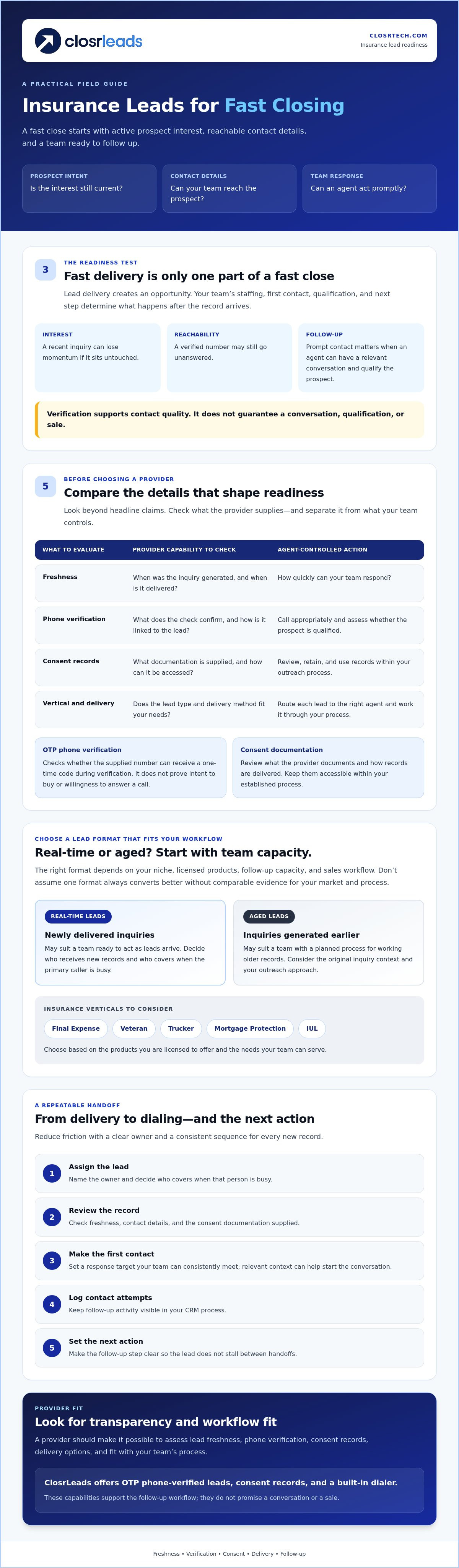
How can agents turn delivered insurance leads into prompt follow-up?
Better leads can’t compensate for delayed or inconsistent outreach. A usable follow-up system gives every new record an owner, a clear first action, and a documented next step. Set an internal response target your staffing can meet, and align contact practices with applicable requirements. The target should create a reliable handoff, not pressure agents to call before reviewing the available information.
What should happen immediately after lead delivery?
Use the same sequence each time: receive the lead, assign it to a responsible agent, confirm the relevant details are accessible, and review the available consent information before contact. Follow established outreach procedures. Then log the attempt and outcome in the CRM, including whether the prospect answered, requested a later call, or needs another appropriate next step.
Close the loop. An unassigned record or undocumented attempt is easy to overlook, especially when several agents share incoming leads.
How can teams measure whether their lead process is working?
Track delivery-to-first-attempt time, contact outcomes, appointments, and final disposition by lead type. Review these measures over a consistent period before changing providers or buying patterns. Otherwise, a short-term fluctuation can prompt a decision without enough context.
Separate inputs from outcomes. Lead age, verification status, and delivery are provider-side indicators. Response time and documented activity reflect your team’s process. Contact and sales outcomes depend on multiple factors, so don’t treat any single metric as proof that a provider or agent is solely responsible.
How does ClosrLeads fit into a faster workflow?
ClosrLeads provides OTP phone-verified leads with TCPA-compliant consent records, plus a built-in dialer and real-time CRM delivery. These features can support a more direct handoff from receipt to calling and documentation, but agents still need to review records, follow applicable requirements, and manage qualification. ClosrLeads also offers a replacement guarantee for invalid contacts; review the current terms and scope before purchasing.
The ClosrLeads lead options include features that may fit teams looking to streamline delivery and follow-up. A repeatable workflow makes insurance leads for fast closing actionable: assign, review, contact, document, and set the next step.
How to choose an insurance lead provider for faster closing
Choose a provider by testing how well its offer fits your sales process, not by relying on a promise of speed or conversion. A clear scorecard makes comparison easier and highlights details to confirm before you buy:
- Vertical fit: Does the provider offer leads that match the insurance products you’re equipped to discuss?
- Freshness: Can it explain when inquiries are generated and how quickly each lead is delivered?
- Verification: What does phone verification confirm, and is that status identifiable on the lead?
- Consent records: What documentation is supplied, and how can your team access it?
- Delivery and support terms: Does the handoff fit your CRM and calling workflow, and are replacement terms clear?
Score each item against your actual capacity. A real-time option may be less useful if your team can’t receive and route incoming records promptly. An aged option may suit a planned outreach process, provided the lead’s age and context are clear. Strong provider features can reduce friction, but they can’t guarantee faster sales.
What questions should agents ask a lead provider?
Ask how leads are generated, delivered, and matched to the selected insurance vertical. Clarify what phone verification checks and what consent records accompany each delivery. Ask how invalid-contact replacements are handled, including the policy’s scope and any conditions. Finally, confirm whether lead details reach the right agent and whether the dialer and CRM handoff fit your current contact process.
When is ClosrLeads a practical option to evaluate?
ClosrLeads offers real-time and aged leads across Final Expense, Veteran, Trucker, Mortgage Protection, and IUL verticals. Its leads are OTP phone-verified and include TCPA-compliant consent records. The platform also supports real-time CRM delivery and includes a built-in dialer. Consider real-time delivery only if your team can act on it, and assess aged leads against your planned follow-up workflow.
ClosrLeads offers a replacement guarantee for invalid contacts. Review the current terms and scope, along with the availability of your chosen vertical and delivery option, before purchasing. These features can support a more organized process, but they don’t assure contact or a sale. Use your scorecard to decide whether the offer fits your team’s needs.
Compare the details against your workflow through ClosrLeads lead options, and confirm current availability and terms before you buy. The best insurance leads for fast closing are the ones your team can qualify, contact, and follow up with consistently.
Build a Lead Process Your Team Can Act On
Insurance leads for fast closing depend on the fit between the prospect’s inquiry, reliable contact details, the right insurance niche, and timely agent follow-up. Before buying, compare lead freshness, verification, consent records, and delivery against your team’s actual capacity. Then put every new record into a clear process: assign it, review it, contact the prospect, and document the next step.
ClosrLeads offers OTP phone-verified leads with TCPA-compliant consent records, plus a built-in dialer and real-time CRM delivery. These features can support a more direct handoff, but they don’t guarantee a conversation or a sale. Its replacement guarantee covers invalid contacts; confirm the current scope and terms before purchasing.
Ready to compare options with your workflow in mind? Explore ClosrLeads insurance lead options and confirm current vertical availability and delivery details. Choose carefully, follow up consistently, and give your team a stronger foundation for productive conversations.
Frequently Asked Questions
What are the best insurance leads for fast closing?
The best insurance leads for fast closing fit your niche, include reachable contact details, and arrive through a process your team can act on promptly. Match the vertical to your expertise and the products you’re prepared to discuss. Then compare lead freshness, phone verification, consent records, and delivery. No format guarantees a conversation or sale, so staffing and follow-up matter as much as provider features.
Do real-time insurance leads close faster than aged leads?
Not in every situation. Real-time leads are newly delivered inquiries, while aged leads were generated earlier. Real-time delivery may suit agents ready to respond as leads arrive; aged leads may fit a planned outreach workflow. Compare the inquiry context, your team’s availability, and your contact process. Don’t assume one format always converts better. Review comparable results from your own operation before changing your buying mix.
How quickly should agents call a new insurance lead?
Call as promptly as your staffing and applicable contact requirements allow, while following your established procedures. Set an internal response target your team can meet consistently, then route incoming leads to a named agent or backup when the first caller is busy. Record the delivery time and first attempt in your CRM. This helps you identify delays in routing, review, or calling and improve the handoff.
Are OTP-verified insurance leads worth buying?
They can be worth evaluating if invalid phone numbers are consuming your team’s calling time. OTP verification checks the supplied number through a one-time code process, which can increase confidence in the contact detail. It doesn’t confirm purchase intent, product eligibility, or whether the prospect will answer. Ask the provider how verification is performed and associated with each record, then compare lead quality with your own outreach results.
What does TCPA-compliant mean for insurance leads?
It indicates that a provider represents its lead collection or documentation process as aligned with applicable Telephone Consumer Protection Act requirements. Ask what consent records come with each lead, how you can access them, and what they specifically document. A provider’s compliance claim isn’t a blanket assurance that every contact method or agent practice is appropriate. Review the records and ensure your own outreach procedures meet applicable requirements.
Can a built-in dialer help insurance agents close more leads?
A built-in dialer can reduce manual steps between receiving a lead and making a call, especially when it works with lead delivery and CRM documentation. That can help a team follow its process with fewer handoffs. It can’t make a prospect answer or guarantee a sale. Check that the calling workflow suits your team, makes lead details accessible, and supports accurate records of attempts and next actions.
What should I do if an insurance lead has an invalid phone number?
Document the issue in your CRM and follow your provider’s process for reporting an invalid contact. Don’t keep dialing a number you’ve confirmed is incorrect. Ask what evidence is needed and whether the lead qualifies for replacement under the provider’s current terms. ClosrLeads offers a replacement guarantee for invalid contacts; confirm the policy’s scope and conditions before relying on it.