Blog
Insurance Leads: Compare Real-Time and Aged Leads by Sales Stage
Compare real-time and aged final expense leads. See how insurance leads with guaranteed contacts fit your process and improve follow-up by sales stage.

The freshest lead isn’t automatically the best final expense lead. Real-time leads suit agents who can follow up promptly; aged leads can fit a steady process built around repeated outreach. Insurance leads with guaranteed contacts may include a remedy for invalid contact details, but that does not mean every prospect will answer or buy.
Fresh intent and quick follow-up can matter, but the right source also depends on where your sales process is strongest: making first contact, delivering a clear presentation, or following up consistently. Lead age is one factor; what happens after a lead arrives matters just as much.
This comparison explains how real-time and aged leads can support final expense sales, and what to consider when assessing contact, presentations, and applications. Use the practical trade-offs to match lead timing to your follow-up capacity and sales process.
Key Takeaways
- Match lead type to your sales strength: real-time leads reward fast response, while aged leads call for disciplined follow-up.
- Track contact, presentation, and closing as separate stages to identify where your final expense process needs attention.
- Compare shared and exclusive leads by competition and follow-up capacity, not just by the label attached to the lead.
- Treat verified contact details as a starting point, then build a consistent outreach process to move prospects toward a conversation.
Exclusive, shared, aged, and inbound insurance leads
Lead distribution affects competition and follow-up. An exclusive lead is sold to one agent; shared leads typically reach three to five buyers, while semi-exclusive leads usually go to two or three. “Exclusive” describes how the lead is sold, not the consumer’s entire shopping history. A prospect may have contacted other agents before the record reaches you.
Aged leads are typically at least 30 days old and can be 90 days or older. Inbound leads begin with a consumer calling or requesting contact. “Double-verified” has no value unless the contract explains both checks and what records document them. A verified phone number can support calling, but it doesn’t prove exclusive intent or a future sale.
| Lead type | Competition | Timing or intent |
|---|---|---|
| Exclusive | One agent | Generated for one buyer |
| Shared | Typically three to five buyers | Multiple agents may call |
| Semi-exclusive | Typically two or three agents | Limited sharing |
| Aged | Depends on sale terms | Typically 30 days old or more |
| Inbound | Depends on arrangement | Consumer initiates contact |
Choose based on your calling speed, follow-up capacity, and preferred competition level. An inbound-call example uses a 25% close rate, but that figure isn’t a promise for every agent or campaign. For agencies interested in generating their own inbound opportunities rather than relying solely on third-party lists, digital marketing specialists like Social: Managed can help drive direct web traffic and inquiries.
Before buying, read contract terms for lead age, exclusivity, distribution, consent records, invalid-contact definitions, and the claim deadline. For covered autodialed or prerecorded calls, the FCC’s one-to-one consent rule took effect in January 2025 and requires prior express written consent identifying one specific caller at a time.
ClosrLeads offers a replacement guarantee for invalid contacts, including disconnected, wrong-number, or otherwise invalid contacts, in line with its policy. Review the policy to understand the claim process.
Validated contact details don’t guarantee a response or a sale. ClosrLeads leads are OTP phone-verified and captured with TCPA-compliant consent, with consent records documented for each lead. Follow applicable calling rules and keep your outreach records organized.
Insurance agents can compare real-time and aged leads based on delivery timing, lead age, contact validation, and consent records. The right choice depends on your sales process and capacity to follow up.
Contact, presentation, and closing rates
A lead moves through distinct stages: contact, presentation, and sale. Track each separately in your agency pipeline. Phone verification supports the first step, but it does not show whether a prospect will answer, hear a presentation, or apply.
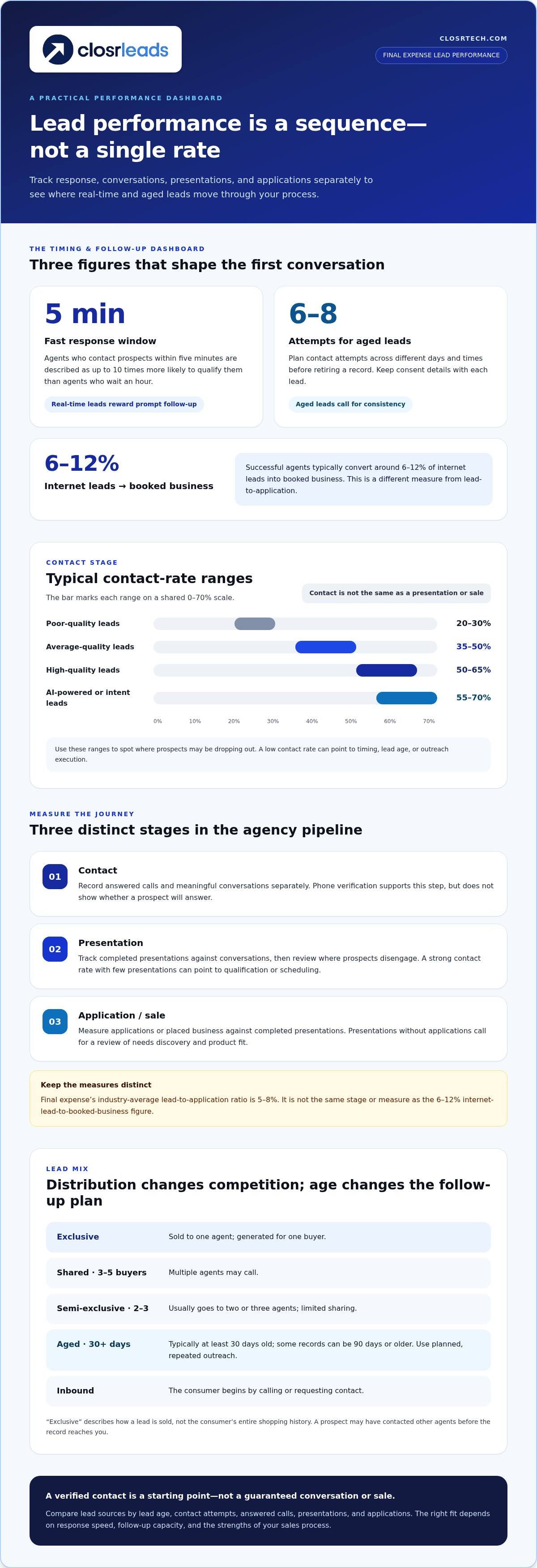
Speed matters most with fresh inquiries. Agents who contact prospects within five minutes are described as up to 10 times more likely to qualify them than agents who wait an hour. For aged leads, use a planned method: make 6-8 contact attempts across different days and times before retiring a record. Keep consent details with each lead.
Compare contact performance by lead quality. Typical contact rates range from 20-30% for poor-quality leads, 35-50% for average leads, and 50-65% for high-quality leads. AI-powered or intent leads are estimated at 55-70%. These ranges help identify whether the pipeline loses prospects before the presentation.
- Contact: Record answered calls and meaningful conversations separately.
- Presentation: Track completed presentations against conversations, then review where prospects disengage.
- Closing: Measure applications or placed business against completed presentations.
For internet leads, successful agents typically convert around 6-12% into booked business. Final expense’s industry average lead-to-application ratio is 5-8%. Those measures describe different stages, so don’t compare them as if they were identical. A low contact rate points to timing, lead age, or outreach execution. A strong contact rate with few presentations points to qualification or scheduling. Presentations without applications call for a review of needs discovery and product fit.
Use a regular scorecard to compare real-time and aged leads by source, contact attempts, answered calls, presentations, and applications. Record how quickly agents make the first call. This gives you a clearer view of how each source moves prospects through your process, rather than simply counting leads.
Real-time versus aged leads
Lead timing affects the first conversation, not just when a record arrives. For final expense agents, the decision depends on response speed, follow-up capacity, and the process used to move prospects forward.
Real-Time Lead Timing
A real-time lead reaches an agent soon after a consumer inquiry. Contacting prospects within five minutes can make agents up to 10 times more likely to qualify them than waiting an hour. That advantage depends on having a calling process ready when leads arrive. Real-time works best when agents can respond promptly, document each attempt, and manage incoming volume without delaying other prospects.
Aged Lead Timing
Aged leads may be 60 days old, while aggregated records can be 90 days or older. They often require more context and consistent follow-up because the original intent may have cooled. Try calling during mid-morning or early afternoon, then track responses by time window. A prospect may still become qualified later: agents can book meaningful business six months or longer after first contact.
Neither real-time nor aged leads guarantees a sale. Real-time leads can support prompt follow-up with current inquiries, while aged leads can help maintain a pipeline for repeated outreach. Compare lead age, contact attempts, presentations, and applications separately. A contact is not the same as a completed presentation or sale.
An agent with limited calling capacity, for example, may choose an aged-lead volume they can work consistently rather than receive inquiries faster than the team can respond. An agent ready to follow up promptly may prefer real-time opportunities. Distribution matters too: when several agents receive the same inquiry, response speed can affect who begins the conversation first.
Compare lead types using the same final expense script and tracking method. Record lead age, time to first call, attempts, and outcomes. Review the results consistently, then direct budget and staff time toward the source that best supports your sales process.
How do guaranteed-contact insurance leads compare with shared and exclusive leads?
These terms describe different things. “Guaranteed contact” generally refers to a policy about contact quality, while “shared” and “exclusive” describe distribution. With insurance leads with guaranteed contacts, read the terms carefully: phone verification or a replacement for an invalid contact does not promise that a prospect will answer, qualify, or buy.
Distribution affects competition. An exclusive lead is sold to one agent; shared leads are typically sold to three to five buyers, and semi-exclusive leads generally reach two or three agents. Even an exclusive lead may concern a consumer who contacted other agents before the record reached you.
- Contact assurance: Check what qualifies as an invalid contact and how replacements or credits work.
- Exclusive: One agent receives the lead through the sale, reducing direct competition among buyers of that record.
- Shared: Several agents may call the same prospect, making quick, organized follow-up important.
Compare outcomes by stage, not by the word “guaranteed.” Track valid numbers, answered calls, presentations, and applications separately. Phone verification can help reduce wasted dialing, but it doesn’t establish buying intent or ensure a conversation. A replacement policy can address an invalid contact, but it can’t recover the time spent trying to reach it.
Before choosing, review how leads are distributed, how contacts are validated, what consent records are provided, and how invalid-contact claims are handled. Then match the lead type to your workflow. If your team can follow up promptly and manage competition, shared leads may fit. If limiting competition between buyers matters more, exclusive distribution may fit. In either case, keep consent and outreach records organized and follow applicable calling rules.
Use a consistent test period and compare each source’s cost per acquisition, not just the number of leads delivered. Check whether a policy covers contact accuracy or sales performance: these are different commitments. Choose an option whose written terms and follow-up demands suit your process.
ClosrLeads: Final Expense Leads
ClosrLeads offers real-time and aged Final Expense Leads, so agents can match lead timing to their follow-up capacity. Leads are OTP phone-verified and captured with TCPA-compliant consent records. The replacement guarantee applies to invalid contacts, not sales outcomes.
For agents managing prompt outreach, the Built-In Dialer delivers leads directly into their CRM for immediate follow-up. ClosrLeads also offers Veteran Insurance Leads and IUL Leads. These options suit agents building a focused insurance pipeline alongside final expense prospects.
Choose based on the stage you want to support: real-time inquiries for prompt follow-up, or aged leads for a structured calling routine. Track contact attempts and outcomes in your CRM to compare how each source performs.
Visit closrtech.com to explore Final Expense Leads.
Make Your Next Lead Decision Deliberate
Turn lead selection into a repeatable operating decision. Before expanding a source, define what counts as a qualified conversation, a completed presentation, and a sale. Use the same definitions across your team. Consistent tracking helps show whether your process or lead mix needs adjustment.
When evaluating insurance leads with guaranteed contacts, treat contact validation as one part of the decision, not the whole scorecard. Match the lead format to your team’s follow-up process and review results against your own sales goals.
ClosrLeads offers Final Expense Leads, Veteran Insurance Leads, and IUL Leads. If those options fit your business focus, contact ClosrLeads to discuss your lead needs.
Build a lead process you can measure, refine, and sustain. Start by choosing a format that fits your follow-up capacity.
Frequently Asked Questions
What’s the best lead source for final expense insurance agents?
The best source is the one that fits your team’s follow-up capacity and sales process. If agents can respond promptly, real-time Final Expense Leads may suit them; if they work from a planned calling schedule, aged leads may be a better fit. Compare results using your own contact and application records. Contact validation supports outreach but does not predict a sale.
Are shared leads worth buying for final expense?
Shared leads may suit agents who can respond promptly and manage competition for the same prospect. Before buying, understand how the leads are distributed, then track whether they result in completed conversations and applications for your team. Compare the results with other sources using the same method. A low lead cost alone doesn’t show whether a source is productive for your agency.
Comparing Sourcing Models: Which Is Right for Your Agency?
Choose a sourcing model that matches lead age and delivery to your operating rhythm. An agency with staff ready to follow up on incoming records may prefer real-time leads; a team with scheduled calling blocks may use aged leads to maintain a steady queue. Assign responsibility for each record, establish how agents log attempts, and review outcomes consistently.
Does any additional information come with each lead?
ClosrLeads documents consent records, including the timestamp, capture method, and originating URL for each lead. These details help agents understand how the prospect’s information was submitted and maintain a record for their workflow. Leads are OTP phone-verified and captured with TCPA-compliant consent. Store lead details and outreach activity together in your CRM so agents can review the record before contacting a prospect.
How does OTP verification work for insurance leads?
OTP means one-time password. During the capture process, the prospect verifies the phone number using a one-time code. ClosrLeads leads are OTP phone-verified and include documented consent captured in a TCPA-compliant process. Verification checks the phone contact; it doesn’t establish that the person is ready to buy. Use the consent details to guide outreach and maintain your contact history.
How often will I receive new leads?
Real-time leads are delivered when generated, while aged leads are available as records for agents to work through. The flow depends on which lead type you select and how you acquire records, rather than a fixed delivery schedule stated here. For example, an agent focused on immediate follow-up can work real-time deliveries; an agent filling planned calling sessions can use aged leads to support that queue.