Blog
Insurance Lead Pricing Models: Compare Options and Choose the Right Fit
Evaluate top insurance lead pricing models to find the right fit for your agency. Compare total operating costs, lead quality, and maximize your sales ROI.

The lowest-cost lead can become the most expensive choice. The right insurance lead pricing models aren’t defined by the headline rate. They depend on whether leads are fresh, reachable, and a fit for your team’s follow-up capacity.
If the differences between per-lead purchases, subscriptions, and other arrangements feel unclear, you’re not alone. A recurring fee may simplify budgeting, while buying leads individually can give you more control over volume. But neither model tells you how often contacts answer, how quickly your team can respond, or how many leads become clients. Those details change the economics.
This guide compares common pricing models and explains what to check before choosing one. You’ll see how freshness, verification, delivery type, and replacement terms affect value, then weigh those factors against your team’s workflow and results. The goal is to compare total operating costs, not just a low price that looks good on paper but strains your follow-up process.
Key Takeaways
- Compare insurance lead pricing models by how you pay, then assess freshness, exclusivity, and verification separately.
- Look beyond the lead price. Track how many leads you reach, convert to appointments, and place as policies.
- Choose an arrangement that fits your insurance vertical, sales capacity, and ability to follow up promptly.
- Ask providers how leads are sourced and distributed, and what consent records and billing terms are included.
- Before buying, confirm replacement eligibility, dispute deadlines, and the documentation you’ll need.
Insurance Lead Pricing Models: What Agents Are Actually Comparing
An insurance lead pricing model is the arrangement that determines how an agent pays for access to prospective insurance customers. It describes the payment basis, such as paying for each delivered lead or paying a recurring fee. It doesn’t, by itself, define what a lead contains or how likely it is to convert.
That distinction matters. Lead generation is the process of attracting and capturing consumer interest. The way a lead is billed is only one part of the purchase. Evaluate it separately from the lead’s format, freshness, distribution, and verification. A low headline price can’t tell you whether a person will answer, fit your market, or be ready to discuss coverage.
What does per-lead pricing mean?
With per-lead pricing, you pay for each lead delivered under the provider’s terms. A record may include contact information and details about the consumer’s stated interest. Depending on the provider and arrangement, it may also include verification or consent documentation. Confirm exactly what’s included before buying.
Qualification standards, exclusivity, and replacement terms vary. A purchased lead isn’t a promise of contact, an appointment, or a sale. Ask how the provider defines an invalid contact, what documentation supports a dispute, and whether a replacement is available under the stated terms.
How is pricing different from lead type?
Real-time and aged describe freshness or delivery timing, not the payment model. Real-time leads are delivered close to the time of inquiry; aged leads were collected earlier. Either may be billed per lead, depending on the provider’s arrangement. Freshness can affect your follow-up workflow, but it doesn’t guarantee a response or conversion.
Shared and exclusive describe distribution. A shared lead may be sent to more than one buyer, while an exclusive lead is sold under a provider-defined exclusivity arrangement. Don’t rely on the label alone. Ask who receives the lead, how long exclusivity applies, and whether the terms are in writing.
These distinctions apply across product categories. Final Expense and Mortgage Protection identify the consumer’s interest or insurance vertical, not a specific billing structure. A provider may offer different freshness or distribution options within a vertical, so compare the actual terms rather than assuming every lead in that category works the same way.
Keep the comparison clear: first identify how you pay, then assess what you receive and how your team will work it. This helps you compare insurance lead pricing models without confusing a delivery feature with a promise of value.
How Insurance Lead Pricing Models Work Across Common Options
Once you separate payment structure from lead format, compare what you’re paying for and what your team must do next. Per-lead purchasing, recurring access, and live-transfer arrangements work differently. Subscriptions and transfers are market options, not confirmed offerings from every provider, so verify availability and terms directly.
Per-lead, recurring, and transfer-based arrangements
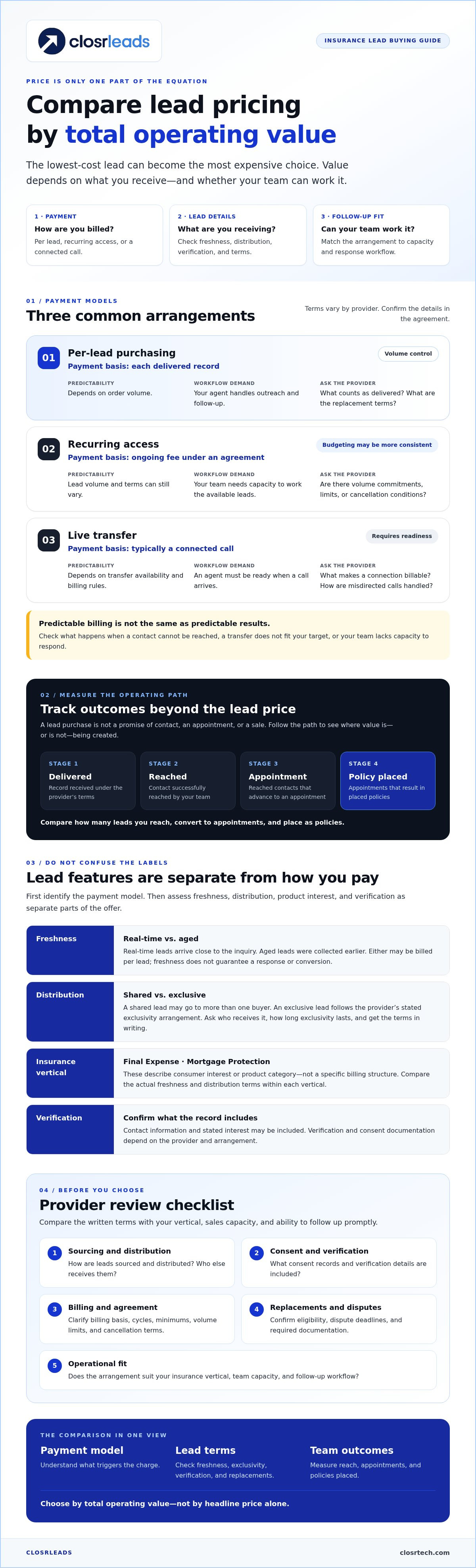
With per-lead purchasing, billing is tied to each record delivered. A recurring arrangement may charge for ongoing access over an agreed period, while transfer-based pricing may bill for a call connected to an agent. Details vary by provider. Minimum volumes, billing cycles, cancellation terms, routing, and included services should be stated in the agreement.
Use this comparison to guide vendor questions:
| Arrangement | Payment basis | Predictability | Workflow demand | Ask the provider |
|---|---|---|---|---|
| Per lead | Each delivered record | Depends on order volume | Agent handles outreach and follow-up | What counts as delivered, and what are the replacement terms? |
| Recurring access | Ongoing fee under an agreement | May make budgeting more consistent; lead volume and terms can vary | Team needs capacity to work the available leads | Are there volume commitments, limits, or cancellation conditions? |
| Live transfer | Typically tied to a connected call | Depends on transfer availability and billing rules | Agent must be ready to engage when a call arrives | What qualifies as a billable connection, and how are misdirected calls handled? |
Predictable billing isn’t the same as predictable results. Compare the agreement’s billing basis with what happens when a contact can’t be reached, a transfer doesn’t fit your target, or your team lacks capacity to respond.
Real-time and aged leads are delivery choices
Real-time delivery can shorten the gap between a consumer’s inquiry and your first outreach. That potential speed advantage only helps if your team is ready to respond; it doesn’t guarantee contact or conversion. Aged leads were generated earlier. Ask when they were collected, whether they’ve been distributed before, and what history or verification accompanies them.
Verification is another separate factor. Review the related guide on OTP-verified insurance leads and ask what the provider’s process documents. A state insurance regulator’s page explains the definition of agents and brokers. Use it as a state-specific reference when considering the legal responsibilities of insurance agents, not as a substitute for advice about your own obligations.
ClosrLeads offers real-time and aged leads, OTP phone verification, CRM routing, and a built-in dialer. To review relevant insurance lead options, compare current availability and terms with your team’s follow-up capacity.
Compare Insurance Lead Pricing by Total Operating Value
To compare insurance lead pricing models, look beyond the invoice. Contactability, freshness, fit, and distribution affect the work required to reach a prospect. Replacement terms and your team’s follow-up capacity matter too. Use your own funnel data rather than an assumed industry conversion rate.
Which costs and terms change the comparison?
Map every cost and operational demand tied to the purchase. Include lead spend, agent time, dialing capacity, CRM workflow, and follow-up effort. Check whether taxes, software access, delivery, or other services are billed separately. A built-in dialer or CRM routing may affect how leads are handled, but neither replaces a consistent follow-up process.
Read replacement policies closely. Ask what qualifies as an invalid contact, what evidence is required, how to submit a dispute, and whether deadlines apply. Don’t assume two providers offer the same protection just because both mention replacements. Compare the written terms and supporting documentation.
How should agents assess lead quality?
Use a consistent funnel for each source or campaign:
- Leads purchased: Count records or calls billed under the agreement.
- Contacts reached: Track how many prospects your team actually connects with.
- Appointments held: Record completed appointments, not just scheduled ones.
- Policies placed: Count resulting sales using a consistent attribution period.
Cost per placed policy equals total lead acquisition and attributable operating costs for a defined period or cohort, divided by the number of policies placed from that same group, using the agency’s recorded billing, labor, software, and sales data. Keep the inputs consistent. If you use an example in your analysis, label it as agency-specific and verify every figure against actual records.
Break results down by source, vertical, freshness, and delivery format. A combined average can hide where contacts are harder to reach or follow-up takes more effort. Review the provider’s verification details and available consent records before launch, then measure outcomes against your own criteria. For aged leads, account for the time since inquiry and the follow-up process they require.
Choose an Insurance Lead Pricing Model That Fits Your Agency
Start with your operation, not a vendor’s headline price. Use this decision process to match your acquisition arrangement to the work your team can handle.
- Start with your vertical, sales capacity, and follow-up speed. Identify the insurance line you’re targeting, such as Final Expense, IUL, or Mortgage Protection. Estimate how many new prospects agents can contact promptly and consistently. Match lead freshness to that response capacity rather than assuming faster delivery will improve results on its own.
- Check the workflow behind the purchase. Confirm that your CRM can receive and assign leads correctly. Review staffing, dialing capacity, and who owns each follow-up. A built-in dialer or CRM routing can support lead handling, but your team still needs a clear process for making contact and recording outcomes.
- Choose your preferred level of purchasing predictability. Per-lead buying can suit agencies that want to manage individual purchases and tolerate variation in volume. A recurring arrangement may fit teams seeking more consistent budgeting, but actual volume and billing terms depend on the agreement. Choose an arrangement your team can work without creating a backlog.
- Set a limited, measurable pilot. Before purchase, define the test period and volume, assign a review owner, and confirm billing and replacement terms. Record the lead source, vertical, freshness, delivery format, agent assignment, and follow-up activity so you can interpret the results.
- Review the funnel before expanding. Track contacts reached, appointments held, applications, and placed policies where applicable. Compare like with like, and account for differences in agent experience and follow-up consistency. Expand only when results meet your agency’s criteria and the team can sustain the workload.
Set a fair pilot and review criteria
Keep the evaluation focused. If you test different sources or delivery formats, separate the results instead of blending them into one average. Note missed follow-ups, routing issues, or staffing changes that could affect outcomes. This helps distinguish a lead-source issue from a workflow gap. Decide in advance what evidence would justify continuing, adjusting, or stopping the arrangement.
Use the same discipline to assess insurance lead pricing models over time. A model that fits one vertical or team may not fit another as capacity and follow-up processes change.
If your evaluation points toward a specific vertical, review Final Expense, Veteran, IUL, Trucker, and Mortgage Protection leads, and confirm current availability and terms before deciding whether they fit your pilot.
Evaluate Insurance Lead Providers and Put the Model to Work
A pricing model only works if the provider’s terms and your team’s workflow line up. Get clear answers in writing before committing. Use this checklist to compare providers beyond billing:
- Lead source: How is interest generated, and what information accompanies each record?
- Freshness and delivery: When was the lead created, and how quickly is it delivered?
- Distribution: Is the lead shared or exclusive? What does that label mean, and for how long?
- Verification and consent: What verification is performed? What consent records are available, and how can you review them?
- Billing: What triggers a charge? Are delivery, software access, or other services billed separately?
- Replacement terms: Which invalid contacts qualify, what documentation is required, and what is the dispute deadline?
Questions to ask before buying insurance leads
Ask the provider to explain how leads are generated, verified, delivered, and distributed among buyers. Don’t treat “verified” or “exclusive” as self-explanatory. Request definitions and supporting documentation. Confirm the replacement process before purchase, including how to submit a claim, what evidence is needed, and when a dispute must be filed. Review consent records and current compliance documentation with the provider, and confirm that the terms fit your intended use.
How ClosrLeads fits a per-lead acquisition workflow
ClosrLeads offers real-time and aged leads across Final Expense, Veteran, Trucker, Mortgage Protection, and IUL verticals. Leads are OTP phone-verified and include TCPA-compliant consent records. Review the current documentation and confirm which verticals and delivery options are available under the terms you’re considering.
The replacement guarantee applies to invalid contacts. Confirm the definition, eligibility criteria, documentation, and submission process before buying. Real-time delivery into CRM systems and a built-in dialer can help agents organize and work leads. They don’t guarantee a connection or a sale; follow-up capacity and execution still matter.
Use these checks to evaluate insurance lead pricing models against your agency’s actual process, not just the advertised arrangement. Explore ClosrLeads’ Final Expense, Veteran, Trucker, Mortgage Protection, and IUL leads, and verify current availability and terms before purchase.
Put Your Lead Strategy to Work
The strongest insurance lead pricing models support your agency’s capacity, not just its budget. Compare the full path from purchase to placed policy, and use your own tracking to see which arrangements justify continued investment. Freshness and verification matter, as do the people, systems, and follow-up process behind every lead.
ClosrLeads offers OTP phone verification and TCPA-compliant consent records. Review current documentation and terms before you buy. Its invalid-contact replacement guarantee applies to invalid contacts, so confirm eligibility and the process in advance. Real-time delivery, CRM routing, and a built-in dialer can help organize follow-up, but results still depend on your team’s execution.
Ready to compare lead options for your vertical and workflow? Explore ClosrLeads’ lead options, confirm current availability and terms, and start with a clear evaluation plan. Track what happens after delivery and build on the approach your data supports.
Frequently Asked Questions
What are the main insurance lead pricing models?
The main insurance lead pricing models include paying per delivered lead, paying a recurring fee for access, or paying for a connected call through a transfer arrangement. Per-lead purchasing is a common way to pay for individual records. Subscriptions and transfers are market options, but availability and terms vary by provider. Compare the billing basis separately from freshness, exclusivity, verification, and the work your team must do after delivery.
How does per-lead pricing work for insurance agents?
With per-lead pricing, an agent is charged for each lead delivered under the provider’s terms. The purchase may include contact details and information about the person’s stated interest, but qualification standards and supporting documentation can vary. Before buying, check what counts as a delivered lead, how billing works, and whether invalid contacts qualify for replacement. A delivered record doesn’t guarantee that the prospect will answer, book an appointment, or purchase a policy.
Are aged insurance leads cheaper than real-time leads?
Aged leads often have a lower upfront cost than real-time leads, but pricing varies by provider, vertical, and lead details. Aged means the inquiry was generated earlier; ask how old the record is and whether it has been distributed before. Real-time delivery may help your team respond closer to the inquiry, but it doesn’t guarantee contact or conversion. Compare both using your own contact rates, follow-up effort, and placed-policy results.
What is the difference between shared and exclusive insurance leads?
A shared lead is distributed to multiple buyers, while an exclusive lead is sold under a provider-defined distribution arrangement. Shared leads may mean more competition for the prospect. “Exclusive” can have different meanings, including limits on who receives the record or how long the limit applies. Ask the provider to define the term in writing, identify who else may receive the lead, and explain any time limits or distribution conditions.
How can an insurance agent calculate the return on lead spending?
Track the leads purchased, contacts reached, appointments held, and policies placed for the same group of leads. To calculate cost per placed policy, divide total acquisition and attributable operating costs by the number of resulting policies placed. To assess return, compare revenue attributable to those policies with the same total costs. Use actual agency data, a consistent tracking period, and clear lead-source attribution. Don’t treat an unverified example or industry benchmark as your expected result.
Does OTP verification guarantee that an insurance lead will convert?
No. OTP phone verification indicates that a phone number passed a one-time passcode verification process, but it doesn’t prove the person is ready to buy, will answer later, or will qualify for coverage. It also doesn’t guarantee an appointment or sale. Treat verification as one quality signal. Review the provider’s process and supporting records, then measure contact and conversion outcomes using your own campaign data.
What should agents check in an insurance lead replacement guarantee?
Confirm exactly what qualifies for replacement, such as an invalid contact, and what issues are excluded. Check the claim deadline, submission steps, required evidence, and whether the remedy is a replacement or another form of credit. Get the terms in writing before purchase. For ClosrLeads, the replacement guarantee applies to invalid contacts; confirm current eligibility rules and the process directly rather than assuming every unreachable or unresponsive lead qualifies.