Blog
Insurance Lead CPA Formula: Calculate CPA in 2026
Master the cost per acquisition insurance leads formula to accurately track campaign spend, measure real policy ROI, and scale profitable marketing in 2026.

The cheapest insurance lead can become the most expensive policy you acquire. A low lead price doesn’t tell you whether a campaign is profitable. The cost per acquisition insurance leads formula only gives you a useful answer when campaign spend and closed policies come from the same cohort, measured with consistent rules. Otherwise, pending applications, uneven follow-up, and mismatched attribution can skew the result.
That’s the real challenge. Different lead sources and sales processes can make a simple comparison misleading. You need to know not just what you paid for leads, but how many policies those leads actually produced and what it took to close them.
This guide shows you how to calculate insurance lead CPA with consistent campaign data. You’ll learn how to compare real-time and aged leads fairly, account for pending applications, and pinpoint whether lead costs, follow-up, or conversion is affecting performance. The goal is a clearer view of acquisition, so you can make decisions based on closed-policy results, not lead cost alone.
Key Takeaways
- Use the cost per acquisition insurance leads formula to divide eligible campaign spend by policies acquired from the same cohort.
- Separate cost per lead from cost per acquisition: one tracks prospect cost, the other measures the cost of winning a policy.
- Compare real-time and aged leads using consistent verticals, follow-up windows, cost boundaries, and policy outcomes.
- Review funnel-stage results to pinpoint whether lead costs, contact rates, applications, or closing performance are affecting CPA.
- Measure lead sources with the same rules. ClosrLeads leads are OTP phone-verified and include TCPA-compliant consent records, with a replacement guarantee for invalid contacts.
What Does Cost Per Acquisition Mean for Insurance Leads?
Cost per acquisition (CPA) tells you how much campaign spend it took to produce an acquired insurance policy. The denominator matters as much as the spend: count outcomes from the same lead cohort whose costs you’re measuring. If you divide one period’s lead spend by policies from a different group, the result may look precise but won’t give you a fair read on campaign performance.
The Cost Per Action (CPA) concept measures the cost of a defined outcome. For insurance lead analysis, make that outcome explicit. You might use an issued policy, or another consistently tracked sales milestone if your reporting needs to account for policies still in progress.
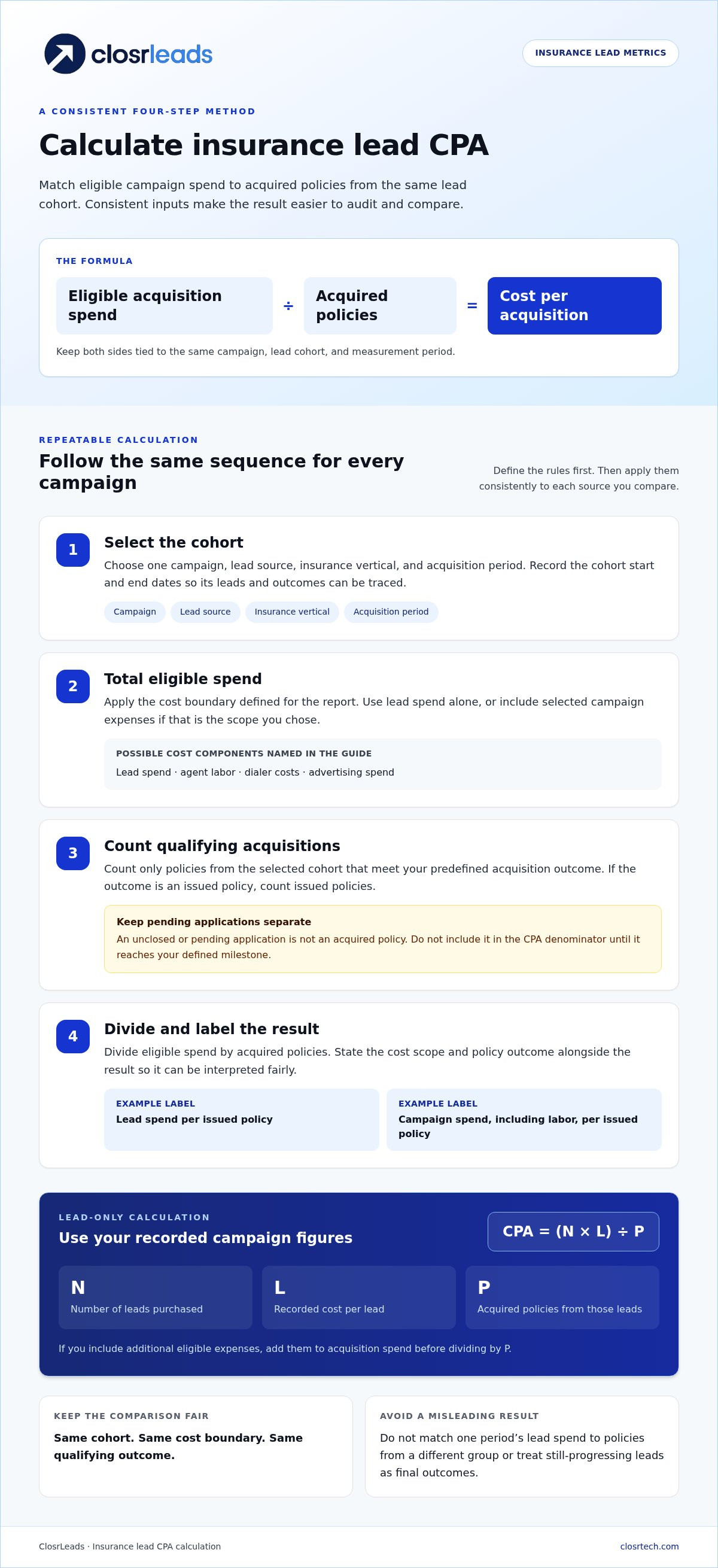
CPA equals eligible acquisition spend divided by the number of acquired policies from the same measurement cohort. That’s the cost per acquisition insurance leads formula in plain language. Define the cohort, cost boundary, and qualifying policy outcome before you compare campaigns.
Cost per lead vs. cost per acquired policy
Cost per lead (CPL) measures the spend required to generate or purchase a prospect. CPA measures the spend required to acquire a customer. They answer different questions. A low CPL can still produce a high CPA if few leads progress through the sales funnel.
Keep the stages distinct: a lead is not an appointment, an appointment is not an application, and an application is not necessarily an acquired policy. Before comparing campaigns, choose the outcome that qualifies as an acquisition. If you use issued policies, count only issued policies. If you use a different milestone, apply the same definition to every campaign.
Which acquisition costs belong in the calculation?
Start with direct lead spend. Then decide whether your CPA will include other campaign expenses, such as agent labor, dialer costs, or advertising spend. These can provide a broader view of acquisition economics, but commissions and general overhead aren’t mandatory CPA components. The right scope depends on the decision you’re making.
For example, a lead-only CPA can help compare lead sources, while a fully loaded CPA can help assess overall campaign economics. Neither is useful if the cost boundary changes from one source to another. Name the scope alongside the result, such as “lead spend per issued policy” or “campaign spend, including labor, per issued policy.”
- Choose one cost boundary: Specify which expenses are included.
- Use one outcome: Define the policy milestone counted as an acquisition.
- Match spend to outcomes: Keep both tied to the same lead cohort and measurement window.
This discipline turns CPA into a comparable operating metric, not just a number in a report. It also helps you investigate whether a campaign’s result changed because of lead cost, follow-up, or conversion through the funnel.
How to Calculate Cost Per Acquisition for Insurance Leads
Keep the calculation simple and the inputs aligned. The formula is:
Eligible acquisition spend ÷ acquired policies = cost per acquisition
For a lead-only calculation, multiply the number of leads purchased by the recorded cost per lead, then divide by the number of qualifying policies acquired. Use the same campaign, lead cohort, and measurement period for both sides of the equation. If leads purchased during one period are still moving through the sales process, don’t compare their spend with policies from a different cohort and treat the result as final.
A repeatable CPA calculation in four steps
Follow the same sequence for each campaign. Consistent inputs make the result easier to audit and compare.
- Select the cohort. Choose one campaign, lead source, insurance vertical, and acquisition period. Record the cohort start and end dates so you can trace its leads and outcomes.
- Total eligible spend. Apply the cost boundary you defined for the report. Include only the expenses that belong in that CPA calculation, such as lead spend alone or lead spend plus selected campaign expenses.
- Count qualifying acquisitions. Count policies that meet your predefined outcome and came from the selected cohort. Keep pending applications separate until they reach that outcome.
- Divide and label. Divide eligible spend by acquired policies. Report the result with its scope, such as “lead spend per issued policy” or “campaign spend, including labor, per issued policy.”
An unclosed or pending application isn’t an acquired policy, so don’t count it in the CPA denominator until it reaches your defined acquisition milestone. This keeps an application that may close later from making current campaign performance look stronger than the completed outcomes support.
Worked example with variables, not assumed market prices
Let N represent the number of leads purchased, L the recorded cost per lead, and P the number of acquired policies from those leads. If the calculation includes lead spend only, then:
CPA = (N × L) ÷ P
For a real campaign, replace each variable with the figures in your records: leads purchased multiplied by their cost per lead, divided by the qualifying policies from that same group. These variables are illustrative, not ClosrLeads pricing. If you include additional eligible expenses, add them to acquisition spend before dividing by P.
If P is zero, the campaign has no acquired policies in the selected cohort yet, so a per-policy CPA can’t be calculated meaningfully. Report the spend and acquisition count, then update the result when the cohort reaches its defined outcome. A built-in dialer can support lead handling, while CRM delivery helps keep leads connected to campaign records. Review your lead-handling workflow alongside the calculation.
How to Compare Insurance Lead Sources Without Distorting CPA
A CPA comparison is only as fair as the conditions behind it. Match each source by insurance vertical, follow-up window, cost boundary, and qualifying policy outcome. If one campaign sells a different product or gets more time to mature, its result isn’t a clean benchmark for the other. Keep the cost per acquisition insurance leads formula consistent, then investigate where performance diverges.
Real-time and aged leads: make the comparison fair
Lead age and delivery timing are cohort attributes, not automatic quality verdicts. Separate real-time leads from aged leads in your reporting, then measure each group over the same follow-up interval. Compare like-for-like verticals and sales processes wherever your data allows. If the workflows differ, note that difference beside the CPA instead of treating the source as the only variable.
Set the follow-up window before reviewing results. A source contacted promptly shouldn’t be compared with one whose leads waited longer for a first attempt. Use a cohort start date and a clear cutoff for outcomes, then update the comparison as cohorts mature. This helps prevent recently delivered leads from being judged against older groups that have had more time to progress.
Verification and follow-up belong in the analysis
Track operational context alongside policy outcomes. Record whether leads were OTP phone-verified, whether TCPA-compliant consent records were provided, and whether an invalid-contact replacement was made. These details help explain what happened within a cohort. They don’t establish that a lead will convert or that every contact attempt is permissible.
Follow the full path from delivery to result. Keep lead delivery, contact attempts, conversations, applications, and acquired policies as distinct stages. Add speed to first attempt and subsequent follow-up activity where available. If one source has fewer conversations, that points to a different issue than strong conversations followed by fewer issued policies. Stage data shows where to investigate, rather than proving the cause.
For verification context, review the criteria and records associated with OTP-verified insurance leads. In your own reports, keep verification fields consistent across sources. If replacements affect the cost calculation, define how they’re handled and apply that rule uniformly. Don’t silently remove a lead or its cost from one cohort while retaining comparable records in another.
Read CPA alongside conversion and revenue
Conversion rate alone can’t tell you which source creates more value. A source may convert a larger share of leads but still have a higher CPA, or produce policies with different business-defined revenue. Compare CPA with the revenue measure your business uses, applying the same attribution rules and outcome window. Keep the denominator clear, and don’t treat an application as a policy simply because it may close later.
- Compare the same vertical and sales process wherever possible.
- Keep source cohorts separate and apply identical follow-up windows.
- Use funnel-stage records to locate where results change.
- Review CPA with a consistently defined revenue measure, not conversion rate alone.
How to Use CPA Data to Improve Insurance Lead Acquisition
A CPA figure is a signal, not a diagnosis. Use it to find where performance shifted, then investigate the funnel before changing spend. The right review cadence depends on campaign volume and how long policies take to reach your defined acquisition outcome. Review often enough to catch operational changes, but don’t treat an immature cohort as a final result.
Diagnose the funnel before changing spend
Break results into lead-to-contact, contact-to-application, and application-to-policy movement. Compare each stage using the same definitions, attribution rules, and measurement windows from one review to the next. If contact movement drops while later-stage performance holds steady, investigate delivery or follow-up first. If applications progress but fewer policies reach the qualifying outcome, examine the later sales stages before blaming lead cost.
Match the review interval to the campaign. Higher-volume campaigns can produce useful operational signals sooner, while lower-volume campaigns may need more time to build a meaningful cohort. Sales-cycle maturity matters too. Mark small or still-developing cohorts as directional, not conclusive. Avoid making a major budget decision from a handful of outcomes.
Change one variable at a time where practical. If you change lead source, follow-up timing, and sales workflow together, a better or worse CPA won’t show which change mattered. State the hypothesis, adjust one factor, and keep cohort definitions stable while you measure what follows.
Build a practical lead-source scorecard
Use a consistent scorecard to connect acquisition spend with activity and outcomes. Include the fields below, then add context that helps explain differences between cohorts.
- Acquisition: Lead source, vertical, lead volume, spend, and calculated CPA.
- Lead context: Lead age, delivery channel, and verification status, including OTP verification where applicable.
- Follow-up: Time to first attempt and subsequent contact activity.
- Funnel outcomes: Contact rate, applications, and acquired policies using your defined outcome.
Read the scorecard from top to bottom. A spend increase with stable stage movement may point to a changed cost input. A drop in contact rate calls for a closer look at contact attempts and timing. Strong application volume with fewer acquired policies directs attention further down the funnel. Treat verification records and invalid-contact replacements as context in the analysis, not as proof of future conversion.
For a deeper look at response timing and workflow, connect your review to a speed-to-lead and dialer strategy. A built-in dialer can help organize lead handling, while consistent records make follow-up activity easier to assess alongside CPA.
Explore ClosrLeads insurance lead options and compare real-time and aged leads using the same measurement rules.
How ClosrLeads Fits a Measurable Insurance Lead Strategy
A useful lead strategy starts with measurement rules, not assumptions. ClosrLeads offers real-time and aged insurance leads that you can track with the same cost per acquisition insurance leads formula: define eligible spend, set the qualifying policy outcome, and attribute acquisitions to the cohort that generated them. The method stays consistent while the lead attributes you’re evaluating change.
Choose lead options around the campaign being measured
ClosrLeads offers leads across Final Expense, Veteran, Trucker, Mortgage Protection, and IUL verticals. Keep each vertical in its own cohort. Then separate real-time and aged leads, along with different delivery approaches, so unlike groups aren’t blended into one misleading CPA. This gives you a clearer view of how each source performs under your campaign’s follow-up process.
Before comparing cohorts, decide what counts as an acquired policy, which costs belong in the calculation, and how long leads will be followed. Apply those rules consistently. ClosrLeads leads are OTP phone-verified and include TCPA-compliant consent records. These records provide operational context, but they don’t establish that every call or contact is legally permissible or guarantee a sale. ClosrLeads provides a replacement guarantee for invalid contacts. Keep replacements visible in your records and apply your cost-accounting rules consistently.
Turn the formula into a clear next step
Organized lead handling helps preserve the connection between a lead and its eventual outcome. ClosrLeads’ built-in dialer supports lead handling, and CRM delivery helps organize campaign records. Use these workflow features to capture delivery, follow-up activity, and policy outcomes in the same reporting system. They can help you measure the process, but they don’t guarantee contact or conversion results.
Before purchasing, write down three decisions: the acquisition outcome you’ll count, the expenses included in eligible spend, and the follow-up window for the cohort. Add the lead vertical, age, and delivery approach to your scorecard. Then calculate CPA only after the cohort has had time to reach its defined outcome. That discipline makes the result more useful for comparing lead options and deciding what to test next.
Use ClosrLeads insurance lead options to compare each cohort against your scorecard, with the same rules for spend, follow-up, and acquired policies.
Make Your Next Lead Decision Measurable
Let your next campaign answer a specific question. Which lead source, follow-up approach, or sales process deserves more investment? Before launching, decide what result would justify continuing, adjusting, or scaling the test. That decision rule keeps a single CPA result from becoming a knee-jerk budget change.
Then give the campaign a clean starting point. Keep its cohort identifiable, record the assumptions behind your measurement, and let the outcome data guide the next move. The cost per acquisition insurance leads formula becomes more valuable over time when each test builds on reliable records and a clear business objective.
ClosrLeads’ real-time and aged insurance leads give you options to evaluate against that framework. Choose the vertical and lead approach that fits your campaign, then measure it using consistent rules. Explore ClosrLeads insurance lead options and put your next acquisition test in motion. Clear measurement gives you a stronger foundation for every decision ahead.
Frequently Asked Questions
Is cost per lead the same as cost per acquisition?
No. Cost per lead measures the spend tied to purchased or generated prospects, while cost per acquisition measures spend against the policies that meet your campaign’s acquisition definition. For example, a report might show both the cost to bring in a lead and the cost to produce an issued policy. Label each metric clearly. Comparing one campaign’s lead cost with another campaign’s policy acquisition cost won’t give you a useful benchmark.
How do you calculate CPA when applications are still pending?
Keep pending applications out of the acquired-policy count until they reach the outcome your report defines. Track them separately as pipeline activity, then update the cohort as decisions arrive. For example, an application awaiting underwriting remains pending rather than being counted as an acquired policy. Use the same maturity window for every source. That way, one campaign doesn’t appear more efficient simply because its unresolved applications are being treated as completed sales.
Should renewals count as acquisitions in insurance lead CPA?
For initial acquisition CPA, count the first qualifying policy acquisition once. Don’t add later renewals to the initial acquisition count, since that changes what the metric represents. Renewals can still inform a separate analysis of longer-term campaign value. If you build a renewal-inclusive measure, give it a distinct name and state the time period and renewal events included. That lets readers distinguish the original acquisition cost from ongoing policy performance.
Can replacement leads change an insurance campaign’s CPA?
Yes, depending on how your accounting rules treat the original contact and its replacement. Record both events separately, including whether the original was classified as invalid and how the replacement was handled. Then apply the same rule across lead sources. Don’t assume every contact issue qualifies for replacement or count a replacement as a policy outcome. The calculation should reflect your actual records and the cost boundary you’ve set.
How often should insurance agents review lead CPA?
Review performance often enough to catch meaningful operational changes, but don’t make a final judgment before the cohort has had time to mature. A practical dashboard can show early indicators, such as contact and application activity, separately from completed-policy CPA. Keep the review window stable from one report to the next. If a cohort has few leads or unresolved outcomes, label its result preliminary and avoid treating it as a reliable benchmark.
Can you compare real-time and aged insurance leads using one CPA formula?
Yes. Apply the cost per acquisition insurance leads formula consistently, but report real-time and aged leads as separate cohorts. Match the insurance vertical, follow-up period, cost scope, and policy outcome as closely as possible. For example, don’t combine recently delivered leads with older leads that have had more time to progress. Compare results after both groups have reached the same measurement window, then investigate differences in delivery and follow-up.
Does a lower insurance lead CPA always mean a more profitable campaign?
No. CPA tells you about acquisition cost, not the campaign’s full financial return. Your business may also evaluate policy value, persistency, operating expenses, and other measures using its own accounting rules. For example, a lower initial CPA may not answer how policies perform over time. Compare CPA with clearly defined business metrics and consistent attribution. A favorable acquisition figure is useful, but it isn’t a guarantee of profitability.