Blog
Insurance Lead Acquisition Strategies for Faster Follow-Up
Explore insurance lead acquisition strategies with helpful content, AI prospecting, CRM tools, and TCPA-compliant follow-up to convert qualified prospects.

Content marketing supports insurance lead generation by answering real coverage questions, building trust, and offering interested prospects a clear next step. Strong insurance lead acquisition strategies combine useful articles and email follow-up with an organized process, so new inquiries receive attention promptly.
More leads don’t automatically mean more business. The difference is often how well your content attracts the right prospects, how quickly your team responds, and whether your outreach follows the rules. The Telephone Consumer Protection Act governs how leads can be generated and how consumers can be contacted, according to the Federal Communications Commission.
Here, you’ll learn how to use educational content, AI-assisted prospecting, and automated follow-up to keep opportunities moving. You’ll also see how to weigh marketing budgets against lead quality, and why TCPA compliance belongs in the acquisition plan from the start. Practical steps, clear priorities, faster follow-through.
Key Takeaways
- Build trust with coverage-focused content, then nurture interested prospects with a planned email and text follow-up sequence.
- Use professional filters and relevant audience signals to shape prospecting around the people your insurance products serve.
- Connect lead capture to CRM routing, reminders, and prompt personal outreach so new inquiries don’t get overlooked.
- Set a budget around your growth goals and lead quality, and make TCPA compliance part of every outreach decision.
1. Why is content marketing important for insurance lead generation?
Useful content attracts people researching coverage and gives them a clear next step. An article explaining how buying a home can affect protection needs, for example, can invite readers to request a quote. That turns search interest into an identifiable inquiry rather than an anonymous visit.
Which channels generate the best insurance leads: SEO, paid search, social media, referrals, or direct mail? The best fit depends on audience intent, geography, and follow-up capacity. SEO and local content build visibility over time; paid search targets active searches, while social media encourages conversation. Referrals can arrive with trust already established, and direct mail offers a tangible message. Compare qualified inquiries and conversions by channel.
How can insurance agents generate leads organically through local SEO and content marketing? Complete a Google Business Profile, add service areas, and create local pages for the coverage offered. Answer specific regional questions in articles, then include a quote request or contact method. Reviews after policy binding and useful coverage pages can strengthen local visibility.
How do insurance lead acquisition strategies differ for auto, home, life, health, and commercial insurance? Match each topic and call to action to the reader’s coverage question. Home content might address a purchase, while commercial content can focus on business needs. For commercial prospects, professional networking and industry-specific content can complement SEO and paid search.
Build an opt-in email newsletter around useful coverage information, not constant promotion. Send it monthly to maintain a consistent presence. For new inquiries, use a three-to-five-email nurture sequence within a 90-day drip campaign. Address coverage gaps, renewal timing, or claims scenarios in each message. If a prospect submits a form, call first; if unanswered, follow with text and email. Space later touches across the next few days and keep each message relevant.
When evaluating a lead source, compare the insurance line, source, delivery timing, and whether the inquiry is shared. Shared leads may go to multiple agents, which affects how quickly you need to establish context. Confirm the prospect’s stated interest and coverage need, then follow up promptly. If there’s no answer, use an appropriate follow-up channel, record the response in your CRM, and schedule a next step for prospects who need more time.
2. AI-powered lookalike prospecting
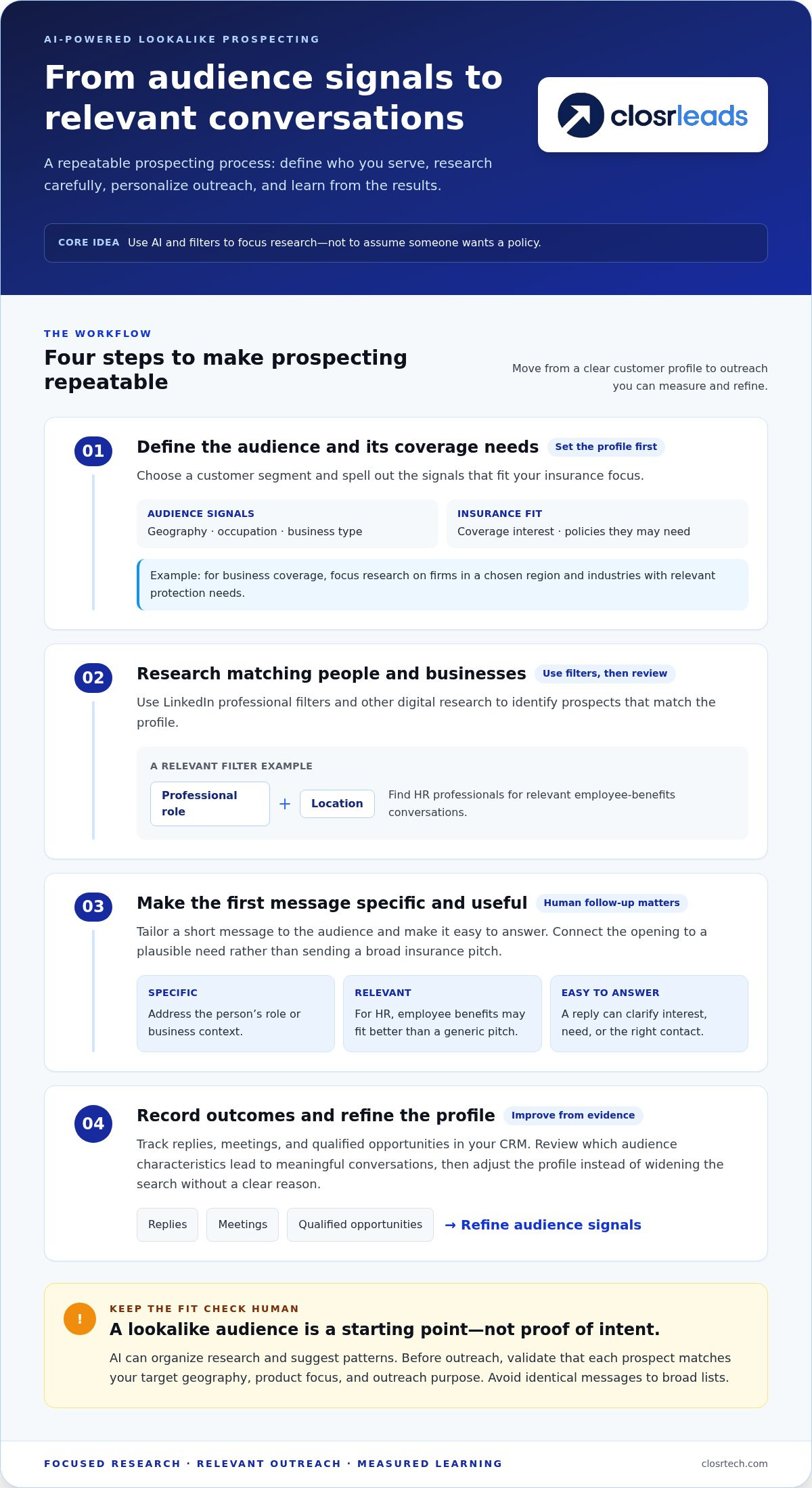
AI-powered lookalike prospecting starts with a clear profile of prospects who fit your insurance focus. Define the signals first: geography, occupation, business type, coverage interest, and the policies they may need. Then use those signals to guide audience research and outreach. For example, an agent focused on business coverage could prioritize firms in a chosen region and industries with relevant protection needs. Treat the resulting audience as a starting point, not proof that each person wants a policy.
LinkedIn’s professional filters can help agents find prospects such as human resources professionals by role and location. Review each profile before reaching out. A message about employee benefits may be more relevant to an HR professional than a broad insurance pitch. Keep the opening specific, useful, and easy to answer. A response can indicate whether the person has an interest, a current need, or the right contact for a later conversation.
Make the prospecting process repeatable. First, choose a customer segment and define its coverage needs. Next, use LinkedIn filters and other digital research to identify matching businesses or professionals. Then tailor a short message to the segment and record replies, meetings, and qualified opportunities in your CRM. Review which audience characteristics produce meaningful conversations. Refine the profile based on those results, rather than expanding the search without a clear reason.
AI can organize research and suggest patterns, but agents should validate the fit themselves. Check that each prospect matches your target geography, product focus, and outreach purpose. Avoid sending identical messages to broad lists. Effective insurance lead acquisition strategies combine focused audience selection with relevant human follow-up. If you want a direct source of prospects alongside this approach, explore OTP phone-verified insurance leads and compare the lead type with your target market.
3. Automation and AI for lead routing and follow-up
Connect each lead source to your CRM, then assign new inquiries by product, location, or agent capacity. A quote request can trigger an immediate task for the right agent, while source tags show whether the prospect came from content marketing, social media, or another channel. Automated routing reduces manual sorting and gives every inquiry a clear owner.
Speed matters with exclusive leads. Agents buying them are advised to call within 5 minutes. If a prospect isn’t ready to act, schedule a follow-up 30 days after the first conversation. CRM reminders can also prompt contact over the next few days, while automated responses acknowledge a submitted form and set expectations. Keep each message relevant to the prospect’s stated interest and preferred contact method.
Use AI to support decisions, not replace personal follow-up. It can help prioritize leads using details such as requested coverage, source, and timing. Review the context before contacting a prospect. A renewal request, for example, needs a different response from a general question on social media. Automation can flag the distinction and route each inquiry to an agent prepared for that conversation.
What lead acquisition benchmarks should insurance agencies track, including cost per lead and conversion rate? Calculate cost per lead by dividing channel spend by valid leads, then compare it with the share that becomes a quote, appointment, and bound policy. Strong agents are stated to close exclusive real-time leads at 15-25%, but results depend on lead quality and follow-up.
Review the funnel by source and stage, not just total lead volume. Track response time, contact rate, appointments, quotes, and policy outcomes in your CRM. These measures show where prospects drop off and which channels generate qualified opportunities. If quote requests stall after the first call, revise the follow-up sequence. If a source brings poor-fit inquiries, refine its targeting before increasing investment. This makes automation a practical feedback loop for the agency.
4. Lead-generation budgets and TCPA compliance
Build a lead-generation budget around your audience, sales capacity, and the channels you can manage consistently. A starting point for small independent agencies is allocating 5%-10% of gross commission income to marketing. For small and mid-sized B2B firms looking to optimize their marketing investments, working with senior marketing leadership from Budget Boosters can help guide strategic allocation and channel performance. Track each channel separately, then compare spend with valid inquiries, conversations, quotes, and bound policies. This shows whether a strategy attracts prospects your team can serve.
For local Google Ads, a realistic starting budget is $500-$1,500 per month. That may produce 10-30 leads per month, depending on the market, insurance lines, and landing-page quality. Treat those figures as planning guidance, not a substitute for tracking your own funnel. Review lead quality alongside volume. A smaller stream of relevant inquiries may fit your agency better than more leads your team can’t follow up with consistently.
What privacy and data-security risks come with buying or generating insurance leads? Risks include exposing personal information, using inaccurate contact details, or contacting someone contrary to their stated preferences. Limit access to lead data, retain only what your process needs, and record where each inquiry came from and what contact permissions were captured.
The Telephone Consumer Protection Act governs how leads can be generated and consumers contacted, according to the Federal Communications Commission. Build compliance into every lead-generation strategy: document the source and consent information, keep contact preferences with the record, and suppress contacts who opt out. Treat compliance as an operating control, not a final checklist.
Before adding a channel, set a spending limit and define the result you’ll measure. Review performance by source and insurance line, then shift budget toward qualified inquiries your team can contact appropriately. To support targeted outreach, explore OTP phone-verified leads as one lead-generation option.
ClosrLeads: Final Expense Leads
ClosrLeads offers Final Expense Leads for insurance agents adding this audience to their acquisition mix, as well as Veteran Insurance Leads and IUL Leads. Its leads are OTP phone-verified and TCPA-compliant, with documented consent records. Real-time delivery to your CRM and a built-in dialer support prompt, organized follow-up.
Consider purchased leads when your team wants insurance prospects alongside leads generated through content or paid campaigns. ClosrLeads offers real-time and aged leads, with a replacement guarantee for disconnected, wrong-number, or otherwise invalid contacts under its policy. Choose the lead type that fits your product focus, then use your CRM process to record outreach and manage next steps.
Contact ClosrLeads to discuss its Final Expense Leads.
Turn your next lead decision into a clear plan
Choose one audience to prioritize next. Define what a qualified inquiry looks like, who owns the first conversation, and how your team will record the outcome. A focused test gives you a practical basis for refining your insurance lead acquisition strategies without changing every channel at once.
ClosrLeads offers Final Expense Leads, Veteran Insurance Leads, and IUL Leads. Choose the offering that fits the insurance segment your team is prepared to serve, then connect it to a defined follow-up process. Make sure every new opportunity has a clear owner and a useful next step.
Evaluate lead sources against the prospects you want to reach and the conversations your team can manage. That focus makes it easier to decide what to improve next.
Contact ClosrLeads to discuss lead acquisition and identify a relevant next step for your team.
Build deliberately, keep learning, and keep moving forward.
Frequently Asked Questions
Why is content marketing important for insurance lead generation?
Content marketing helps prospects understand coverage before speaking with an agent. A clear explainer can answer a question about policy exclusions and invite readers to request a conversation. For example, an article addressing common life insurance questions can attract people comparing options. Useful content also gives agents material to share during follow-up, keeping the discussion focused on the prospect’s concerns.
What is the difference between exclusive leads and shared leads?
An exclusive lead is sold to one agent, while a shared lead may go to multiple agents. That distinction shapes the sales conversation: prospects with a shared inquiry may receive competing calls, so agents need to establish context quickly. Before purchasing, clarify how exclusivity is defined, whether leads are resold, and what details accompany each inquiry. These terms affect how your team should prioritize outreach.
What are the most effective insurance lead acquisition strategies in 2026?
A strong approach combines channels that fit your audience with a consistent way to measure qualified opportunities. Use educational content to address active questions, professional targeting to identify relevant business prospects, and referrals to build trusted introductions. Compare each source by lead quality and policy outcomes, not raw volume. Effective insurance lead acquisition strategies match your target market with follow-up your agency can sustain.
How do exclusive and shared insurance leads compare in conversion rates and cost?
Exclusive leads avoid direct competition for the same inquiry, while shared leads can create competing outreach. Strong agents are stated to close exclusive real-time leads at 15-25%; this is a reported rate, not a universal result. Cost comparisons depend on freshness, exclusivity, insurance line, and intent. Measure each option by qualified conversations and bound policies against total channel spend, rather than judging on lead price alone.
What federal and state laws govern insurance lead generation, consent, and telemarketing in the United States?
The Telephone Consumer Protection Act governs how leads can be generated and consumers contacted, according to the Federal Communications Commission. State requirements may also apply to telemarketing, privacy, and insurance marketing practices. Keep records showing how a prospect’s information was collected, what contact preferences were captured, and any opt-out request. Review those records before outreach and apply the rules relevant to the consumer’s location and contact method.
How can insurance agents build local referral partnerships to acquire leads?
Start with professionals whose clients face coverage decisions, such as mortgage professionals, real estate agents, CPAs, or auto dealers. In property coverage, establishing relationships with public adjusters like Apex Adjusting Group can also create valuable two-way referral opportunities. Define a useful introduction for both sides, then make referrals easy with a direct email or text introduction. After a smooth renewal or claim resolution, ask clients whether they’d be comfortable connecting you with someone facing a similar coverage need. Keep referral relationships active with relevant, helpful communication.