Blog
Instant Insurance Leads: A 2026 Buyer’s Guide for Agents
Buy instant insurance leads smarter in 2026. Compare providers, check OTP verification and consent, and streamline your CRM follow-up with this expert guide.

Fast delivery alone doesn’t make a lead valuable. Instant insurance leads create momentum only when the contact details are usable, consent records are clear, and the handoff fits your follow-up process. A lead that arrives late, has an invalid number, or lands outside your CRM can waste the advantage you paid for.
Look beyond the word “instant.” Before choosing a source, find out how quickly leads are delivered, what verification means, what compliance documentation is provided, and whether your team can act on each lead without adding manual work. Records can support your review, but they don’t automatically settle every compliance question.
This guide gives you a practical way to compare providers. You’ll learn what to ask about freshness, phone verification, consent records, delivery options, and workflow fit. You’ll also see how a built-in dialer or CRM delivery may simplify follow-up. Some providers, including ClosrLeads, offer OTP phone-verified leads, consent records, real-time CRM delivery, and a built-in dialer. The goal is a better-informed buying decision, not a promise of sales.
Key Takeaways
- Compare instant insurance leads by lead age, delivery method, and sharing terms, not speed claims alone.
- Use a consistent buying sequence: choose your insurance vertical, inspect lead details, and review verification and consent documentation.
- OTP verification confirms access to a phone number, but it doesn’t establish purchase intent, policy eligibility, or fulfill every agent-side responsibility.
- Test how lead fields map into your CRM and whether your calling workflow can handle each new record promptly.
- Start with a controlled test, then review actual contact and follow-up data before expanding your buying process.
What “instant insurance leads” means, and what speed does not guarantee
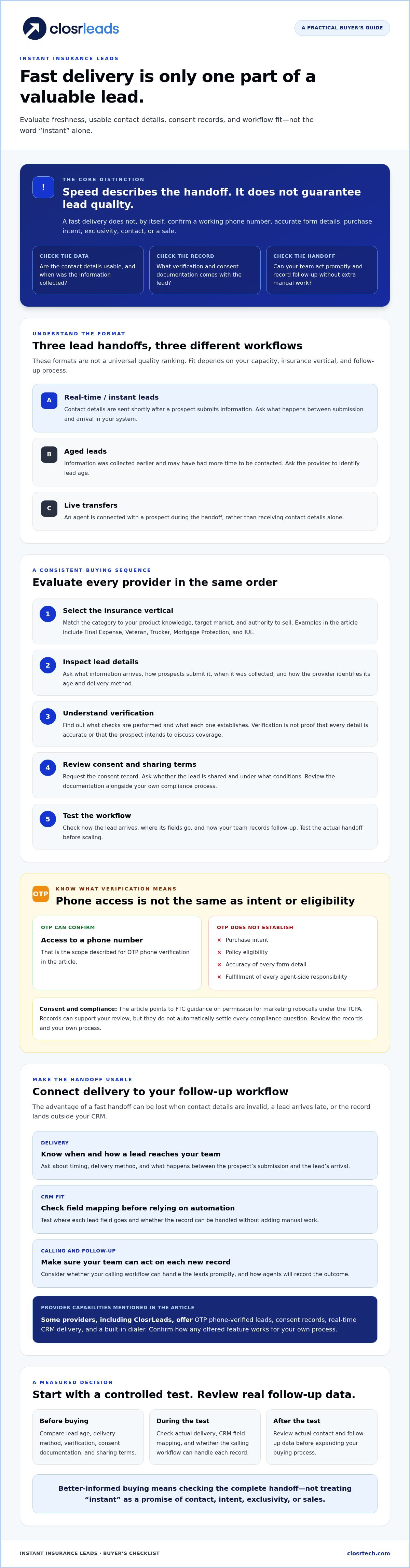
“Instant” sounds precise, but providers may use it to describe different delivery processes. In practical terms, instant insurance leads are contacts sent to an agent shortly after a prospect submits information. Timing and delivery methods can vary, so ask what happens between submission and arrival in your system.
A lead is information about a potential customer gathered through lead generation. Speed describes the handoff, not the prospect’s readiness or the accuracy of every detail. Treat freshness as one part of a broader review of the data, consent record, and follow-up workflow.
How instant leads differ from aged leads and live transfers
Real-time leads are delivered soon after a prospect submits a form. Aged leads were collected earlier and may have had more time to be contacted. Live transfers connect an agent with a prospect during the handoff, rather than simply sending contact details. Each format creates a different workflow, not a universal quality ranking. Your capacity to respond, the insurance vertical, and your follow-up process all affect which format fits. For a closer look at age, see this guide to aged insurance leads.
Why speed alone cannot establish lead quality
A fast handoff doesn’t confirm that a phone number works, that form details are accurate, that the prospect intends to discuss coverage, or that the lead is exclusive. Those are separate questions. Ask the provider how it identifies lead age, explains sharing conditions, and verifies submitted contact information. Then review the records supplied with the lead instead of relying on a “real-time” label alone.
Instant insurance leads are contacts delivered shortly after a prospect submits information, not a promise of contact, intent, exclusivity, or a sale. Keep that distinction in view. Delivery speed is partly shaped by the provider’s process. How quickly your team responds depends on your own workflow. Even prompt outreach can’t guarantee that a prospect will answer or move forward.
Before buying, assess the whole handoff: what information arrives, what consent documentation accompanies it, and how easily your team can act and record the outcome. Apply those checks before lead volume or speed claims sway your decision.
How to evaluate instant insurance leads before you buy
Use the same buying sequence with every provider. This keeps speed claims in perspective and makes it easier to compare details that affect your day-to-day process.
- Select the vertical. Match the lead category to your product knowledge, target market, and authority to sell. A provider may offer Final Expense, Veteran, Trucker, Mortgage Protection, and IUL leads, but availability alone doesn’t make a category right for your agency. If Final Expense is your focus, review this Final Expense lead guide.
- Check the lead details. Ask what information comes with each contact, how prospects submit it, and when the information was collected. Confirm whether the provider identifies the lead’s age and delivery method before purchase.
- Inspect verification. Find out what checks are performed and what each one establishes. For example, OTP phone verification can confirm access to a phone number, but it doesn’t prove a prospect’s intent or that every form detail is accurate.
- Review consent and sharing terms. Request the consent record and ask whether the lead is shared, and under what conditions. The FTC’s Telephone Consumer Protection Act (TCPA) guidance discusses permission for marketing robocalls. Review the documentation provided alongside your own compliance process.
- Test the workflow. Confirm how a lead arrives, where its information goes, and how your team records follow-up. Test the actual handoff before scaling your process.
Match the lead type to your insurance vertical and sales process
Choose a category your team can handle with confidence, not simply the one labeled fastest. Consider whether agents have the relevant product knowledge, whether the prospect profile fits your focus, and whether your licensing scope supports the business you intend to write. Then check that your follow-up process suits the lead format and volume you’re considering.
Check lead records, sharing terms, and invalid-contact policies
Get the provider’s exact terms in writing. Ask whether a lead is exclusive or shared, what “invalid contact” means, what proof you must submit, and whether a deadline applies. Don’t assume a replacement policy covers unanswered calls, low intent, or other outcomes. Confirm eligibility and required steps before buying so you know exactly what the policy addresses.
Use this checklist to compare providers side by side. Then start with a controlled test and review the contact and follow-up data. If you’re comparing insurance lead options, review the available lead categories as part of your evaluation.
OTP verification and TCPA records: what they confirm and what they do not
Verification and consent documentation answer different questions. A phone check can help assess whether a person completing a form can access the number provided. A consent record documents what the prospect was shown and how they responded. Neither replaces your review of the lead or your own compliance process.
OTP phone verification
A one-time passcode confirms that someone completing the form can access the phone number used in the verification step. It doesn’t establish the person’s full identity, need for coverage, policy eligibility, or willingness to buy.
Consent documentation
Provider-supplied records may help show the disclosure and consent associated with a lead. Ask how each record is tied to the contact and what information is available for your review.
Agent-side responsibilities
Review the records and terms, then assess your own obligations for contacting prospects and maintaining documentation. Don’t treat a verification badge or “compliant” label as a substitute for that assessment.
What OTP phone verification can establish
An OTP process typically asks the person submitting information to enter a one-time code sent to the phone number they provided. A successful check supports that the person had access to that number at the time. It doesn’t confirm who they are, whether the information on the form is accurate, or whether they want to discuss a particular product. For more detail, see this guide to OTP-verified insurance leads.
What to review in consent records and compliance terms
Before purchasing, ask how consent records are associated with each lead and how you can access them. Review the disclosure shown to the prospect, the recorded response, timestamps, and other available context. Check the provider’s terms for how records are retained and supplied, and keep copies in a format your team can retrieve.
The FTC's Telemarketing Sales Rule guidance outlines telemarketing requirements and record-keeping considerations. It is a useful reference, but it doesn’t determine every rule that may apply to your outreach. A provider’s documentation is evidence to examine, not blanket clearance for every call or text.
For instant insurance leads, verify what each document actually covers. Then assess your own procedures and seek qualified compliance advice for specific legal questions. Clear records can support careful review, but they don’t eliminate the need to understand your responsibilities.
Build a follow-up workflow that puts instant insurance leads to work
Delivery is only the start. A clear process helps your team move from notification to a documented outcome without losing records in manual handoffs. Map the steps before increasing lead volume, then test each one with your actual CRM and calling setup.
Prepare your CRM and calling process before leads arrive
Start by checking that incoming fields land where agents expect. Confirm that names, phone numbers, lead source, submission details, and available consent records map to the correct CRM fields. Assign an owner to each new record, including a backup process for when that person is unavailable. CRM delivery can reduce manual entry, but test field mapping first. A misplaced number or consent note can create avoidable delays.
Next, set an internal response target that reflects your staffing and applicable requirements. Don’t assume one timing rule fits every team or situation. Test the notification, record assignment, calling process, and outcome dispositions before scaling. If your platform includes a built-in dialer, check how agents launch calls and log results. A dialer can streamline steps, but it can’t ensure someone answers or chooses to proceed.
- Receive: Confirm the notification reaches the right user or queue.
- Review: Check the lead details and accompanying records.
- Contact: Follow your internal process and applicable rules.
- Record: Log the attempt and select a consistent outcome.
Track results by source and lead type
Use a simple pilot scorecard to see where the process works and where it breaks. Track delivered leads, valid contact details, response time, prospects reached, and outcomes your agency defines, such as qualified, follow-up needed, or closed. Keep these stages separate. A high delivery count alone won’t tell you whether records were valid or agents connected with prospects.
Compare results by source, vertical, lead age, and follow-up process using your own records. For example, separate real-time leads from aged leads and note whether assignment delays or incomplete CRM fields affected contact attempts. Review a consistent test period and sample before drawing conclusions. Early results can guide adjustments, but they aren’t a guaranteed forecast of future performance.
ClosrLeads offers real-time delivery into users’ CRM systems and a built-in dialer. Confirm the setup details and test how they fit your workflow. Explore CRM delivery and dialer options as you plan your pilot.
Choose an instant insurance lead provider that fits your operation
The right provider is one whose lead details, documentation, and delivery process match how your agency works. Compare the same points across providers. Don’t let a fast-delivery label or broad product range replace clear answers about the handoff and terms.
- Vertical fit: Does the provider offer leads for the insurance categories your team handles?
- Delivery method: Can it explain how leads are delivered and categorized as real-time or aged?
- Verification and consent: What does the OTP check confirm, and what consent documentation comes with each lead?
- Sharing and replacements: Are leads shared? How do the written terms define an invalid contact, and what steps apply to replacement eligibility?
- Workflow fit: Can your CRM and calling process receive, assign, and track each record?
Questions to ask before selecting a provider
Ask how leads are sourced, categorized, and delivered. Request examples of the details and consent documentation buyers receive, and confirm how those records connect to individual leads. Get written answers about sharing conditions, invalid-contact definitions, documentation requirements, and any deadlines for requesting a replacement. Clear terms make comparisons practical and help your team know what to review if a contact detail is invalid.
When ClosrLeads may fit your lead workflow
ClosrLeads offers real-time and aged leads across Final Expense, Veteran, Trucker, Mortgage Protection, and IUL categories. Its leads are OTP phone-verified and include TCPA-compliant consent records. Real-time CRM delivery and a built-in dialer may suit agents looking to connect lead intake with follow-up. Treat these as workflow features, not promises of contact, sales, or revenue. Confirm current delivery setup and terms before choosing.
Start with a controlled test your team can manage. Record delivery and response details, valid contacts, prospects reached, and outcomes using consistent definitions. Review the results in writing before expanding. A test can reveal whether fields arrive as expected, ownership is clear, and agents can keep records current. It can inform your next decision, but it can’t guarantee future results.
Ready to compare available categories and confirm current terms? Explore ClosrLeads insurance lead options and check that the lead type and workflow fit your operation before you buy.
Make your next lead decision with confidence
Speed is only one part of a strong lead process. Before you buy instant insurance leads, confirm the vertical fits your operation, understand what verification and consent records establish, and make sure your team can receive, review, and follow up on each record.
ClosrLeads states that its leads are OTP phone-verified and include TCPA-compliant consent records. Its platform also includes real-time CRM delivery and a built-in dialer. These features can support an organized workflow, but they don’t promise contact or sales. Review the current terms and test the handoff against your own process.
Explore ClosrLeads insurance lead options and compare the available categories and workflow features before choosing. Start with a focused test, learn from your actual contact and follow-up data, and build a process your team can sustain. A clear next step puts you in a stronger position to make each lead count.
Frequently Asked Questions
Is an instant insurance lead guaranteed to be exclusive?
No. “Instant” describes how soon a lead is delivered, not whether it’s exclusive. Before buying, ask the provider to state the sharing terms in writing, including whether the same lead may be sent to other agents and under what conditions. Lead availability and terms vary by provider, so don’t assume exclusivity from a product label. Even an exclusive lead doesn’t guarantee the prospect will answer or make a purchase.
How quickly should I follow up with an instant insurance lead?
Follow up promptly, but set a response target that fits your agency rather than relying on one universal deadline. A timely response lets you contact someone while their inquiry may still be recent. For instant insurance leads, decide who receives each record and how quickly they can act, while considering staffing, provider terms, and applicable requirements. Track response times and contact outcomes in your CRM, then adjust your process using your agency’s own data.
What does OTP verification mean for insurance leads?
OTP verification uses a one-time passcode to confirm that someone completing a form can access the phone number provided. It’s a phone-number check, not full identity verification. It doesn’t prove that the person intends to buy, qualifies for coverage, or will answer a later call. Before purchasing, ask what the provider’s OTP process confirms, when it happens, and what verification or consent documentation is supplied with each lead.
Are TCPA-compliant insurance leads enough to meet an agent’s compliance responsibilities?
No. Provider-supplied consent records can help document how a lead was collected and what consent process was recorded, but a “TCPA-compliant” label doesn’t automatically resolve every agent obligation. Review the actual records associated with each lead, along with the provider’s contract and terms. Your own outreach and record-handling practices matter too. For situation-specific questions, consult qualified compliance counsel rather than relying on a provider label alone.
Can instant insurance leads be delivered directly into my CRM?
They can be, depending on the provider’s platform, available integrations, and configuration. ClosrLeads describes real-time CRM delivery, but confirm current setup details and compatibility with your system before buying. Ask how lead fields map, which notifications are available, and how records are assigned. Test the handoff before expanding volume. A field-mapping issue, such as a phone number landing in the wrong place, can disrupt follow-up even when delivery works.
What should I do if an insurance lead has an invalid phone number?
Document the issue promptly and follow the provider’s stated reporting process. Before purchasing, confirm what qualifies as an invalid contact, what evidence you’ll need, and how to submit a request. ClosrLeads describes its replacement guarantee as applying to invalid contacts, not broader outcomes such as unanswered calls or lack of interest. Ask for the current eligibility terms and required steps in writing so you know what to do if a number is invalid.
Are instant insurance leads better than aged leads?
Neither format is automatically better for every agent. Real-time delivery may suit a team prepared to act promptly, while aged leads may fit a different follow-up strategy or operational capacity. Compare the provider’s lead details, age, delivery and sharing terms, and verification process. Then track valid contacts, outreach, and outcomes separately in your own records. Lead age is one factor, not a reliable standalone measure of performance.