Blog
Improving Contact Rates on Purchased Leads: Agent Guide
Start improving contact rate on purchased leads with this agent guide. Learn proven follow-up workflows, speed-to-lead tactics, and tracking strategies now.

What if a missed first call says less about the lead than it does about your follow-up process? Improving contact rate on purchased leads starts with a consistent plan, not a string of rushed attempts. Purchased leads may not answer the first call, and uneven follow-up makes it difficult to tell whether timing, lead age, or data quality is the main obstacle.
That frustration is real. A disciplined workflow gives you a clearer way to respond, track results, and adjust without relying on pressure tactics or unsupported promises. In this guide, you’ll learn how to build a repeatable contact process, measure performance by lead source and age, and use each result to choose what to improve.
We’ll cover speed-to-lead, practical follow-up routines, and the metrics that reveal where conversations are getting lost. OTP phone verification and consent records can support a more reliable starting point, while real-time delivery and a built-in dialer can help organize outreach. These are workflow tools, not guarantees of an answer. The goal is more consistency, better visibility, and compliant outreach that gives each lead a fair opportunity to become a real conversation.
Key Takeaways
- Define contact rate as two-way conversations, and keep it separate from appointments, applications, quotes, and sales.
- Improving contact rate on purchased leads starts with tracking results consistently by source and lead age.
- Test one change at a time, such as call timing, opening language, or follow-up consistency, to see what affects reach.
- Use a clear five-step workflow: receive the lead, review consent and context, attempt contact, document the result, and follow up appropriately.
- OTP phone verification, CRM delivery, and a built-in dialer can support organized outreach, but they can’t guarantee a live answer.
Why contact rates on purchased leads fall, and what the metric actually measures
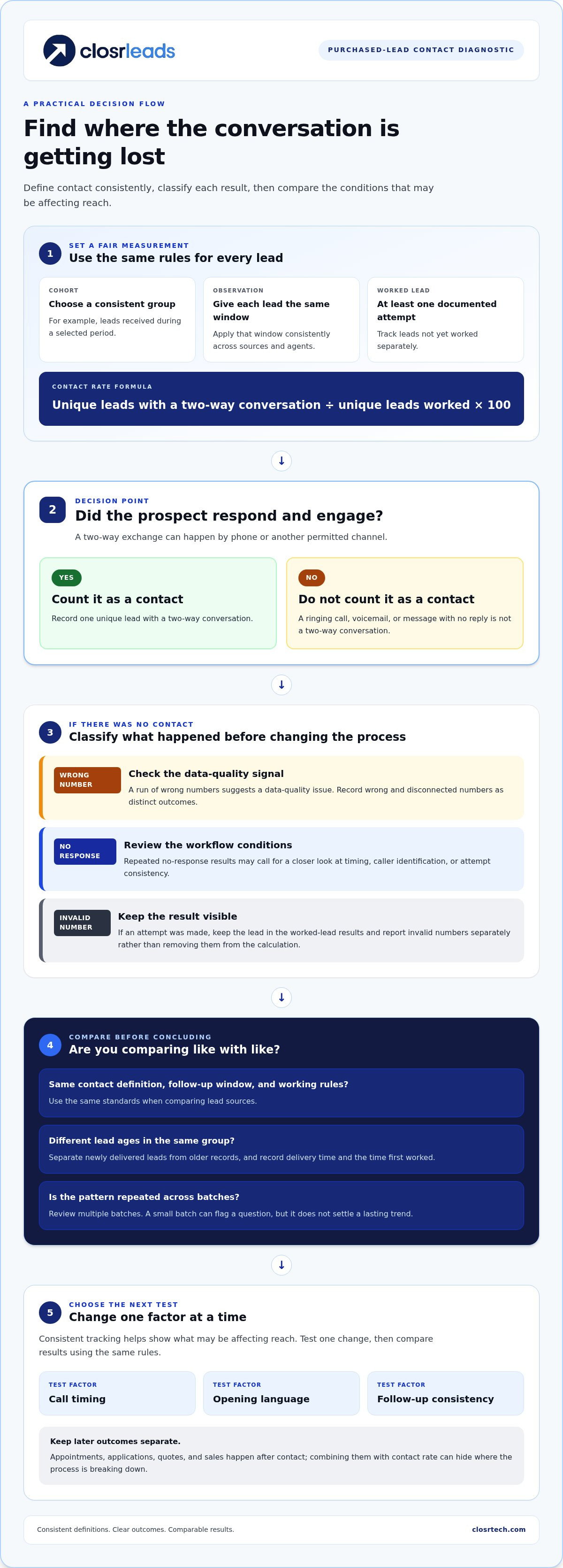
A lead is a record of interest, not a guaranteed conversation. Contact rate is the share of purchased leads worked that result in a two-way conversation with the prospect. Count an exchange where the prospect responds and engages, whether by phone or another permitted channel. A call that rings, a voicemail, or a message with no reply is not a contact.
Keep contact rate separate from what happens next. Reaching someone doesn’t mean they book an appointment, submit an application, request a quote, or buy a policy. Those are later outcomes, and combining them with contact rate hides where the process is breaking down. The broader concept of lead generation starts with identifying prospective customers; your contact metric measures whether your follow-up creates an actual exchange.
Reach can suffer for different reasons. A phone number may be stale or incorrect. A delay can weaken the connection between the person’s original request and your call. If your caller identity isn’t clear, a prospect may hesitate to answer. And when agents vary the number or timing of attempts, it becomes difficult to tell whether the lead source or the workflow deserves attention. Improving contact rate on purchased leads starts with defining the metric before changing the process.
How should insurance agents calculate contact rate?
Use one consistent cohort, such as leads received during a selected period, and give each lead the same observation window. Decide what counts as a two-way conversation, then apply that definition across sources and agents.
Contact rate = unique leads with a two-way conversation ÷ unique leads worked × 100. Define “worked” as a lead with at least one documented contact attempt. Exclude duplicate or test records only under a consistent rule, and track leads not yet worked separately. If an attempt was made, keep invalid numbers in the worked-lead results and report them as a separate outcome rather than removing them and inflating the rate.
Which lead-level signals help diagnose low contact?
Log enough context to compare like with like. At minimum, capture the source, delivery time, lead age when first worked, insurance vertical, and attempt history. Then categorize the result: two-way contact, wrong number, disconnected number, or no response. These outcomes point to different questions. A run of wrong numbers suggests a data-quality issue; repeated no-response results may call for a closer look at timing, caller identification, or attempt consistency.
- Compare sources fairly: Use the same contact definition, follow-up window, and working rules for each source.
- Check lead age: Separate newly delivered leads from older records to avoid blending different conditions.
- Look for repeat patterns: Review results across multiple batches before treating a source difference as a lasting trend.
A small batch can flag a question, not settle it. Track results consistently, then use the evidence to decide what to test next.
How timing, lead context, and caller trust shape contactability
Timing matters because context fades. A prompt, organized attempt can connect your call to the prospect’s recent request while it’s still familiar. That doesn’t mean every lead must be called within a fixed number of minutes. There’s no universal threshold that guarantees contact. Instead, record when each lead arrives and when your team first works it, then compare outcomes using the same rules.
Context matters just as much. A person who expressed interest in mortgage protection shouldn’t hear an opening that sounds like a generic pitch for an unrelated policy. Use the information attached to the lead, but don’t claim more than it shows. Relevant, transparent follow-up supports Lead Nurturing: keep the conversation connected to the person’s interest, and let them decide whether they want to continue.
What should the first outreach attempt establish?
Start with three points: who you are, why you’re calling, and what the prospect can do next. Keep it brief. For example: “Hi, this is Jordan, a licensed insurance agent. I’m following up on your request for information about final expense coverage. Is now a good time to talk?” This identifies your role and purpose without implying that the prospect asked for a quote or agreed to an appointment. Give them room to respond before moving into product details.
Clarity builds trust; a hard sell can create friction before the conversation begins. If the prospect doesn’t recognize the context, explain it plainly rather than overstating what they submitted. Your goal on the first attempt is an honest opening and a response, not to force a decision.
How do real-time and aged leads change the opening?
With a real-time lead, refer to the recent inquiry while allowing that the prospect may not be available: “You recently requested information about IUL coverage. Is this a convenient time?” Real-time delivery can help preserve the connection between the request and outreach, but it can’t ensure the person will answer.
For an aged lead, don’t pretend the request just came in. Reintroduce yourself, state the insurance interest recorded, and ask whether it’s still relevant. The prospect may have changed plans or already addressed the need. Treat that possibility respectfully. For more on what a one-time passcode verifies, see OTP-verified insurance leads. OTP verification confirms a phone number through a code; it doesn’t prove that the person is available or will answer when you call.
Make freshness and context part of your process, not assumptions. ClosrLeads’ real-time CRM delivery and built-in dialer can help keep outreach structured. Learn more about lead workflow tools.
Which contact-rate improvements should agents compare and test?
Don’t change your entire follow-up process at once. If you shift call timing, rewrite the opening, and add more attempts in the same test, a change in contact rate won’t tell you which adjustment mattered. Pick one variable, define the comparison before you start, and keep the remaining steps consistent. That’s how improving contact rate on purchased leads becomes a measurable process instead of guesswork.
For each test, compare leads handled under your current approach with leads handled under one clearly defined alternative. Use the same contact definition and observation window. Keep identification and call purpose transparent in every version.
- Promptness: Compare your existing first-attempt timing with a more prompt, organized response. Keep the opening, permitted contact method, and follow-up window consistent.
- Opening language: Compare your current introduction with a concise, context-specific version. Keep call timing and the attempt plan steady.
- Call blocks: Compare one planned calling period with another suitable period. Keep lead mix, caller identification, and opening language consistent.
- Follow-up consistency: Compare current handling with a documented, consistently applied attempt routine. Keep lead eligibility and the measurement period the same.
Should agents change call timing, messaging, or both?
Test timing and messaging separately first. For a timing test, hold the introduction steady and compare a defined call schedule with an alternative. For a messaging test, keep the schedule steady and change only the wording. For teams looking to sharpen how they communicate and engage prospects through creative storytelling and AI, platforms like Media BrAIns - We think, we create and you grow demonstrate how tailored messaging drives better audience response. In both versions, identify yourself and explain the reason for calling honestly. Track two-way conversations as the contact outcome, then measure appointments, applications, and sales separately. Those later results matter, but they answer different questions.
How can agents compare lead sources fairly?
Apply the same contact definition and observation window to every source. Compare rates, not raw answer totals: a source receiving more leads may produce more conversations simply because more leads were worked. Review source results alongside lead age, insurance vertical, agent workload, and handling consistency. Where possible, compare similar groups rather than mixing fresh and aged leads or different lines of insurance into one headline number.
Break results down by source, lead age, vertical, and agent only when each group has enough observations to make the comparison useful. A small batch can be noisy. Treat differences as directional signals, not proof of a lasting pattern, unless you have adequate data and see a consistent result across additional cohorts. If one agent’s rate differs sharply, check whether they received a different lead mix or followed a different process before attributing the result to individual performance.
Document the test dates, group definitions, process change, and outcome. Keep a simple record of leads worked and conversations reached. That makes each comparison easier to interpret and gives the next test a clear starting point.
A practical, compliant workflow for working every purchased lead
Consistency starts before the first call. A defined workflow helps agents act on lead context, keep a clear record, and avoid treating every unanswered attempt the same way. Use these five steps as a repeatable process, while following the consent, calling, and opt-out requirements that apply to your outreach. Rules can change, so verify current requirements rather than relying on an old script or assumption.
- Receive: Confirm the lead has entered the correct CRM or work queue. Capture its source and delivery time so it can be tracked and assigned.
- Review consent and context: Check the stated insurance interest, contact details, and available consent information before choosing a permitted outreach method.
- Attempt contact: Identify yourself and explain the relevant purpose clearly. Don’t imply the prospect requested anything beyond what the lead record shows.
- Document: Log the attempt timestamp, channel, disposition, and any relevant response in the CRM. Use the same labels across the team.
- Follow up appropriately: Set a next action only when further outreach is permitted. Stop or suppress outreach when required by an opt-out or other applicable restriction.
This structure turns improving contact rate on purchased leads into an operational routine: each record has an owner, an outcome, and a clear next step when appropriate. It also makes missed handoffs easier to spot. A lead with no owner or next action can sit untouched, while inconsistent notes make it difficult to understand what happened.
What belongs in a lead-handling checklist?
Keep the checklist short enough to use on every record. Confirm the lead’s contact details, stated interest, source, and available consent information. Assign ownership, then record the result of each attempt with a shared disposition such as “two-way conversation,” “no response,” “wrong number,” or “disconnected.” Add a timestamp and next action so another team member can understand the lead’s status without guessing.
How should agents use follow-up without crossing compliance lines?
Use only channels and practices allowed by applicable rules and the consent on record. Respect opt-outs, and maintain suppression records according to current requirements so a person who has asked not to be contacted isn’t accidentally returned to an active queue. Don’t treat a follow-up count or cadence as universally safe legal guidance. Requirements can depend on the situation, channel, and jurisdiction; verify current rules and get qualified compliance guidance when needed.
A CRM workflow or built-in dialer can help agents keep lead records and attempts organized, but tools don’t replace sound judgment or compliance checks. Explore the ClosrLeads lead workflow to see how real-time CRM delivery and the built-in dialer support consistent lead handling.
How ClosrLeads can support a more organized purchased-lead process
A dependable contact workflow needs useful lead information and a clear way to act on it. ClosrLeads provides OTP phone-verified insurance leads, consent records, real-time CRM delivery, and a built-in dialer. These are tools for organizing lead handling, not promises that a prospect will answer, book an appointment, or buy a policy. Your outreach process still determines how each record is reviewed, worked, and documented.
What does verification contribute to purchased leads?
OTP phone verification means a phone number was checked through a one-time passcode process. It can support data quality, but it doesn’t establish that the number’s owner is available when you call or guarantee a live conversation. Consent records accompany leads and can help agents review the documented context for outreach. They aren’t a blanket legal assurance or a substitute for checking whether a specific contact attempt is permitted under current requirements.
Invalid contacts are covered by ClosrLeads’ replacement guarantee. Keep invalid numbers distinct from leads that simply don’t answer: an unanswered call doesn’t, on its own, show that a contact is invalid. Clear CRM dispositions help preserve that distinction and make it easier to apply the guarantee accurately.
How can delivery and dialing tools reduce workflow friction?
Real-time delivery into an agent’s CRM can reduce manual handoffs and make new records available within the existing lead workflow. The agent can review the available context, assign ownership, and proceed according to the team’s documented process. The built-in dialer supports agents as they work purchased leads. Neither CRM delivery nor dialing tools create prospect availability; they help organize the work around each lead.
For example, a team can use consistent lead records to track source, delivery time, contact attempts, and outcomes in one process. That makes it easier to distinguish workflow gaps, such as a lead awaiting assignment, from an unanswered call or an invalid number. It also supports comparisons across lead sources without treating every unsuccessful attempt as the same result. Agents working in final expense can also use this final expense leads guide for vertical-specific context.
Use the tools to reinforce the process: review the record, confirm the outreach context, make a permitted attempt, and document the result. Then assess contact performance using consistent definitions. That’s a practical foundation for improving contact rate on purchased leads, without confusing operational support with guaranteed outcomes.
Explore ClosrLeads to see how its lead delivery, verification, and built-in dialer can support a more organized purchased-lead workflow.
Turn each lead cycle into a smarter next step
The next advantage comes from what your team learns over time. Treat each working period as a chance to build organizational memory: retain clear records, review patterns regularly, and turn repeatable lessons into shared practices. That way, improvements don’t depend on one agent’s habits or disappear when the day gets busy. For businesses looking to align their sales follow-up with practical marketing strategies, teams like De Mensen van Marketing provide accessible marketing support to help connect campaigns with conversion goals.
Keep the goal grounded. Improving contact rate on purchased leads isn’t about forcing an answer; it’s about making each permitted attempt purposeful and learning from the outcome. Give your team a practical process they can follow, then refine it as you gather evidence. Consistency creates a stronger foundation for better decisions, clearer accountability, and more meaningful conversations.
When you’re ready to bring lead handling into a more organized workflow, explore ClosrLeads and build a more organized lead workflow. Take the next step with a process designed to keep your team focused, informed, and moving forward.
Frequently Asked Questions
Does OTP verification guarantee that a purchased lead will answer the phone?
No. OTP verification confirms that a phone number was verified through a one-time passcode process, but it can’t show whether the person is available when you call or willing to speak. Treat verification as a data-quality step, not an answer-rate promise. If calls go unanswered, assess timing, caller identification, and lead context separately rather than assuming verification failed.
How should an insurance agent calculate contact rate on purchased leads?
Divide the unique leads that resulted in a two-way conversation by the unique leads worked during the same measurement period, then multiply by 100. For example, if 12 of 60 worked leads led to a conversation, the contact rate is 20%. Define “worked” in advance, apply the same observation window to each group, and report duplicates or test records under a consistent exclusion rule.
Should agents call real-time leads differently from aged leads?
Yes, adjust the introduction to match the lead’s age. For a real-time lead, refer to the recent inquiry without assuming the person can talk. For an aged record, identify yourself, explain the recorded insurance interest, and ask whether it’s still relevant. For instance, don’t describe an older final expense inquiry as something the prospect just submitted. Keep the purpose clear in either case.
Can a low contact rate mean the leads are invalid?
Not by itself. A low rate may reflect unanswered calls, stale numbers, inconsistent handling, or other factors. Separate wrong and disconnected numbers from no-response outcomes, then review patterns across more than one batch. If a contact is confirmed invalid, follow the applicable process for reporting it. ClosrLeads’ replacement guarantee applies to invalid contacts, not simply to leads who don’t answer.
How many times should an agent follow up with a purchased lead?
There isn’t one attempt count that fits every lead or situation. Set a consistent follow-up plan based on the consent and contact practices that apply to your outreach, and verify current requirements before putting it into use. Stop when an opt-out or other restriction requires it. Track attempts and outcomes so you can evaluate your process without treating a particular count as legal advice or a guarantee of contact.
What should agents record after each call attempt?
Record the attempt date and time, contact channel, lead source, and outcome using your team’s standard labels. Note whether you reached the prospect, left no conversation, or identified a wrong or disconnected number. Add a brief factual note if the person responds, along with any permitted next action. Consistent records help teammates pick up the file accurately and make later performance reviews more useful.
Can a dialer improve contact rates on purchased insurance leads?
A dialer can support a more organized process for working purchased leads, but it can’t guarantee more answers. Its value is operational: agents have a tool for placing calls as they work their lead flow, rather than relying on an improvised routine. To assess its effect, compare contact rates across comparable lead groups while keeping the contact definition and follow-up rules consistent. Track conversations separately from sales.