Blog
How to Dispute a Bad Lead from a Vendor: A Practical 2026 Guide
Learn how to dispute a bad lead from a vendor with our practical guide. Gather evidence, follow vendor criteria, and secure valid lead replacements today.

An unanswered call or a prospect who doesn’t convert can be frustrating, but neither automatically proves a contact was invalid. Knowing how to dispute a bad lead from a vendor starts with separating contact quality from sales outcomes.
You’re right to expect accurate, usable contact details and clear terms for what qualifies for a replacement. This guide shows you how to classify an issue against a vendor’s written criteria, gather relevant evidence, and submit a concise, fact-based claim through the stated process. You’ll also learn how to avoid common dispute mistakes and assess lead sources with clearer quality and replacement terms.
That distinction matters. ClosrLeads provides OTP phone-verified insurance leads and TCPA-compliant consent records, with a replacement guarantee for invalid contacts. An unanswered call or low conversion alone doesn’t mean a lead qualifies. Use the steps ahead to make a fair, well-supported case and set stronger expectations for future leads.
Key Takeaways
- Learn how to dispute a bad lead from a vendor by matching the reported defect to the vendor’s written validity criteria.
- Build a focused evidence record with the lead ID, delivery details, source or campaign, and the specific issue observed.
- Compare dispute policies for definitions, documentation requirements, submission channels, deadlines, and remedies.
- Follow the vendor’s stated process in order, and keep your claim concise, factual, and easy to review.
- Use what you learn to prioritize lead sources with clear standards, accessible records, and transparent remedies.
How to Dispute a Bad Lead from a Vendor: First Define the Problem
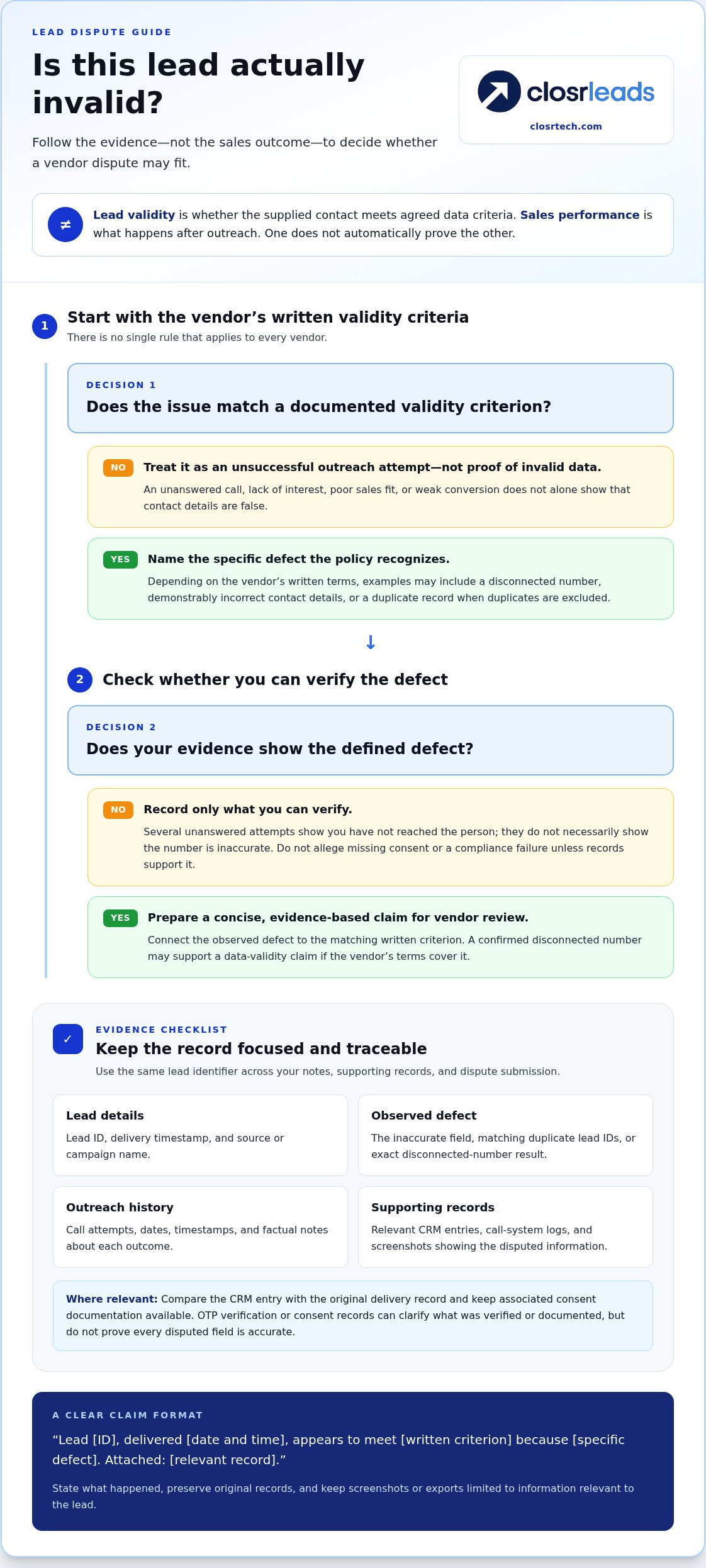
Paying for contact data you can’t use is frustrating. Before challenging a charge or requesting a remedy, identify the specific defect. A lead should be considered invalid for a dispute only when it fails a documented validity criterion, not simply because it didn’t turn into a sale.
A lead is a person or organization identified as a potential customer through a Lead generation process. But “potential customer” doesn’t mean guaranteed buyer. A prospect may be unreachable, uninterested, or a poor fit and still have accurate contact details. When considering how to dispute a bad lead from a vendor, start with the vendor’s written terms. They define what counts as a valid lead, which defects qualify, and what remedy may apply. There’s no single rule that applies to every vendor.
Lead validity is about whether the supplied contact meets the agreed data criteria; sales performance is about what happens after outreach. Keep that distinction front and center. It makes your claim more precise and helps the vendor assess the issue against the same standard.
What usually makes a lead objectively invalid?
Depending on the vendor’s written definition and applicable terms, possible defects may include a disconnected number, demonstrably incorrect contact details, or a duplicate record when duplicates are excluded. Be specific about which detail is wrong and what you observed. Document a name mismatch or duplicate rather than presuming one. Likewise, don’t allege missing consent or a compliance failure unless the relevant records support that claim.
Some lead programs use phone verification or provide consent records. These records can help clarify what was verified or documented, but they don’t prove every detail about a prospect or promise a sale. Compare the information you received with the vendor’s stated criteria. If the evidence doesn’t show a defined defect, describe what you know without overstating it.
Is an unresponsive prospect automatically a bad lead?
No. An unanswered call alone doesn’t establish that a number is inaccurate or disconnected. The prospect may be busy, screening calls, unavailable at that moment, or simply not interested. Rejection, weak sales fit, and poor conversion describe the prospect’s behavior or your sales outcome. They aren’t automatically evidence of an invalid contact.
Keep these categories separate before disputing. A number confirmed as disconnected may support a data-validity claim if the vendor’s terms cover it. Several unanswered attempts show that you haven’t reached the person, not necessarily that the contact details are false. State the verifiable defect, link it to the written criterion, and leave sales results out unless the policy explicitly treats them as grounds for a dispute.
This first check prevents a common mistake: treating disappointment as proof. Read the validity language before submitting a claim, then describe the issue using the terms the policy recognizes. That gives you a stronger basis for deciding whether to dispute the lead or record it as an unsuccessful outreach attempt.
What Evidence to Gather Before Challenging an Insurance Lead
A credible dispute is built on a clear record, not a vague sense that a lead was unusable. Before submitting a claim, capture enough detail for someone else to identify the lead, understand the defect, and compare it with the vendor’s written criteria. Keep the original records intact. Clear evidence helps distinguish a data problem from an unsuccessful sales attempt.
Build a clear record of the contact issue
Start with the lead ID, delivery time, and source or campaign. Then record the specific defect in plain language. If a call returns a disconnected-number message, preserve the exact message or call outcome with its date and time. If the record appears duplicated, identify the matching lead IDs and delivery details. Use the same lead identifier in your CRM notes, screenshots, and dispute submission so the evidence stays connected.
Use a checklist to keep the record complete:
- Lead details: Lead ID, delivery timestamp, and source or campaign name.
- Observed defect: The inaccurate field, duplicate record, or exact disconnected-number result.
- Outreach history: Call attempts, dates, timestamps, and factual notes about each outcome.
- Supporting records: Relevant CRM entries, call-system logs, and screenshots showing the disputed information.
Log unanswered calls accurately, but don’t present them as proof that a number is invalid. Record what happened, not what you can’t verify. Avoid editing original entries after the fact. Add a dated note or preserve a copy if you need to clarify your record. Limit screenshots and exports to information relevant to the lead, so the claim stays focused and doesn’t expose unrelated prospect data.
Check delivery details and consent documentation
Compare the contact information in your CRM with the original delivery record available in your system. Check that you’re reviewing the correct lead and that the defect wasn’t introduced by a later data-entry change. Where relevant to the issue, review the associated consent documentation and keep the record available. OTP verification and consent records can help establish what was verified or documented. They don’t, by themselves, prove that every disputed field is accurate. The OTP-verified insurance leads guide explains how verification and consent records relate to lead quality.
Keep your summary short: “Lead [ID], delivered [date and time], appears to meet [written criterion] because [specific defect]. Attached: [relevant record].” Don’t claim a legal or compliance violation unless the evidence supports that conclusion. For general guidance on organizing a company complaint, see filing consumer complaints with USA.gov. When reviewing lead-quality safeguards for future purchases, explore lead-quality safeguards as part of your assessment.
How to Evaluate a Vendor's Bad-Lead Dispute Policy
A dispute policy is useful when you can tell what it covers and how to follow it. Compare vendors by their written terms, not by assumptions about what providers usually do. One policy may define eligible contact defects narrowly; another may address duplicates or other documented issues. The wording determines whether your case fits, what evidence to provide, and which remedy may apply.
Which policy details should agents compare?
Read the current terms before you buy and again before submitting a claim. Look for four practical elements: definitions of invalidity, evidence requirements, the official submission route, and any stated deadlines. Keep the policy version or date with your records when available. Timing and process can differ between vendors, so don’t apply one provider’s rules to another.
- Eligible issue categories: Does the policy define an invalid number, incorrect details, duplicate records, or other qualifying defects?
- Required documentation: Does it specify the records or details needed to support a claim?
- Submission channel: Does it direct you to a particular form, account area, or contact method?
- Applicable timing: Does it state when a dispute must be submitted or when a response is expected?
- Available remedy: Does the policy describe a replacement, credit, or another resolution, and under what conditions?
Use only deadlines and remedies stated in the specific vendor’s written terms. If a timing rule or required record isn’t stated in the material you have, don’t assume one. Review the agreement, policy page, or other current terms that govern your purchase. If the wording is ambiguous, describe the issue factually and avoid assuming a particular outcome.
How do replacement terms differ from sales guarantees?
A replacement for invalid contact data addresses whether the supplied lead met a defined quality standard. It doesn’t promise that the prospect will answer, agree to an appointment, or buy a policy. Those are sales outcomes affected by factors beyond contact validity. In contrast, services built around scheduled meetings rather than raw contact lists—such as LuxeScale in the luxury real estate sector—focus on vetting prospects and booking listing appointments directly. When purchasing standard lead data, however, treat claims about response, appointment setting, or conversion as separate promises, and rely on them only if the applicable written terms clearly make them.
ClosrLeads provides a replacement guarantee for invalid contacts. That is a specific quality safeguard, not a guarantee that every lead will convert or that an unanswered call qualifies for replacement. Review the applicable terms to understand how invalid contacts are defined and how the remedy applies. Use the same standard when evaluating any vendor.
To decide how to dispute a bad lead from a vendor, match your evidence to the policy’s definition, then follow its stated submission route and timing. A side-by-side comparison helps reveal whether vendors use the same words but offer different eligibility criteria or remedies. Focus on clarity: a useful policy makes the standard, process, and possible resolution understandable before a dispute arises.
How to Submit a Clear, Evidence-Based Lead Dispute
A strong claim is easy to verify. It identifies one lead, one specific defect, and the evidence that supports it. The process isn’t universal, so start with the vendor’s written terms and follow the stated channel and requirements. Don’t assume that a phone call, email, or particular deadline applies unless the policy says so.
Use this sequence to keep the dispute focused and traceable:
- Find the applicable terms. Locate the policy or agreement that applies to the lead. Confirm the eligible issue categories, required documentation, submission route, and any stated timing. Follow those instructions rather than relying on another vendor’s process.
- Match the issue to a criterion. Identify the specific policy definition the lead appears to fail. A general description such as “poor quality” is hard to assess. A precise claim, such as “the supplied number returned a disconnected-number recording,” gives the reviewer a verifiable issue to evaluate.
- Assemble relevant evidence. Include the lead identifier, delivery timeline, and supporting records required by the policy. Connect each factual statement to a CRM entry, system record, screenshot, or timestamp. Keep original notes intact and avoid attaching unrelated prospect information.
- Submit through the stated channel. Use the route identified in the vendor’s terms and provide information in the requested format. Keep your language neutral and direct. Don’t add unsupported conclusions about consent, compliance, or the prospect’s intent.
- Save the record and track the outcome. Retain a copy of the full submission and any confirmation or response. Compare the vendor’s decision with the written policy, then document any replacement, credit, or other remedy actually issued. Don’t record a remedy as approved until it has been provided.
Write the dispute so the issue is easy to verify
Lead with the defect, then connect it to the evidence. For example: “Lead [ID] was delivered [date and time]. The number returned [exact system message] on [date and time]. Attached is the call record.” This format avoids broad complaints and lets the reviewer check the claim quickly. Keep prospect opinions, unanswered calls, and sales results separate from defects in the supplied data.
Follow up and document the resolution
If the policy gives a follow-up route or response timeframe, use it and track the relevant dates. If it doesn’t, don’t invent a deadline or assume a standard interval. Preserve each reply with the original case details so the record stays complete. A clear paper trail helps you see whether the issue was assessed under the stated terms and what resolution, if any, followed.
For future insurance lead purchases, explore ClosrLeads' insurance lead options and consider how clearly each source sets out its quality standards and remedies.
Prevent Repeat Disputes by Choosing Clear Lead Standards
Use each dispute to sharpen your next buying decision. Clear standards won’t guarantee every lead becomes a customer, but they can make contact expectations and remedies easier to understand before you commit. Compare vendors on what they define in writing, what records they provide, and how their stated process handles a qualifying defect.
Set expectations before buying leads
Start with fit. Consider whether the lead type and age suit your team’s follow-up capacity and sales process. Real-time and aged leads may call for different outreach planning, so choose a delivery type that aligns with how quickly your agents can work new records. Similarly, service-based businesses looking to avoid shared aggregator quality issues often turn to specialized agencies like Cloud Tech Digital to develop targeted, direct campaigns.
Before purchase, look for written answers to practical questions:
- What specifically counts as an invalid contact?
- How are duplicate records or incorrect details treated?
- What delivery, verification, or consent information accompanies the lead?
- What evidence, submission route, timing, and remedy does the policy state?
Keep the terms and purchase details together with delivery records. That gives your team a shared reference if a concern comes up later. Don’t rely on the word “guarantee” alone. Read the definition of an eligible issue and the conditions attached to any remedy. A replacement policy for invalid contact data is not a promise of a response, appointment, or sale.
Verification and documentation can make expectations more concrete. OTP phone verification can support a clear standard around phone contact, while consent records provide documentation associated with the lead. These records help agents evaluate what was supplied; they don’t guarantee that a prospect will answer or convert. For a specific insurance vertical, the Final Expense leads guide offers an example of how lead details and verification can be considered together.
How ClosrLeads addresses contact validity
ClosrLeads’ insurance leads are OTP phone-verified and include TCPA-compliant consent records. The company’s replacement guarantee applies to invalid contacts. It isn’t a guaranteed-sales promise, and an unanswered call or low conversion alone doesn’t establish that a contact is invalid. Keep that distinction clear as you compare quality standards and written remedies.
Build your checklist around transparency: defined validity criteria, accessible lead documentation, and a remedy described in applicable terms. Those standards give your team a stronger basis for evaluating a source and deciding whether a future issue merits a dispute. To review ClosrLeads’ insurance lead platform, see ClosrLeads’ insurance lead platform.
Make Your Next Lead Decision With Confidence
A dispute can do more than resolve one questionable record. Use what you learn to set a stronger standard for future lead purchases: define what your team needs, know what documentation matters, and make quality terms part of the decision before leads reach your pipeline.
Instead of judging a source only by whether a prospect buys, evaluate whether the contact meets clear expectations and whether the written policy explains how to address a genuine defect. Keep refining your process as you review lead performance, and make each sourcing decision with evidence rather than assumptions.
If you’re ready to put those standards into practice, explore ClosrLeads’ OTP-verified insurance leads and consider how the lead options align with your sales process. A clear approach to how to dispute a bad lead from a vendor can help protect your time and support smarter growth.
Frequently Asked Questions
What qualifies as a bad lead from an insurance vendor?
A lead may qualify as bad if it fails a validity criterion in the vendor’s applicable written terms. For example, a disconnected number might fit a policy’s invalid-contact definition, while a prospect declining coverage may not. Before deciding how to dispute a bad lead from a vendor, compare the issue with the policy and identify the record that supports your claim. Criteria can vary, so don’t apply one vendor’s rules to another.
Can I dispute a lead if the prospect never answers?
You can submit a claim if the facts meet the vendor’s stated criteria, but silence alone doesn’t show that a phone number is wrong. Record the dates and outcomes of your attempts. If a call goes to voicemail, note that outcome accurately. Don’t relabel nonresponse as a disconnected number unless you have evidence of disconnection.
What evidence should I provide when disputing a lead?
Provide enough information for the vendor to locate the record and assess the issue: the lead identifier, delivery details, a concise description of the defect, and relevant supporting records. For instance, a system message or call log may help substantiate a disconnected-number claim. Avoid sending a full CRM export if a focused entry will do. Keep a copy of the materials and note exactly what you submitted.
How long do I have to dispute a bad lead?
There’s no single deadline for every vendor. Check the terms tied to your purchase or account and look for both a submission window and any required channel. If the policy sets a limit, use your delivery records to calculate the relevant date and submit promptly. Save a timestamp or confirmation showing when you filed. Don’t rely on a deadline you remember from a different provider or past transaction.
Will a vendor replace a lead that does not convert?
Not necessarily. A remedy depends on the vendor’s written policy and whether the facts meet its eligibility criteria. A prospect who declines coverage may have accurate contact details, so the sale outcome alone may not qualify for replacement. Keep conversion tracking separate from contact-validity records. If a lead has both low engagement and a verifiable data defect, base the claim on the documented defect and the policy language that covers it.
Does OTP phone verification guarantee that an insurance lead will answer or buy?
No. OTP phone verification reflects a phone-verification step; it doesn’t promise a future answer, product eligibility, or purchase. A prospect’s availability and buying decision are separate from whether a number was verified. Use verification as one quality signal, then follow your normal process to assess fit and interest. If you’re evaluating a concern, focus on what the verification record establishes rather than treating it as proof of a likely sale.
What should I do if a vendor rejects my dispute?
Compare the rejection reason with the policy and your submitted evidence. Check whether the vendor addressed the specific defect or whether a key record was missing, unclear, or tied to a different lead. If the policy allows a follow-up, send a focused clarification through its stated route and retain the reply. Track repeated outcomes by issue type; patterns can help you assess whether the vendor’s standards and process suit your operation.