Blog
How to Avoid TCPA Fines as an Insurance Agent: A Practical 2026 Guide
Discover how to avoid TCPA fines as an insurance agent. Master consent tracking, safe dialing workflows, and lead verification to protect your agency today.

What if a phone-verified lead still leaves your agency exposed? Knowing how to avoid TCPA fines as an insurance agent starts with a clear distinction: a lead label or phone check alone doesn’t establish that a particular call or text is authorized. Risk depends on the whole contact process, including consent, dialing technology, opt-outs, calling times, and records.
Does the consent cover your agency and the method you plan to use? Can you show when and how the consumer gave it? This guide walks through a repeatable process for reviewing consent before outreach, managing calls and texts, honoring opt-outs, and keeping records. It also explains how to assess lead documentation and supporting technology without treating verification as a legal guarantee.
OTP phone verification and consent records give you information to review before contacting a lead. A built-in dialer and CRM delivery can help organize follow-up. But those tools support, rather than replace, the safeguards in your process. Here’s how to make that process clear, documented, and responsive to applicable federal and state requirements.
Key Takeaways
- Use a pre-contact checklist to match the consumer, consent source, seller, purpose, and permitted channel before outreach.
- Learn how to avoid TCPA fines as an insurance agent by reviewing consent alongside your dialing method, contact timing, and opt-out controls.
- Build a repeatable workflow that assigns responsibility for exceptions, suppression lists, and regular procedure reviews.
- Keep consent and contact records organized so your agency can show what was reviewed and when outreach decisions were made.
- Use OTP phone verification and lead documentation as inputs to due diligence, not as a guarantee of legal compliance.
Why TCPA Risk Starts Before an Insurance Agent Makes Contact
TCPA risk begins when you decide to contact a prospect, not only during the call. A lead can have a valid phone number but lack clear evidence that the consumer agreed to contact from your agency, for your purpose, or through your chosen method. The Telephone Consumer Protection Act of 1991 (TCPA), codified at 47 U.S.C. § 227, restricts certain calls and text messages, including some automated or prerecorded outreach. Which requirements apply depends on the facts and technology involved.
Practical definition: TCPA compliance means following applicable federal and state requirements for consent, calling and texting methods, contact timing, and consumer requests, while keeping records that support your decisions. Compliance isn’t a label attached to a lead. It’s a process for deciding whether, how, and when your agency may contact someone.
What TCPA compliance means for insurance outreach
Insurance marketing may involve live calls, texts, prerecorded messages, or dialing systems. These methods aren’t automatically treated alike. Requirements can depend on whether the outreach is telemarketing, the technology used, the consent obtained, and whether the consumer has asked not to be contacted. State requirements may add conditions. Assess the actual campaign rather than assuming that the word “dialer” determines the rules.
For each planned contact, identify the channel and technology. Then check the consent basis, relevant calling-time limits, and applicable do-not-call or opt-out status. A live, manually placed call and an automated marketing text can raise different questions. If the setup or consent language is unclear, pause the contact and resolve the issue before outreach. These steps manage risk, but they can’t guarantee that a fine or claim will never occur.
Why a verified lead does not eliminate agent-side risk
Phone verification supports contact-quality checks by helping establish that a number was entered and validated. It doesn’t, by itself, prove that the consumer authorized your agency, the marketing purpose, or your planned call or text method. Review the underlying consent record, including the language shown to the consumer and the identity of the seller or sellers it covers.
Keep source documentation with your own outreach records. Note what you reviewed, which channel you approved, and whether a consumer request changed that decision. For example, a valid number paired with consent that doesn’t clearly cover your planned marketing text is a reason to pause and investigate, not to assume permission. Lead-source records support due diligence, but you remain responsible for assessing your contact practices.
That distinction is central to how to avoid TCPA fines as an insurance agent: verify the lead, then review the proposed contact. OTP phone verification and consent records are useful inputs, but neither replaces your agency’s documented controls or legal review of applicable requirements.
How Insurance Agents Should Review Consent Before Contacting a Lead
Make consent review a required step in your lead-to-contact workflow, not a quick glance at a “TCPA compliant” label. Confirm that the evidence supports the outreach you plan to make. Requirements can vary by channel, technology, campaign, and applicable federal and state rules, so don’t assume the same consent standard applies to every call or text. Have qualified counsel review the current legal requirements for your specific setup.
What to check in a lead's consent record
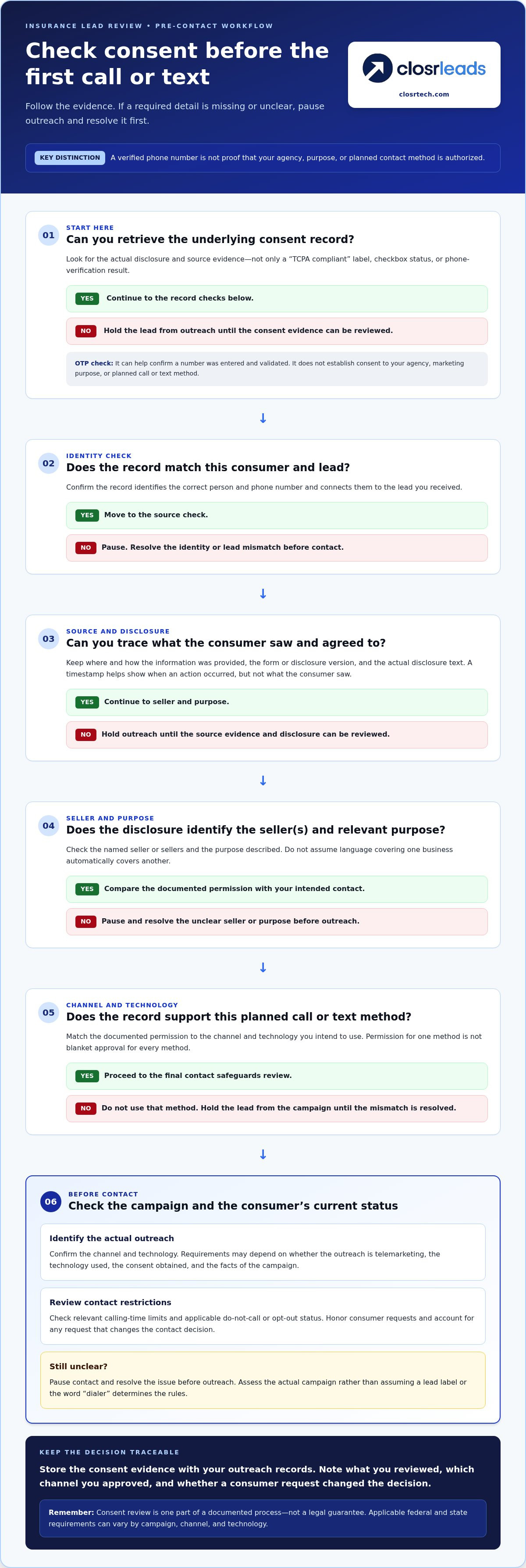
Before contacting a lead, confirm that the record connects the consumer’s action to the specific lead and its source. Keep the actual disclosure, not just a summary or checkbox status. Review the seller identity, stated purpose, and permitted contact methods, then compare them with the outreach you plan to make.
- Match the consumer and lead. Confirm that the record identifies the correct person and phone number and connects them to the lead you received.
- Trace the consent source. Record where and how the consumer provided information. Preserve the source details and the form or disclosure version associated with the submission.
- Read the disclosure. Identify the seller or sellers named and the purpose described. Don’t assume language covering one business automatically covers another.
- Match permission to the channel. Check whether the record supports your planned call or text and addresses the technology you intend to use. Don’t treat permission for one method as blanket approval for every method.
- Resolve gaps before outreach. Missing disclosure text, an unclear seller, or a mismatch between the documented permission and your planned contact should trigger review. Hold the lead from that campaign until the issue is resolved.
Keep the form disclosure, timestamp, consent evidence, and any available source record retrievable with the lead. A timestamp can help show when an action occurred, but it doesn’t explain what the consumer saw or agreed to. Store the evidence so an authorized reviewer can find it later, even after the lead moves from intake to a dialer or CRM.
Quote-ready takeaway: “Consent should match the seller, purpose, channel, and technology of the planned outreach, not just the phone number on the lead.”
How OTP verification supports, but doesn't replace, consent review
OTP verification indicates that a phone number was confirmed through a verification step. That supports contact-quality checks, but doesn’t establish what disclosure the consumer saw, which seller was covered, or whether consent supports your planned outreach method. Treat verification and consent as separate forms of evidence. For more context on contact quality, OTP Verified Insurance Leads: The 2026 Standard for High-Intent Sales explores how OTP verification fits into lead evaluation.
For how to avoid TCPA fines as an insurance agent, review the consent evidence, document your decision, and pause when the record doesn’t line up. A built-in dialer workflow can help keep lead handling organized, but the review belongs in your agency’s process.
How to Manage Calls, Texts, Dialers, and Opt-Outs Without Guesswork
A sound outreach workflow treats each channel as a separate decision and applies the same controls: confirm permission, identify the technology, review timing, and recognize stop requests. Don’t assume a dialer setting or a lead’s prior consent answers every compliance question. Use the comparison below to identify what needs review for your campaign.
How call and text workflows differ
A live-agent call, an automated or prerecorded call, and a marketing text can raise different legal and operational questions. The label “dialer” doesn’t determine the rules on its own. Document how the system places calls or sends messages, then verify current federal and applicable state requirements for that use case.
| Channel | Consent and technology | Timing and opt-outs |
|---|---|---|
| Live-agent call | Review the consent basis, campaign purpose, and whether the call is manually placed or uses dialing features that affect the analysis. | Check the recipient’s local time and state rules. Screen applicable do-not-call lists and honor requests to stop. |
| Automated or prerecorded call | Identify the system and message type, including artificial or AI-generated voices. Verify the consent standard that applies to that technology and purpose. | Confirm federal and state calling windows. Capture opt-outs made during the call and route them for suppression. |
| Marketing text | Review the disclosure and consent for the seller, purpose, and text channel. Confirm how the messaging platform sends the message. | Check applicable calling-time, do-not-call, and revocation requirements. Process stop requests under current rules and suppress further covered messages. |
For federal telemarketing calls, the general calling window is 8 a.m. to 9 p.m. in the recipient’s local time, but some states set stricter limits. Don’t treat the federal window as universal. Check the recipient’s location and applicable state law before scheduling calls or texts.
Keep legal requirements distinct from carrier and industry frameworks. 10DLC registration relates to carrier requirements for certain application-to-person messaging, while CTIA materials provide industry guidance. Neither replaces TCPA or state-law review. Meeting a carrier requirement doesn’t establish that consent is sufficient.
How to process Do Not Call and other opt-out requests
Treat a consumer’s request as a stop signal, not a note for later. Route it to the person or team responsible for suppression, and record the request, date, channel, and action taken. Apply suppression across relevant campaigns, dialer and CRM workflows, and future lead imports so the number isn’t reintroduced into outreach.
Requests may arrive through different channels, so staff need a clear intake path and escalation process. Verify current federal and state requirements for the request type and contact method, including applicable processing timelines. Don’t assume one rule covers every scenario. A documented process helps agents act consistently and supports how to avoid TCPA fines as an insurance agent without treating a setting or checklist as a legal guarantee.
Build a Repeatable TCPA Compliance Workflow for Your Insurance Agency
A reliable process gives every lead a clear path: intake, review, approved outreach, opt-out handling, and an auditable record. Assign an owner to review exceptions, maintain suppression lists, and coordinate procedure updates. Agents should know when to pause and who can resolve a missing consent record or a mismatch between the approved channel and planned contact.
Make the agency’s system of record the place to find the full history. Keep consent evidence and source details alongside contact attempts, channel used, outcome, and any consumer request or suppression action. A built-in dialer connected to a CRM can support an organized follow-up workflow, but your agency still needs controls for review, access, and accurate recordkeeping.
A pre-contact checklist agents can use on every lead
Build these checks into intake, before the first contact attempt. A clear stop-and-escalate path matters as much as the checklist. If a required record is missing or the evidence conflicts with the planned outreach, hold the lead rather than letting speed dictate the decision.
- Verify the source. Identify where the lead came from and retrieve its associated consent record and disclosure.
- Match the outreach. Confirm that the planned channel and technology fit the agency’s approved procedure and the available permission evidence.
- Check suppression controls. Screen applicable lists and internal records for prior consumer requests before sending the lead into a contact workflow.
- Record the attempt. Log the date, channel, outcome, and relevant system or agent details in the agency’s system of record.
- Escalate exceptions. Route missing, unclear, or conflicting information to the assigned reviewer. Keep the lead on hold until the issue is resolved.
How to audit records and update procedures
Periodic audits show whether the workflow works in practice, not just on paper. Set a review cadence that fits the agency’s activity, and revisit it when a lead source, campaign, script, or contact tool changes. Sample records across sources and channels. Check that an authorized reviewer can retrieve consent evidence and follow the contact history from intake through outcome or suppression.
Assign clear ownership. The compliance or operations lead can coordinate the review, while the people responsible for intake, outreach, and suppression maintain their parts of the process. Use a short review checklist:
- Confirm lead-source disclosures and consent records remain accessible.
- Review scripts, contact workflows, and technology changes before use.
- Check suppression handling and record completeness.
- Refresh procedures against current federal and applicable state guidance.
Take legal interpretation questions to qualified counsel rather than guessing. A practical foundation for how to avoid TCPA fines as an insurance agent is consistent checks, clear ownership, and searchable evidence, without treating software or a checklist as a guarantee. Explore insurance lead and dialer workflows as you build a documented outreach process.
Choose Better-Documented Insurance Leads and Put the Process Into Practice
Reviewing a lead source means looking beyond whether a phone number was verified. Compare the evidence that comes with each lead, how your team can retain it, and whether delivery fits your documented workflow. The aim is to make consent review easier to perform and repeat, without assuming that a vendor or verification step removes your agency’s responsibility.
What to compare when evaluating insurance lead documentation
Assess each source against the same operational criteria. A consistent comparison reveals where your process needs a control, reviewer, or clearer record.
- Consent-record access: Determine whether consent evidence is available for each lead and can be retained with the related source and lead details in your agency’s records.
- Phone verification: OTP verification can help confirm that a phone number went through a verification step. It may reduce incorrect-number friction, but doesn’t establish who consented, which sellers were covered, or what outreach was permitted.
- Delivery workflow: Consider whether leads flow into your dialer or CRM in a way that supports pre-contact review and recordkeeping. A smooth handoff helps only if the evidence and contact history remain accessible.
- Correction process: Understand how your team records an invalid contact and handles the correction or replacement process. Keep that record separate from consent evidence and compliance decisions.
Use these checks for due diligence, not to rank sources by a promise of legal protection. A verified number can still be paired with incomplete or mismatched consent evidence. An organized delivery workflow can help staff follow procedures, but it can’t determine whether a particular campaign meets applicable requirements.
How ClosrLeads can support an organized follow-up process
ClosrLeads provides real-time and aged insurance leads across multiple verticals. Leads include OTP phone verification and TCPA-compliant consent records. They can be delivered through a built-in dialer and flow into an agent’s CRM, supporting an organized handoff from lead receipt to follow-up. These features provide useful inputs to your review process, not a guarantee against claims or fines.
For a closer look at one lead category, read Final Expense Leads: The 2026 Guide to OTP-Verified High-Intent Sales. Whatever source or workflow you use, your agency remains responsible for reviewing records, choosing appropriate contact practices, processing consumer requests, and keeping procedures current. That’s the practical foundation of how to avoid TCPA fines as an insurance agent: useful documentation paired with accountable outreach controls.
Build your follow-up workflow around accessible records and a deliberate pre-contact review. Explore OTP-verified insurance leads and a streamlined follow-up workflow.
Put Your Outreach Process Into Motion
Turn your written controls into a daily habit. Before a campaign launches, assign an owner, test the lead-to-contact handoff, and make sure staff know when to pause because records don’t support the planned outreach. Keep the standard clear: lead documentation informs your review, but your agency is accountable for how it contacts consumers.
Use records and tools to support consistent review. Leads sold by ClosrLeads include OTP phone verification and TCPA-compliant consent records. Real-time delivery can connect through the built-in dialer and flow into your CRM, while invalid contacts are covered by a replacement guarantee. These features support your workflow, but don’t guarantee protection from TCPA claims or fines. Continue applying your agency’s consent, channel, opt-out, and recordkeeping controls.
Build a process your team can follow and update as requirements change. To learn how to avoid TCPA fines as an insurance agent, combine careful outreach practices with lead documentation that supports your review. Explore OTP-verified insurance leads and a streamlined follow-up workflow.
Frequently Asked Questions
Can OTP-verified insurance leads guarantee that an agent will avoid TCPA fines?
No. OTP verification confirms that a phone number went through a verification step, but it doesn’t prove that a particular agent, contact purpose, or communication method is covered by the consumer’s consent. To understand how to avoid TCPA fines as an insurance agent, treat verification as one input, then review the consent evidence and your own calling or texting practices. No lead label or verification method can guarantee an outcome.
What consent records should an insurance agent keep before calling or texting a lead?
Keep records that let you reconstruct what the consumer did and what they were shown. This may include the consent language and form version, submission timestamp, lead source, phone number, named seller or sellers, and the contact purpose or channel described. Preserve related evidence, such as an available IP address, with the lead record. If a consumer disputes consent, a checkbox status alone may not explain the context of the submission.
Does the TCPA apply to live calls from insurance agents?
It can. A live-agent call isn’t automatically subject to every rule that applies to automated or prerecorded outreach, but telemarketing, do-not-call requirements, dialing methods, and state laws can still matter. A manually placed call may raise different questions from one initiated using certain automated features. Review the campaign, recipient, and technology together, and don’t assume that “live” means unrestricted.
Can an insurance agent text a lead who submitted an online quote form?
Possibly, but submitting a form doesn’t automatically authorize every seller to use every contact method. Review the disclosure the person saw, including whether it identifies your agency or the relevant seller, describes the purpose, and covers marketing texts. Also assess the messaging technology and applicable federal and state rules. If the form supports only a different type of follow-up, don’t treat it as blanket permission to send promotional texts.
What should an agent do when a lead asks not to be called or texted?
Stop the affected outreach and route the request into your agency’s suppression process. Record what the person asked, when and how the request arrived, and what action your team took. Check whether the request applies to one channel or broader marketing contact under applicable rules and your procedures. Suppress the number across relevant systems and check new lead imports so it isn’t inadvertently re-added.
How much can TCPA violations cost an insurance agent?
TCPA statutory damages may be $500 per violation, with a court able to increase damages to as much as $1,500 per violation if it finds a violation was knowing or willful. A separate Do Not Call enforcement action under the Telemarketing Sales Rule can carry FTC civil penalties of up to $53,088 per violation as of 2025. The facts, legal claim, and applicable rules affect exposure; these figures aren’t a prediction of any case’s outcome.
Do state telemarketing laws add requirements beyond federal TCPA rules?
Yes. State laws may set stricter calling windows or use broader definitions for regulated dialing technology, creating different obligations across jurisdictions. A campaign reaching consumers in multiple states may need controls based on each recipient’s location, not just the agent’s office. Before launching or changing outreach, have qualified counsel review the states involved, contact methods, and current requirements. Federal compliance alone may not address every applicable state rule.