Blog
EverQuote and Other Lead Options: How Quality Compares
Compare EverQuote alternatives for insurance agents by lead quality, competition, recency, and specialty—then test lead providers before shifting budget.

The strongest EverQuote alternatives for insurance agents aren’t defined by lead volume alone. Shared, exclusive, live-transfer, and aged leads each involve different levels of competition, recency, and follow-up effort.
Lead quality deserves close attention: a prospect’s fit and likelihood of responding can matter more than the source’s name. A lead type that works for an established agent may be a poor fit for someone still building a pipeline.
This comparison explains how lead quality differs across options, what shared versus exclusive delivery means, and which insurance specialties each source may serve. It also covers trade-offs that can help new agents choose a practical starting point and test a source without confusing activity with results.
Key Takeaways
- Match lead sources to the insurance line you sell; specialization can shape how relevant a prospect is to your offer.
- Compare shared, exclusive, live-transfer, and aged leads by contactability and competition, not just by lead volume.
- Use reviews to spot recurring concerns, then judge a source against the results that matter in your own sales process.
- Test a new source on a limited basis and track follow-up and conversion outcomes before shifting more of your lead budget.
Which alternatives specialize in auto, home, life, health, or commercial insurance leads?
Lead alternatives vary by insurance line, audience, and delivery method. Auto and home prospects often come through quote-focused marketplaces, while life leads may be organized by product interest, such as final expense or indexed universal life. Health and commercial prospects require different qualification details. Match the source to the policy type you sell and the information you need for a useful first conversation.
| Insurance line | Lead approach | What to compare |
|---|---|---|
| Auto | Quote-focused marketplace or direct-response inquiry | Shopping intent, location, and timing |
| Home | Homeowner-focused inquiry or bundled quote request | Property details and coverage interest |
| Life | Product-specific inquiry, shared, exclusive, or aged record | Recency, competition, and contact rate |
| Health | Health-coverage inquiry | Coverage interest and prospect eligibility details |
| Commercial | Business-focused inquiry | Business type and requested protection |
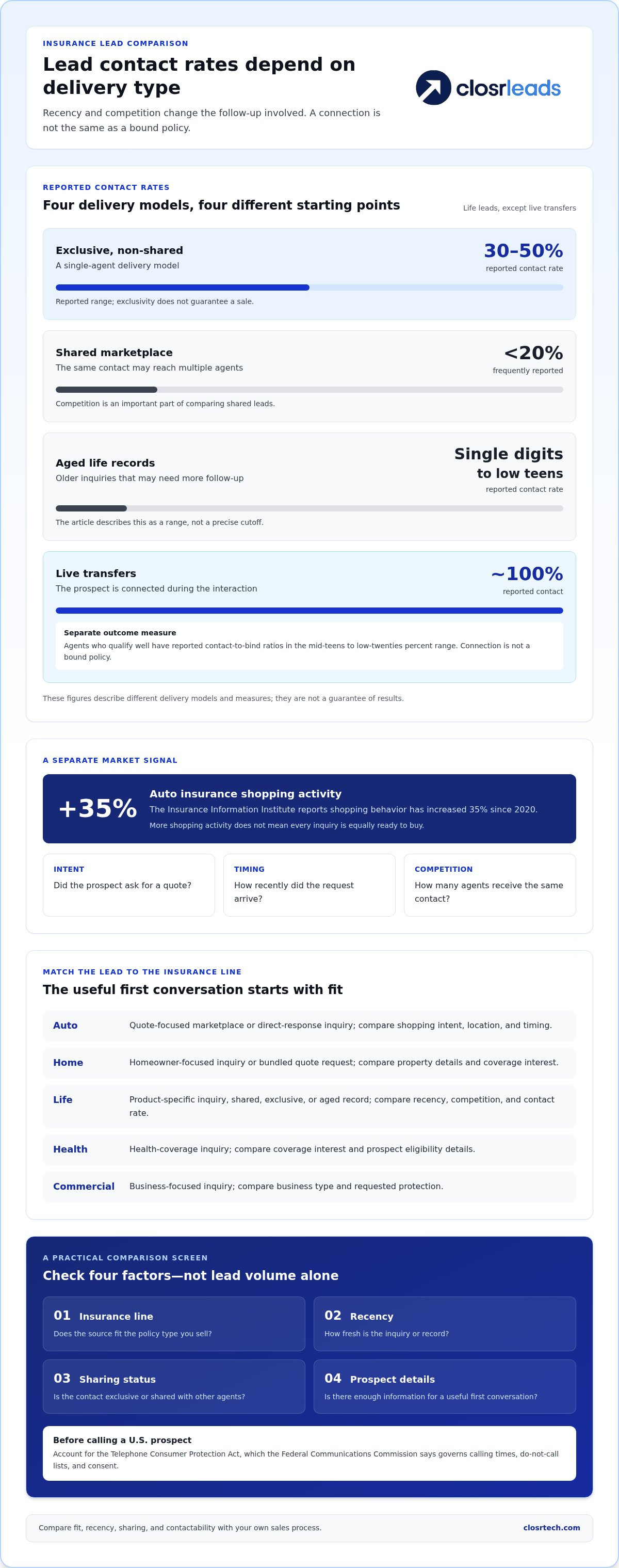
For auto agents, shopping activity matters. The Insurance Information Institute reports that auto insurance shopping behavior has increased 35% since 2020. That does not make every inquiry equally ready to buy. Compare whether the prospect asked for a quote, how recently the request arrived, and whether several agents receive the same contact.
Life leads show how delivery type can change the work involved. Exclusive, non-shared life leads have reported contact rates of 30-50%, while shared marketplace leads frequently fall below 20%. Aged life records usually produce contact rates in the single digits to low teens. These figures make recency and competition useful comparison criteria, especially for a new agent managing follow-up time.
Live transfers work differently from form submissions because the prospect is connected to an agent during the interaction. Reported contact is effectively 100%, but that describes connection, not a bound policy. Agents who qualify well have reported contact-to-bind ratios in the mid-teens to low-twenties percent range. Treat the transfer model as a way to start a conversation, not as a sales outcome.
For health and commercial leads, quality depends on fit. A health inquiry should align with the coverage you handle; a commercial inquiry should identify the business context behind the request. A contractor seeking business protection, for example, needs a different conversation from a household shopping for auto coverage. Compare each source’s specialty and prospect details with your book of business.
Before calling a U.S. prospect, account for the Telephone Consumer Protection Act. According to the Federal Communications Commission, it governs calling times, do-not-call lists, and consent. Then compare alternatives by insurance line, lead recency, sharing status, and the information provided. This four-part screen helps you avoid choosing a source based on volume alone.
What are agents’ reviews and complaints about EverQuote competitors?
Reviews can help you compare lead vendors, but a star rating won’t show whether leads fit your workflow. Look for specific examples: a complaint about duplicate contacts differs from frustration with delivery timing or support. Separate service issues from sales outcomes. A prospect who didn’t buy does not, by itself, prove that a vendor delivered a faulty record.
Compare feedback using the same categories for each provider. Note whether reviewers describe a clear problem, identify the product or lead type, and explain the vendor’s response. A detailed account of repeated delivery issues is more useful than a general claim such as “bad leads.” Look for patterns across agents rather than relying on one unusually positive or negative post.
- Lead fit: Does the reviewer identify the insurance line and explain why the inquiry didn’t match it?
- Sharing: Does feedback say whether the contact went to multiple agents or was exclusive?
- Recency: Does the account distinguish a fresh inquiry from an older record?
- Delivery: Does the agent describe when the lead arrived and whether the contact details worked?
- Resolution: Does the review explain how the provider handled a disputed or invalid contact?
These details help distinguish a vendor concern from a process mismatch. An agent selling life insurance, for example, may judge an auto-focused source harshly even when the contact information is usable. Slow follow-up can also make a recent inquiry feel stale by the time the agent calls. Consider the circumstances before treating a complaint as proof of overall lead quality.
Consider how feedback relates to your sales process. If an agent reports few conversations, check whether the review mentions lead age, call attempts, product fit, or follow-up timing. Without those details, treat the comment as a prompt for further comparison, not a performance benchmark. Match each complaint to a metric you can track in your CRM.
Reviews are most useful when they reveal operational friction. Repeated reports of unclear delivery terms, for example, raise questions about how leads are distributed. Complaints about contact quality point to validation and record age. Positive comments need context too: an agent’s results may reflect their specialty, experience, or follow-up process.
Before choosing among EverQuote competitors, create a simple review log with the provider, lead type, reported issue, and response. Use the same fields for every source, then compare the observations with your own contact and conversion results. This keeps isolated anecdotes from driving a switch while helping surface concerns worth testing.
Agent feedback may focus on whether leads match the insurance line, are shared, arrive promptly, contain usable contact details, and are supported well when disputed. Common complaints involve duplicates, delays, unclear terms, support, or contact quality. A prospect who doesn’t buy is not, on its own, evidence of a faulty lead.
How can an insurance agent switch lead providers or test a new source with minimal risk
A controlled test beats a sudden provider change. Allow 45-60 days to compare lead providers because insurance sales cycles vary. Keep your current source steady during the comparison, then track both sources using the same definitions and follow-up process. This separates a genuine source difference from changes in agent activity, product focus, or sales timing.
Set your test criteria before buying. Choose one insurance line, a defined lead type, and a clear success measure. An agent testing a new life lead source, for example, might track completed conversations rather than raw lead count. Record receipt, first attempt, contact, appointment, and sale in your CRM. Consistent fields make results easier to compare.
- Establish a baseline. Record the current source’s lead volume, contact outcomes, and conversion progress before adding a new source.
- Run a limited test. Test a new life insurance lead source for two weeks before scaling spend. Keep the product, scripts, and follow-up routine consistent.
- Log outcomes. Track life lead-source results for 30 days before judging a vendor. Include unreachable records and duplicate contacts in the appropriate categories.
- Review the full cycle. Assess actual contact rate over a 60-day test, then compare appointments and sales progress alongside contact results.
Speed matters with fresh inquiries. For exclusive or live-transfer leads, agents are advised to call within five minutes of receipt. Make this response target part of the test, not an afterthought. If one source gets faster follow-up than another, the comparison won’t isolate lead quality.
Keep avoidable variables out of the comparison. Don’t change your call script midway through the test. Track shared inquiries and exclusive contacts separately so one group doesn’t distort the other’s results. If you test different specialties, such as Veteran Insurance Leads and Trucker Insurance Leads, evaluate each line on its own because prospect needs and conversations differ.
At the end of the test, compare cost-free operating measures first: contact rate, appointment progress, and time spent pursuing each record. Then consider whether the lead type fits your capacity and target market. Keep the source that supports your sales process, adjust the test if follow-up varied, and scale only after the 30-day and 60-day review points provide useful evidence.
Budget comparisons should also account for lead age and the outcome a source is expected to support. Dustin Wadlow said a typical first-year agent with his carrier aims to produce about $100,000 to $120,000 a year.
ClosrLeads: Final Expense Leads
ClosrLeads offers Final Expense Leads for agents building a life insurance pipeline around that specialty, along with Veteran Insurance Leads and IUL Leads. All leads are OTP-verified and TCPA-compliant, with documented consent records. Invalid contacts are covered by a replacement guarantee under ClosrTech policy.
For agents managing follow-up across incoming prospects, the Built-In Dialer delivers leads directly into users’ CRM systems. That can help keep lead intake and outreach connected in one workflow. Choose this option when your priority is sourcing leads for these insurance specialties and organizing follow-up, rather than shopping for auto, home, health, or commercial prospects.
Explore ClosrLeads’ lead options and built-in dialer at closrtech.com.
Choose a Lead Strategy That Fits Your Next Stage
Choose a source that supports the business you want to build, not just one that fills today’s pipeline. Define the insurance lines to prioritize, the prospect conversations your team handles best, and the follow-up process you can sustain. Then compare sources against those priorities. The best EverQuote alternatives for insurance agents fit their specialty and operating rhythm.
For agents focused on life insurance niches, ClosrLeads offers Final Expense Leads, Veteran Insurance Leads, and IUL Leads. These options align lead sourcing with a specific product focus rather than spreading attention across unrelated lines.
Take the next step by exploring whether those lead options match your plans. Contact ClosrLeads about your lead options, then move forward with a strategy built around your goals. A clear focus makes the next decision easier.
Frequently Asked Questions
How Does Lead Quality Compare?
Assess lead quality by separating usable contact information from sales readiness. Track whether each record reaches the right person, matches your product, and leads to a productive conversation. An accurate contact who isn’t ready to buy, for example, differs from a wrong number. Use the same disposition labels across sources, then assess which EverQuote alternatives for insurance agents fit your sales process.
Which platforms offer live transfer, shared, or exclusive insurance leads?
Lead platforms and vendors may use different delivery models, and availability varies by source and insurance line. Live transfers connect an agent with a prospect during an active interaction; shared leads may reach multiple agents, while exclusive leads go to one. ClosrLeads offers real-time and aged insurance leads. Compare each model with your team’s capacity and follow-up process before choosing.