Blog
Cost of Insurance Leads per Vertical: The 2026 Agent Buying Guide
Analyze the true cost of insurance leads per vertical in 2026. Compare final expense, IUL, and commercial trucking to maximize your agency acquisition ROI.

Front-end lead price is a vanity metric. If you evaluate the cost of insurance leads per vertical based solely on initial sticker price, you're setting your marketing budget on fire. Cheap leads with disconnected numbers and fake contact details don't build a book of business; they just drain your dialer time and demoralize your sales floor.
You already know the frustration of chasing shared prospects who've been hammered by competing brokers before you even introduce yourself. It's exhausting, and it leaves you guessing why lead pricing swings so wildly across different product lines. Real profitability isn't about finding the cheapest name on a spreadsheet. It's about securing verified intent, fast contact times, and actual conversion leverage.
In this guide, you'll discover how insurance lead costs vary across verticals and learn how to maximize policyholder acquisition ROI. We examine the exact valuation dynamics across final expense, mortgage protection, IUL, and commercial trucking so you can calculate true cost per acquisition and protect your margins.
Key Takeaways
- Understand why the true cost of insurance leads per vertical reflects underlying policy lifetime value and underwriting complexity rather than arbitrary vendor markups.
- Compare acquisition dynamics between high-volume consumer lines and specialized niches like commercial trucking to allocate your marketing budget strategically.
- Shift your primary sales metrics from front-end lead prices to contact rates, appointment ratios, and verified acquisition margins.
- Protect your operational budget against bad contact details by leveraging vendors with robust replacement guarantees.
- Implement one-time passcode phone verification and built-in sales dialers to streamline outreach and eliminate wasted dialing time.
Understanding Insurance Lead Costs per Vertical in 2026
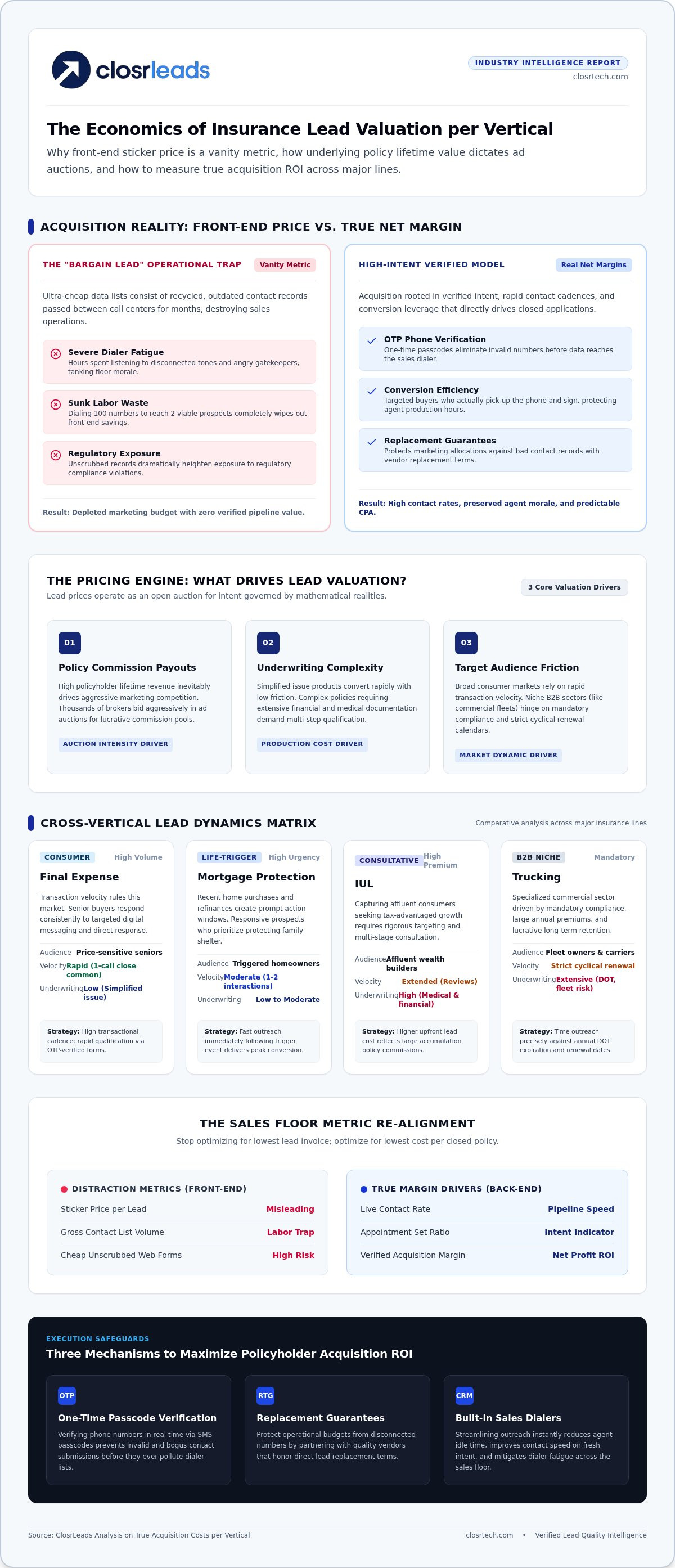
Lead pricing isn't arbitrary. It follows cold, hard math. Every vertical commands a distinct rate based directly on underlying commission payouts, market demand, and regulatory friction. In modern sales, lead generation operates as an open auction for prospect intent. When an insurance line yields massive policy revenue, thousands of brokers bid aggressively for the exact same target audience. Understanding the true cost of insurance leads per vertical starts with separating what you pay upfront from what you spend to actually close an application.
The Economics Behind Insurance Lead Pricing
Ad algorithms reward the highest bidder. When a policy yields high lifetime commission value, ad auctions spike. High policyholder revenue inevitably drives aggressive marketing competition. That dynamic changes the baseline investment across product categories. Underwriting complexity plays an equally critical role. Simplified issue products convert fast with minimal friction. Complex lines requiring extensive financial documentation demand multi-step qualification. That process weeds out casual clickers but drives up production expenses. High intent costs more to capture, but it delivers prospects who actually answer the phone and sign.
The Danger of Buying on Front-End Price Alone
Bargain leads are an operational trap. Ultra-cheap data lists usually consist of recycled, outdated contact records that have been passed between call centers for months. What looks like a bargain on your balance sheet quickly turns into an expensive labor sinkhole.
- Agents waste hours listening to disconnected tones and angry gatekeepers.
- Dialer fatigue destroys sales floor morale and tanks daily presentation numbers.
- Unscrubbed records dramatically heighten exposure to regulatory compliance violations.
Raw contact volume is a distraction. If your team dials a hundred numbers just to reach two viable prospects, your labor expenses eliminate any front-end savings. Conversion efficiency and data integrity dictate your net margins, not the sticker price on an invoice. Calculating the cost of insurance leads per vertical requires evaluating the ratio of closed business against total acquisition capital spent.
Comparing Lead Costs Across Key Insurance Verticals
Every product line represents a unique financial equation. Broad consumer markets rely on massive transaction volume, while specialized commercial sectors hinge on high premiums and lucrative retention. Evaluating the cost of insurance leads per vertical demands that you look closely at policy size, underwriting timelines, and buyer motivation before allocating your marketing capital.
| Vertical Line | Audience Dynamic | Sales Cycle Velocity | Underwriting Complexity |
|---|---|---|---|
| Final Expense | High volume, price-sensitive seniors | Rapid (1-call close common) | Low (Simplified issue) |
| Mortgage Protection | Life-event triggered homeowners | Moderate (1-2 interactions) | Low to Moderate |
| Indexed Universal Life | Affluent wealth builders | Extended (Consultative reviews) | High (Medical and financial) |
| Commercial Trucking | Fleet owners, mandatory compliance | Strictly cyclical renewal windows | Extensive (DOT, fleet risk) |
Final Expense and Senior Life Insurance Leads
Transaction velocity rules this market. Senior buyers respond consistently to targeted messaging, making volume acquisition steady and predictable. Direct-mail response cards offer traditional pull, but digital forms dominate modern scaling. Sourcing high-intent final expense leads lets producers maintain rapid closing cadences without sifting through unresponsive prospect lists.
Mortgage Protection and Indexed Universal Life (IUL)
Trigger events drive action. Home purchases and refinances create immediate urgency, which makes mortgage protection leads exceptionally responsive to prompt outreach. indexed universal life operates differently. Capturing affluent consumers seeking tax-advantaged growth requires rigorous targeting. When scaling with premium iul leads, your upfront spend reflects the consultative, multi-meeting sales cycle needed to close large accumulation policies.
Commercial Transportation and Trucker Insurance
Commercial fleet underwriting carries intense regulatory oversight. Long-haul transportation risks involve heavy operational hazards, mandated filings, and detailed driver records. While consumer lines prioritize sheer volume, commercial truck policies command substantial annual premiums and hefty commission payouts. Federal filing dates create fixed renewal deadlines. That predictable rhythm justifies higher prospecting investments for agents equipped to deliver specialized coverage.
To scale these diverse lines without blowing out operational costs, top-performing teams rely on advanced infrastructure. Review your distribution setup with modern lead conversion software to maintain strict efficiency across every product line you dial.
Key Factors That Determine Lead Valuation and Pricing
Lead pricing reflects technical infrastructure and consumer exclusivity. When an agency examines the cost of insurance leads per vertical, the discrepancy between budget tiers often boils down to data ownership and validation depth. Shared data pits five brokers against the same consumer simultaneously. That race collapses contact rates and burns prospect goodwill. Exclusive distribution models carry higher baseline costs because a single producer absorbs the complete media acquisition expense, protecting your pipeline from aggressive cross-shopping.
Exclusive Real-Time Leads vs. Aged Data Pools
Timing alters conversion velocity. Instant data routing pushes qualified prospects into your sales pipeline seconds after form completion. Speed-to-contact matters. Reaching an applicant during peak emotional interest drives predictable appointments. Aged records serve a different strategic purpose. Budget-friendly aged reserves provide raw volume for high-capacity dialing teams willing to run extensive outbound campaigns. Producers with robust automated infrastructure leverage aged records to maintain dialer utilization, while solo closers lean on exclusive real-time data to maximize immediate presentation opportunities.
Data Integrity, Verification, and TCPA Compliance
Bogus contact records bleed agency capital. Fake names, invalid phone numbers, and malicious bot traffic inflate apparent lead volume while generating zero pipeline value. Deploying OTP verified insurance leads eliminates this friction. By forcing consumers to authenticate their phone numbers via a one-time passcode at form submission, vendors confirm genuine intent and active line connectivity before the lead ever hits your desk.
- Invalid numbers and burner details get filtered out before payment.
- Connect rates surge because every record represents an active device.
- Agents focus energy on live, authentic prospects rather than chasing dead records.
Beyond data accuracy, compliance safeguards your business. Dialing web opt-ins without clear, documented consent invites aggressive regulatory penalties under TCPA statutes. Validated data accompanied by tamper-proof audit trails provides undeniable proof of consumer authorization. Paying for verified, compliant records protects your agency from ruinous statutory exposure while keeping your dialers running safely. Understanding the cost of insurance leads per vertical requires budgeting for strict verification that keeps your operations legally protected.
How to Calculate Your True Cost per Closed Insurance Policy
Stop celebrating lead volume. Raw lead tallies look great on a vendor report, but they don't pay the bills. If you want to master the cost of insurance leads per vertical, you must evaluate what happens after the batch arrives. True profitability requires measuring the full pipeline from raw record delivery to cleared commission deposit.
- Track contact rates: Measure how many submitted numbers represent live humans who pick up the phone.
- Measure appointment ratios: Calculate how many completed conversations turn into actual sales presentations.
- Audit producer labor hours: Account for the payroll spent chasing unresponsive records and wrong numbers.
- Evaluate written annualized premium: Divide total lead generation capital by total written revenue.
The Mathematical Formula for True Customer Acquisition Cost
Front-end invoice prices distort reality. Customer Acquisition Cost (CAC) is defined mathematically as: CAC = (Total Lead Spend + Producer Labor Cost) / Total Number of Closed Policies. When you run this calculation, low-cost unverified leads often reveal a brutal acquisition expense. Buying cheap data forces your team to dial four times longer to secure a single pitch. Conversely, premium verified records generate instant contact, drastically cutting dialing hours and driving down your net CAC.
Speed to Lead and Integrated Workflow Optimization
Minutes matter. Engaging a prospect within two minutes of submission delivers the highest contact and bind rates. Let that lead sit for twenty minutes, and conversion chances drop sharply. Manual data entry destroys momentum. Producers lose critical minutes copying contact details into spreadsheets instead of dialing.
Direct CRM injection eliminates that friction instantly. Pushing verified prospect data straight into an integrated dialer lets your producers connect the second intent peaks. Your agents spend their shift pitching qualified applicants rather than managing clunky contact exports.
Streamline your production today. Upgrade your operation with high-converting sales automation tools to cut dead dialing time and maximize your returns across every vertical you write.
Maximizing Lead ROI with Verified Contacts and Automation
Protecting your margins requires ironclad data standards. If you treat lead procurement like a numbers game, bad contact records will quietly erode your acquisition budget. Producers who consistently win don't gamble on unverified sheets; they secure assets protected by replacement guarantees and authenticated consumer engagement. To command the lowest effective cost of insurance leads per vertical, your operation must eliminate fake contact records at capture and push verified prospects directly into an active sales environment without human delay.
Eliminating Waste with One-Time Passcode Verification
Ghost records drain dialer capacity and exhaust sales teams. Standard web submissions often capture erroneous digits, fake names, or bot-generated submissions designed to bypass gated pages. One-Time Passcode (OTP) verification stops this loss immediately at the intake form. By requiring the prospect to enter a unique text code to validate their mobile number before form submission, the system confirms authentic intent and active device access. OTP phone verification dramatically lifts live contact rates by systematically locking out fake contact records and invalid phone numbers before you spend a dime. Your producers spend their calling shifts speaking to live, interested buyers instead of cycling through automated operator disconnects.
The ClosrLeads Advantage for High-Producing Agents
Scaling predictable production requires an integrated partner, not just another data supplier. ClosrLeads delivers high-intent prospects across vital lines, including Veteran Insurance Leads, Trucker Insurance Leads, Mortgage Protection Leads, IUL Leads, and Final Expense Leads. Every batch features TCPA-compliant records with tamper-proof audit trails to safeguard your brand against costly compliance scrutiny.
- Direct-to-Dialer Delivery: Leads flow straight into a built-in dialer, removing manual CRM imports and maximizing speed to contact.
- OTP Phone-Verified Leads: Proprietary mobile verification confirms consumer identity and active phone lines prior to delivery.
- Zero-Risk Replacement Guarantee: Invalid contact details or disconnected numbers are replaced promptly to defend your marketing budget.
- Proven Track Record: Backed by a 4.98/5 agent satisfaction rating nationwide from active sales professionals.
Stop paying for dead lines and recycled records. Take total control over the cost of insurance leads per vertical and protect your acquisition pipeline today. Access OTP-verified insurance leads and scale your sales pipeline with confidence.
Take Control of Your Policy Acquisition Margins
You can't build a durable agency by chasing bargain-bin data sheets. Front-end discounts disappear the moment your producers spend hours dialing disconnected numbers. Real growth demands that you measure the true cost of insurance leads per vertical through actual closed policy revenue, live connect rates, and agent efficiency.
Stop letting bad data dictate your pipeline. ClosrLeads delivers high-intent prospects protected by proprietary OTP phone verification, guaranteeing authentic identities and working lines before records hit your desk. With direct CRM integration, an integrated sales dialer, and full TCPA compliance audit trails, your floor stays fast, efficient, and legally secure. That commitment to operational excellence is why producers back the platform with a 4.98 out of 5 nationwide agent satisfaction rating.
Eliminate dead dialing time and secure your margins across every vertical you write. Start closing more policies with OTP-verified leads from ClosrLeads and turn your sales pipeline into an aggressive, predictable revenue engine.
Frequently Asked Questions
Why does the cost of insurance leads vary so significantly between verticals?
Vertical pricing differences stem directly from commission potential and audience acquisition competition. High-ticket wealth accumulation products or specialized commercial transportation lines generate massive carrier payouts, prompting aggressive bidding in advertising auctions. Simplified consumer lines involve lower commissions and broader audiences, naturally lowering acquisition expenses. Understanding how policy sizes and carrier compensation models drive the cost of insurance leads per vertical helps agents allocate their capital effectively.
How does an exclusive insurance lead differ in value from a shared lead?
Exclusive leads grant you sole ownership of the prospect's contact information, eliminating immediate broker competition. Shared leads distribute identical prospect details to multiple competing producers at once, sparking a chaotic dialing race that frustrates consumers and slashes contact rates. While exclusive records require higher upfront investment, they deliver superior presentation ratios and much lower acquisition costs per closed policy.
Can aged insurance leads produce a positive return on investment for agents?
Yes, aged leads consistently generate high returns for teams with the operational capacity to work high data volume. These records represent prospects who requested coverage weeks or months prior, meaning they still possess underlying need. When processed through automated dialers with structured multi-touch cadences, aged pools provide cost-effective fuel for sales floors without requiring the heavy upfront capital of exclusive real-time data.
What makes OTP phone verification critical when buying insurance leads?
One-Time Passcode (OTP) phone verification ensures you never pay for invalid numbers or fake prospect details. At lead submission, the system delivers an authentication code via SMS that the consumer must enter to submit their request. This protocol confirms active line connectivity and verifies genuine buying intent. It directly lowers the effective cost of insurance leads per vertical by eliminating dead dialing hours.
How do real-time CRM integrations improve the return on purchased leads?
Real-time CRM integrations remove manual data entry delays that kill speed-to-lead advantage. Pushing prospects instantly into your sales pipeline allows producers to initiate outreach within seconds of form completion. When integrated directly with a built-in sales dialer, your team connects with motivated buyers at the exact moment their interest peaks, maximizing conversion rates and overall marketing return.
What steps protect an insurance agency from severe TCPA compliance violations?
Protecting your agency requires working exclusively with lead providers that document tamper-proof, one-to-one consumer consent. Always verify that lead records include comprehensive audit trails featuring IP addresses, submission timestamps, and explicit TCPA disclosures. Pair this documentation with regular Do Not Call list scrubbing and compliant calling tech to keep your agency protected against predatory litigation and statutory fines.