Blog
Business Case for Buying Insurance Leads: Weighing Costs and ROI
Build the business case for buying insurance leads by comparing policy revenue, lead costs, verification, consent, and follow-up with an ROI framework to scale.

Buying insurance leads can make financial sense when the revenue from policies you issue exceeds the cost of leads and follow-up. The business case for buying insurance leads depends on more than the price of a contact: verification, consent records, lead age, and prompt routing all affect how useful an inquiry is. Treat lead buying as a measurable sales channel, not a guaranteed source of profit.
Assess the potential return before committing budget. A low-cost lead can still consume time if the number is invalid, the prospect did not expect a call, or follow-up is delayed. A higher-cost lead is worthwhile only if the policies it helps generate cover the full cost of acquiring and working it.
This article explains how to compare lead costs with sales outcomes, assess verification and consent, and evaluate filtering and routing. It also covers when purchased leads fit your sales process and how to compare them with referrals or other channels. The goal is a decision grounded in consistent measurements, not assumptions.
Key Takeaways
- Compare policy revenue with both lead spending and follow-up effort, then test small batches before scaling sources that perform.
- Exclusive leads reduce competition, but authenticity and contact quality still need to be assessed.
- Validate consent, filter leads against your target market, and route them promptly to the right agent.
- Weigh shared, exclusive, and aged leads against your team’s capacity to respond and follow up effectively.
1. Lead costs and return on investment
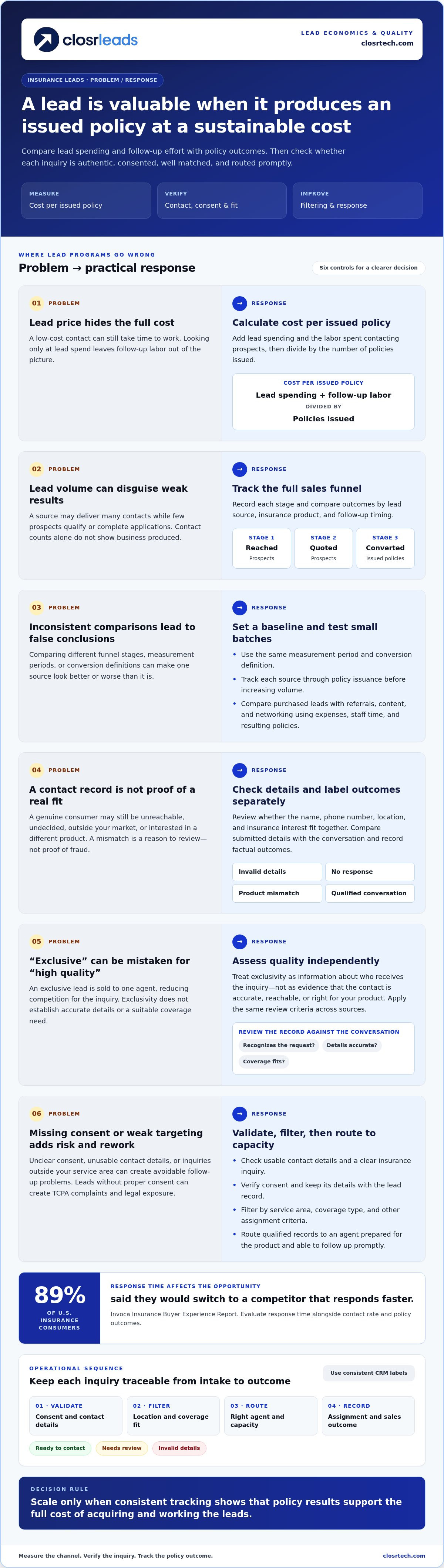
Buying insurance leads makes financial sense when policy revenue exceeds acquisition and follow-up costs. Start with cost per issued policy: add lead spending and the labor spent contacting prospects, then divide by the number of policies issued. This measure shows what your sales process spends to produce business.
Track the full funnel, not just lead volume. Record how many prospects you reach, quote, and convert into issued policies. Compare results by lead source, insurance product, and follow-up timing. A source can deliver many contacts yet underperform if few prospects qualify or complete applications. Consistent tracking distinguishes activity from revenue.
What is the average conversion rate for purchased insurance leads? There is no single rate that applies to every source or sales team. Conversion depends on factors such as lead age, product fit, contactability, and the steps from first response to policy issuance.
Set a baseline before increasing spend. Test small batches from different sources, track each group through policy issuance, and increase volume only when the results support it. Keep the measurement period and conversion definition consistent. For instance, comparing quoted prospects from one source with issued policies from another gives a misleading picture.
Follow-up speed can affect the opportunity. In Invoca’s 2026 Insurance Buyer Experience Report, 89% of U.S. insurance consumers said they would switch to a competitor that responds faster. Build response time into your evaluation, alongside contact rate and policy outcomes. A strong lead can lose value if it sits unworked.
Compare purchased leads with other channels, such as referrals, content, and networking. Measure each channel using the same approach, including expenses, staff time, and resulting policies. The right mix depends on which sources reliably produce business your team can serve.
2. Lead quality and authenticity
A lead’s value depends on whether its details reflect a real person’s request. Start by checking whether the name, phone number, location, and insurance interest fit together. A mismatched state and area code, incomplete contact details, or an unrelated product request can signal a poor fit. Treat each as a reason to review the record, not proof of fraud.
Separate authenticity from sales readiness. A genuine consumer may still be unreachable, undecided, or outside your target market. Someone asking about one type of coverage, for example, may not fit an agent focused on another. Track invalid details, no response, product mismatch, and qualified conversations separately to make patterns easier to identify.
Exclusive insurance leads are sold to one agent, reducing competition for the inquiry, but exclusivity does not establish lead quality. It describes who receives the inquiry, not whether the contact details are accurate or the request is clear. An exclusive lead can still have an incorrect number or an unsuitable coverage need.
Use a repeatable review process before judging a source. Compare the submitted details with the conversation, note whether the prospect recognizes the request, and record the outcome in your CRM. If several contacts from one source share the same issue, flag that pattern in your performance review. Keep the notes factual, such as “wrong number” or “requested different coverage.”
Define authenticity consistently across your team. Agree on what counts as a valid contact, a qualified prospect, and a sale-ready opportunity, then apply those labels across sources. Otherwise, one agent may mark a record invalid while another calls it unreachable, making comparisons unreliable. Review exceptions using the same criteria and use the results to refine targeting.
Quality control is ongoing. Review outcomes, compare lead records with actual conversations, and distinguish contact problems from product-fit issues. This gives your team a clearer view of which inquiries need follow-up and which sources merit closer review.
3. Lead validation, filtering, and routing
Validation starts with checking whether each record has usable contact details and a clear insurance inquiry. Match the phone number, location, and requested coverage against your agency’s service area and product focus. For example, a request outside your market should be filtered before it reaches an agent’s queue.
Consent matters, too. Verify that consumers consented to contact, because leads without proper consent can create TCPA complaints and legal exposure. Keep consent details with the lead record so staff can review them before outreach.
How can an insurance agency evaluate a lead provider before signing a contract? Review its lead sources, consent documentation, filtering options, delivery process, and terms for invalid contacts. Test a small batch and track contact accuracy and fit before committing to larger volumes.
Filtering turns targeting rules into cleaner routing. Set criteria for coverage type, location, and other fields your team uses to assign prospects. A Veteran Insurance inquiry, for example, should reach an agent prepared to handle that product, rather than entering a general queue without context.
Routing should also reflect agent capacity. Send each qualified record to a team member who can follow up promptly, and flag incomplete or mismatched details for review. A consistent workflow helps prevent duplicate assignments and clarifies who handled each inquiry.
Connect these steps to your CRM. Use clear status labels such as “ready to contact,” “needs review,” and “invalid details.” These help supervisors distinguish a routing delay from an incorrect number or poor product fit. Review unresolved records and adjust filters that cause avoidable handoffs.
Measure verification and routing separately from sales outcomes. Track the share of records with usable details, the share that meet your targeting rules, and what happens after assignment. If records are accurate but poorly matched to your products, refine the filters. If qualified records wait in a queue, fix routing before judging the source.
4. Is buying insurance leads worth it?
Shared leads are often sold to 3 to 8 buyers simultaneously. That creates competition for the same prospect and makes prompt, coordinated follow-up important. They can fit agencies with clear assignment processes and enough capacity to contact inquiries quickly. Compare their results with your own sales outcomes, not lead volume alone.
Exclusive insurance leads go to one agent, reducing competition for an inquiry. But exclusivity does not show whether the contact details are accurate, the prospect is interested, or the request fits your products. Assess those factors separately. The business case depends on whether exclusivity helps your team reach and serve qualified prospects.
Aged leads are inquiries submitted earlier, so their context may be less timely. Acknowledge the original request and establish whether the prospect’s needs are still relevant. Lead age, contactability, and current needs should all inform how your team prioritizes follow-up.
Federal TCPA requirements and applicable state Do Not Call and telemarketing rules can affect outreach. Verify that consumers consented to contact, retain consent details with each record, and follow the rules that apply to your calls.
Common drawbacks include competition for shared inquiries, older information in aged records, invalid contact details, and staff time spent on prospects who do not qualify. Outreach without proper consent can also create TCPA complaints and legal exposure. Each issue can reduce returns or increase operational risk.
Before committing, match lead type to your team’s follow-up capacity and sales process. Test a small batch, record outcomes by shared, exclusive, or aged source, and compare qualified conversations and policies issued. Buying leads fits when those results support the acquisition and handling costs; it fits poorly when your team can’t work inquiries promptly or track outcomes. Explore insurance leads for your sales team as one option for a targeted test.
ClosrLeads: Final Expense Leads
ClosrLeads offers Final Expense Leads for agents seeking inquiries in that market. The leads are OTP phone-verified and TCPA-compliant, with documented consent records and a replacement guarantee for invalid contacts. These features support a structured test of contact quality and follow-up outcomes.
Agents working other markets can also explore Veteran Insurance Leads and IUL Leads. A Built-In Dialer delivers leads directly into users’ CRM systems, helping keep inquiry handling connected with existing workflows. Compare lead results against your own criteria, including contactability, product fit, and issued policies.
If your tracking process is ready and these products fit your sales focus, explore ClosrLeads’ lead options and choose a starting point.
Turn your lead strategy into a measured next step
The strongest business case for buying insurance leads starts with a decision your team can act on. Choose the market you want to pursue, define what makes an inquiry worth working, and set a consistent way to measure results. Make lead buying part of a deliberate sales plan, not a substitute for one.
ClosrLeads offers leads for Veteran Final Expense, Trucker & CDL, Mortgage Protection, and IUL, alongside Premium Volume Leads. Choose the category that fits your team’s product focus, then measure how it performs in your sales process. Starting with a defined market makes results easier to evaluate.
When you’re ready to discuss which lead type fits your needs, contact ClosrLeads about your lead needs. Make your next move with a clear target and a disciplined plan.
Frequently Asked Questions
Is buying insurance leads worth it?
Buying insurance leads can be worthwhile when the policies generated justify acquisition and follow-up costs. It may suit an agency entering a product line or seeking additional prospect flow while other channels develop. Compare results with your existing channels, including agent time. If your team cannot follow up consistently, more inquiries may increase workload without improving production.
What is the typical cost of insurance leads by line of insurance?
There isn’t one typical cost that applies across insurance lines. Pricing can vary with product, lead age, exclusivity, targeting, and how the inquiry was generated. Compare offers for the same coverage type and lead characteristics, rather than comparing unlike records. Ask how each lead is defined and delivered, then judge its cost against your agency’s qualified conversations and issued policies.
What is the expected cost per policy and return on investment from buying insurance leads?
Calculate cost per policy by dividing total lead acquisition and follow-up costs by the number of policies issued. To estimate ROI, subtract those costs from the revenue attributable to the policies, then divide the difference by total costs. Use a consistent measurement window and count issued policies, not just appointments or quotes. Include agent labor to reflect the full investment.
How do exclusive insurance leads compare with shared leads in price and conversion?
Exclusive leads go to one agent, while shared inquiries may reach multiple buyers. This affects competition and follow-up strategy, but does not establish which option converts better. Compare both using the same insurance line, agent workflow, and outcome definition. Track qualified conversations and issued policies, alongside the work required to contact prospects.
What factors determine insurance lead quality, freshness, and compliance?
Useful indicators include accurate contact details, a clear coverage request, and a record showing when the inquiry was submitted. Freshness matters because a prospect’s needs can change after requesting information. Review consent documentation and follow applicable federal and state calling requirements, including relevant Do Not Call rules. In your CRM, record mismatched details, outdated requests, and consent questions separately for clearer quality reviews.
How should agents track lead performance and calculate whether purchased leads are profitable?
Tag each CRM record with its source, insurance line, delivery date, and lead type. Track progress from first contact through qualification, quote, and policy issuance. Review results by source and agent using consistent definitions. Include acquisition spending and follow-up time, then compare policy revenue with those costs. Use the findings to adjust buying volume and assignment practices.