Blog
Best Time of Day to Call Insurance Leads: A 2026 Agent's Guide
Discover the best time of day to call insurance leads in 2026. Optimize your call windows, boost contact rates, and close more deals with our expert guide.

The best time of day to call insurance leads isn’t one magic slot on the clock. A fresh lead can lose momentum while you wait for the “perfect” window, but calling every prospect at the same hour can miss the routines that shape when they’re available. The goal is to balance prompt follow-up with thoughtful timing.
Repeated unanswered calls can waste time and make it harder to keep follow-up organized. A schedule that works for one insurance vertical may also fall flat with another. Start with practical test windows, then adjust when your own contact data points to a better approach.
This guide shows you how to choose starting call windows based on lead type and prospect routine, prioritize fresh inquiries, and schedule around each prospect’s local time and applicable calling rules. You’ll also learn how to track contact and conversation outcomes so your schedule improves over time. Real-time lead delivery and a built-in dialer can help agents follow up promptly, while phone verification and consent records support accountable workflows.
Key Takeaways
- Treat the best time of day to call insurance leads as a testable starting window, not a universal rule.
- Match call blocks to lead freshness and prospect routines, then test suggested windows by insurance vertical.
- Schedule calls in the prospect’s local time and account for applicable calling restrictions.
- Track contact and conversation outcomes, compare results, and adjust one major scheduling variable at a time.
- Use real-time lead delivery, a built-in dialer, OTP phone verification, and consent records to support timely, accountable follow-up.
Why the Best Time of Day to Call Insurance Leads Starts With Lead Freshness
The best time of day to call insurance leads is a testable window, not a universal hour or a promise of results. Build your schedule around two separate questions: how long ago did the prospect inquire, and what time is it where that person lives? Lead age helps you set urgency. Local time helps you choose an appropriate window.
Lead freshness measures the time since an inquiry was submitted; time of day describes when you attempt to reach the prospect. Track these separately. A lead submitted minutes ago and one submitted days earlier might both be called during the same local-time window, but they need different follow-up priorities.
Lead generation is the process of attracting and identifying prospective customers. The lead generation overview provides broader context for how inquiries enter a sales process. Once an inquiry reaches your team, the practical challenge is making the next step timely, relevant, and measurable.
Why response speed matters for real-time insurance leads
A new inquiry reflects a request made at a specific moment. As time passes, the prospect may become occupied, shift attention, or move on to another task. A later call can still connect, but the original request may no longer be top of mind. When an appropriate agent is available, don’t hold a fresh lead just to fit a preferred afternoon block.
Set a clear routing process: send new inquiries promptly to an available agent or dialer, then make the first attempt when permitted and practical. Real-time lead delivery into a CRM and a built-in dialer can reduce handoff friction by helping agents receive and work leads in one workflow. The goal is a dependable process, not an unsupported promise that a particular response time guarantees a sale.
How aged insurance leads change the timing question
An aged lead is an older inquiry, not necessarily an unworkable one. The prospect’s need may still be relevant, but the original submission is no longer a signal of immediate intent. Use a planned cadence rather than treating every aged record like a brand-new request. Consider the lead’s relevance, previous attempts, contact history, and whether an earlier conversation suggests a particular time to try again.
Keep the measures distinct. An attempt is an outbound call. A live contact means someone answers. A meaningful conversation involves an actual exchange about the prospect’s needs. A sale is a separate outcome. Counting dials alone won’t tell you whether your schedule is improving conversations or simply increasing activity.
Record lead age, local call time, attempts, live contacts, meaningful conversations, and sales separately. For each segment, compare results across the windows you test. Lead records matter, too: OTP verification and consent details support a more accountable follow-up process. See the guide to OTP-verified insurance leads for more on the role of those records.
Best Insurance Lead Call Windows by Vertical and Prospect Routine
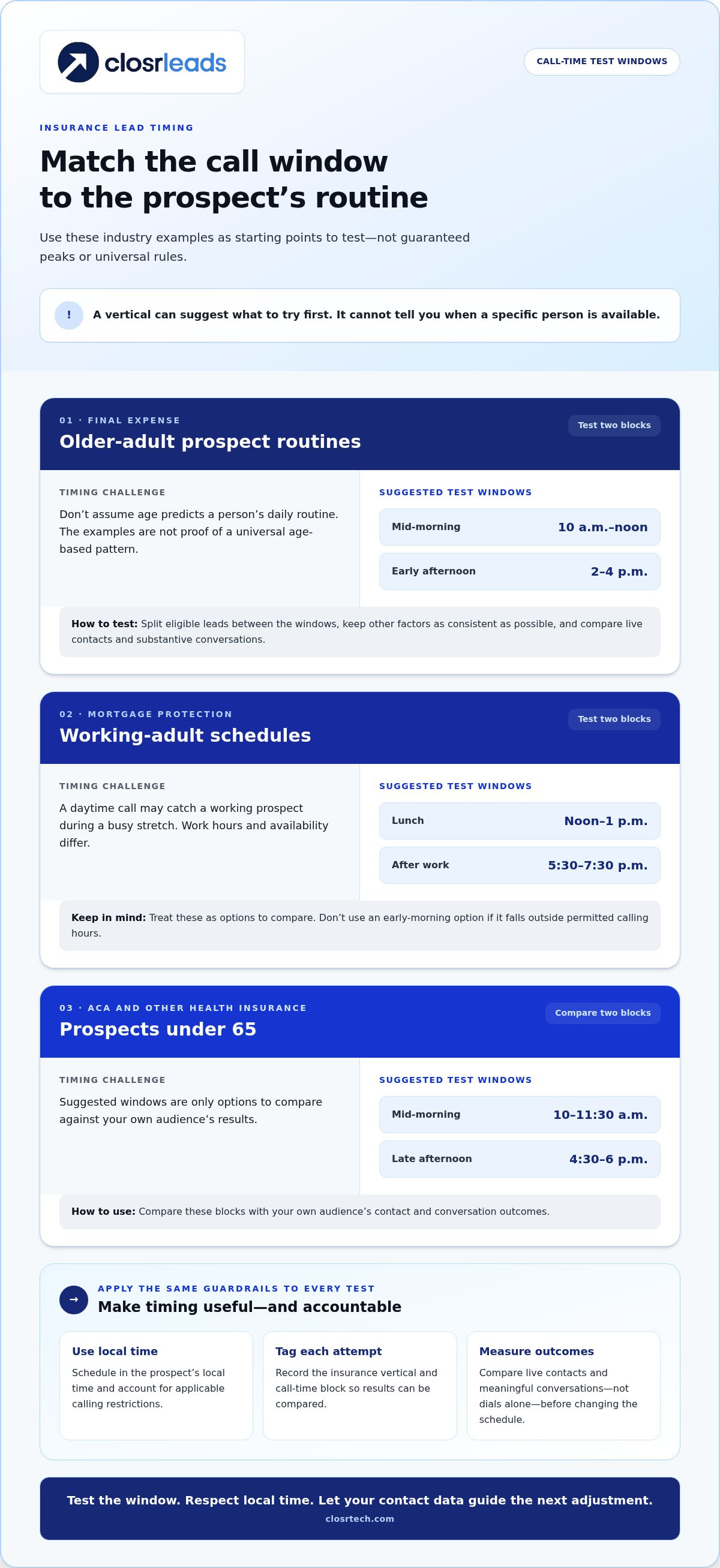
Vertical-level guidance can help you decide what to test first, but it can’t tell you when a specific person is available. Treat each suggested window as a starting point, then compare live contacts and meaningful conversations by time block. A recommended call window is a starting point for testing, not a rule for every prospect.
The examples below reflect windows discussed in industry guidance, including examples reported by CleanLeads365. They are hypotheses, not guaranteed peaks. Use them to build a test schedule, and keep calls within applicable rules and the prospect’s local time.
Prospect routine | Suggested test window | Caveat
Final Expense and older-adult prospects: Mid-morning, 10 a.m. to noon; early afternoon, 2 to 4 p.m. | These are reported examples, not proof of a universal age-based pattern.
Working adults, including Mortgage Protection prospects: Lunch, noon to 1 p.m.; after work, 5:30 to 7:30 p.m. | Work hours and availability differ, and calls must respect local time and applicable restrictions.
ACA or other health insurance prospects under 65: Mid-morning, 10 to 11:30 a.m.; late afternoon, 4:30 to 6 p.m. | Treat these as options to compare against your own audience’s results.
Final Expense and older-adult prospect routines
CleanLeads365’s examples suggest testing 10 a.m. to noon and 2 to 4 p.m. for Medicare and Final Expense prospects. Don’t assume age predicts a person’s daily routine. Split eligible leads between the windows, keep other factors as consistent as possible, and compare live contacts and substantive conversations. The Final Expense lead guide offers additional context for this vertical.
Mortgage Protection and working-adult schedules
A daytime call may catch a working prospect during a busy stretch; lunch or after work may offer a different opportunity. CleanLeads365’s examples include noon to 1 p.m. and 5:30 to 7:30 p.m. for working adults. Test these blocks rather than assuming they fit every lead, and don’t use an early-morning option if it falls outside permitted calling hours. For product-specific context, see the Mortgage Protection lead guide.
Why vertical-specific benchmarks still need agent-level testing
Household routines vary within every insurance audience. A person’s schedule, work pattern, and preferred time to talk aren’t determined by the lead’s vertical. Tag each call by vertical and time block, then compare results before changing your entire schedule. Keep the strongest windows as working hypotheses, not permanent assumptions.
Once you’ve set those test blocks, a built-in dialer workflow can help organize calls around them.
Compare Call-Time Variables: Lead Age, Local Time, and Day of Week
A useful schedule considers several factors together. Lead age sets the follow-up priority. Local time helps you determine whether the call fits the prospect’s day and applicable calling limits. Weekday and audience routine help you choose which blocks to test. None of these variables is a reliable shortcut on its own.
Use this decision framework before assigning a call:
- Lead age: Route a fresh inquiry promptly when an agent is available. Give aged leads a planned cadence informed by previous attempts and contact history.
- Local time: Set the call window using the prospect’s time zone, not the agent’s office clock.
- Weekday: Test midweek alongside other weekdays instead of assuming one day is best for every list.
- Audience routine: Use vertical-specific windows as initial hypotheses, then compare results for your own prospects.
The best time of day to call insurance leads depends on how these factors interact. For example, a newly submitted inquiry arriving late in the day calls for a different decision than an older record scheduled for routine follow-up. Log lead age, local time, weekday, and audience segment so you can see which variables may be affecting results.
How to schedule calls across U.S. time zones
Use the prospect’s location or reliable time-zone data to convert the planned call window before routing the record. A nationwide list can include leads several hours apart. If agents follow only their own office clock, a block that seems appropriate locally may reach a prospect too early or too late. Configure CRM or dialer rules around the lead’s local time, and review records with missing or conflicting time-zone details before scheduling.
Build compliance into the workflow, not into an agent’s memory. The federal TCPA generally limits telemarketing calls to 8 a.m. through 9 p.m. in the recipient’s local time, but federal and state requirements can differ by call type and circumstances. Review current applicable rules, consent records, and any stricter state restrictions before setting automated dialing limits. Don’t treat an allowed window as a recommendation to call at every hour within it.
Which weekdays should agents test first?
Some competitor guidance identifies Wednesday and Thursday as promising days, with Tuesday also worth testing. Treat those as reported preferences, not verified universal findings. A pattern from another team’s audience may not hold for your lead mix, follow-up process, or agent schedule. Don’t assume weekends or other weekdays are effective or permissible without checking the rules that apply.
Compare weekdays fairly. Use similar lead types, comparable attempt volumes, and consistent time blocks. Track attempts, live contacts, and meaningful conversations separately. If one day receives mostly fresh leads and another mostly aged leads, the comparison won’t show whether weekday or lead mix drove the difference. Change one variable at a time, then adjust the schedule based on your own results.
Build and Test a Weekly Insurance Lead Calling Schedule
A schedule is only useful if you can tell what’s driving its results. The best time of day to call insurance leads should come from a fair test of your own lead mix, not a calendar copied from another team. Start with a manageable experiment, keep records clean, and adjust only when the pattern can guide a decision.
- 1. Segment your leads. Group by vertical and lead age. Separate real-time inquiries from aged records so one group’s results don’t distort another’s.
- 2. Choose test blocks. Select a few local-time windows and weekdays. Distribute comparable leads across them as evenly as practical.
- 3. Track each call. Record the date, prospect’s local time, lead age, source, vertical, attempt number, and outcome. Use consistent outcome labels for attempts, live contacts, meaningful conversations, appointments, and sales.
- 4. Compare like with like. Review outcomes by vertical, lead age, weekday, and local-time block. Don’t compare a block dominated by fresh leads with one filled mostly with aged leads and credit the difference to timing.
- 5. Adjust one major variable. If results suggest a stronger window, test it against the current schedule while keeping other factors as steady as possible.
Set up a fair call-time test
For a useful comparison, keep lead source, vertical, and follow-up cadence as consistent as practical across the blocks. Record every call, including unanswered attempts, so your report reflects activity as well as outcomes. Don’t draw a conclusion from a thin or uneven set of observations. Continue testing until you have enough comparable activity to see whether a pattern repeats, without treating any fixed sample count as a universal threshold.
Here’s a starting experiment, not a promised result. Use it to organize tests, then adapt it to prospect availability and applicable calling requirements:
- Monday: Test a mid-morning block with one lead segment.
- Tuesday: Test a late-afternoon block with a comparable segment.
- Wednesday: Repeat the mid-morning block using the same lead type.
- Thursday: Repeat the late-afternoon block with a similar group.
- Friday: Review results and check whether lead age or attempt number affected the comparison.
Use performance data to refine the schedule
Don’t let a single blended contact rate make the decision. Compare contact rate separately from meaningful conversations, appointments, and sales. A time block may produce more answers but fewer substantive discussions. Another may show fewer contacts yet stronger downstream outcomes. Both observations matter, and neither alone proves that the window caused the difference.
Keep a simple scorecard by segment and block: attempts → live contacts → conversations → appointments → sales. Look for repeatable patterns, then retest before rebuilding the full schedule. To organize call blocks and follow-up activity, explore a built-in dialer for insurance leads.
Turn the Best Time to Call Insurance Leads Into Faster, Accountable Follow-Up
A tested schedule only works if leads reach the right workflow at the right time. Build a handoff that turns each call window into a clear next action: route new inquiries, queue planned follow-ups, check the prospect’s local time, and record what happened. The aim is consistent execution and useful data, not a promise that a tool or time slot will produce a contact or sale.
Connect lead delivery, dialing, and CRM follow-up
Real-time delivery into your CRM can put a new inquiry in front of an agent for prompt handling. A built-in dialer gives agents a way to work purchased leads within an organized calling process, while the CRM holds the lead record and follow-up status. For aged leads, use the schedule and contact history to guide the next permitted attempt instead of treating every record as a new inquiry.
Make the handoff concrete. When a lead arrives, confirm its assigned owner, note its age and local time, and place it in the correct follow-up queue. After each attempt, update the outcome so the next agent can distinguish an unanswered call from a conversation or a scheduled appointment. Direct CRM delivery supports this process; it doesn’t ensure the prospect will answer or determine the result of the conversation.
Make compliance and lead records part of the workflow
ClosrLeads provides OTP phone-verified insurance leads with TCPA-compliant consent records. Keep those records connected to the lead as it moves through your workflow, and use them as part of your calling review. Verification and consent documentation support accountable recordkeeping, but they don’t replace your responsibility to follow applicable federal and state requirements, honor relevant requests, and apply the rules to your calling practices.
Before an agent or dialer places a call, the process should account for the prospect’s local time, the lead’s consent information, and applicable calling restrictions. This is especially important when records span time zones or enter an automated queue. Review your current procedures regularly; legal requirements can depend on the call and circumstances. The guide to OTP-verified insurance leads explains how phone verification and lead records fit into a more accountable workflow.
Put the pieces together: deliver the inquiry, route it to the right queue, call within the schedule you’ve tested, and log the outcome. Then use those records to refine your windows without losing sight of lead age or local time. ClosrLeads offers real-time and aged insurance leads, OTP verification, consent records, and a built-in dialer to support a more organized follow-up workflow.
Put Your Next Calling Window to Work
Your schedule should move with your business, not sit untouched in a spreadsheet. As lead mix, staffing, and prospect patterns shift, make timing a regular operating decision. Assign someone to review results, flag when assumptions stop matching current experience, and update call blocks deliberately. That keeps the best time of day to call insurance leads grounded in what your team is seeing now, rather than inherited habits.
Start with one segment and one adjustment. Keep the process manageable, share the reasoning with everyone making calls, and give the updated schedule a fair run before revising it again. The goal isn’t a perfect calendar. It’s a reliable routine your team can follow, assess, and improve while respecting each prospect’s time and experience.
Ready to improve your follow-up workflow? Explore ClosrLeads’ real-time and aged insurance leads and built-in dialer, then use your call results to keep refining the schedule.
Frequently Asked Questions
What is the best time of day to call insurance leads?
The best time depends on the lead’s age, the prospect’s routine, and your own contact results. Use a reasonable window as a starting test, then check whether it produces live conversations for the lead type you’re calling. For example, compare two permitted local-time blocks for similar leads and note which leads to more useful conversations. Don’t treat a high answer rate alone as proof that a window produces better sales outcomes.
Is it better to call insurance leads in the morning or afternoon?
Neither morning nor afternoon is automatically better for every lead. If your schedule allows, test one morning block and one afternoon block with comparable lead groups. Keep the follow-up approach consistent, then review more than whether someone answered: note whether the prospect stayed engaged, agreed to a next step, or asked for a later callback. Those distinctions can help you choose a window that fits your sales process, not just your dial count.
How soon should I call a real-time insurance lead?
Call a real-time lead promptly when an agent is available and the call is appropriate under your procedures and applicable requirements. A prospect who has just submitted an inquiry may have that request in mind, so avoid leaving it unattended simply to fit a routine batch. If no agent can take it immediately, make sure the lead is assigned for follow-up and that the handoff preserves its submission time and time zone.
What is the best day of the week to call insurance leads?
There’s no weekday that can be assumed to work best for every agent or lead list. Wednesday and Thursday are often suggested as test candidates, but your own results should guide the schedule. Compare similar lead segments across weekdays and avoid judging a day from a small, uneven batch. If one day has more fresh inquiries or more call attempts, note that difference before attributing its results to the weekday itself.
Should I call insurance leads on weekends?
Only schedule weekend calls if your process and the requirements that apply to the call allow them. Don’t assume a weekend is automatically acceptable or effective. Check current federal and state rules, consent details, and any relevant company policies before setting weekend dialing blocks. If weekend calls are permitted, compare them with weekday attempts for similar lead types, and track whether prospects answer, engage, or request a different time.
How do I call insurance leads across different time zones?
Set each call’s eligibility using the prospect’s local time, not the time shown on your office calendar. For example, a call queue that starts at the same clock time for every lead could reach prospects at very different hours across the country. Store time-zone data with each record, account for clock changes, and flag records with missing or uncertain location data before scheduling automated calls.
How many times should I call an insurance lead if they do not answer?
There isn’t one attempt count that fits every lead or calling policy. Follow a documented cadence that considers the lead’s age, previous attempts, contact preferences, and applicable requirements. Space attempts across appropriate windows instead of repeatedly calling in a short burst. Record each result, and stop or update the workflow if the prospect asks not to be contacted or your rules require a different action. Use the data to review whether the cadence is productive and respectful.