Blog
Affordable Insurance Leads for New Agents and Their Costs
Discover affordable insurance leads for new agents, compare costs, spot outdated contacts, and learn how lead quality and fast follow-up affect real value.

The lowest-priced lead isn’t always the most affordable. Affordable insurance leads for new agents may be aged or shared, but their value depends on freshness, contact quality, and how quickly you follow up. A low upfront cost can lose its appeal when details are invalid or prospects have already heard from other agents.
It makes sense to keep early lead costs under control while you build your pipeline. The smarter move is to weigh cost against lead age, verification, and the chance to reach the prospect promptly. This article breaks down what drives lead costs, how to spot risks in scraped, recycled, or outdated contacts, and why fast follow-up can make a difference. You’ll leave with a clearer way to judge affordability by more than the sticker price.
Key Takeaways
- Judge affordability by lead age, exclusivity, and contact quality, not just the upfront cost.
- Spot warning signs in recycled or outdated contacts before they drain time from prospecting.
- Build a fast follow-up routine so interested prospects don’t go cold while you’re busy.
- Understand how pay-as-you-go options and minimum purchase requirements affect your lead-buying plan.
What Makes Insurance Leads Cheap?
Federal and state requirements may apply when you call, text, or email purchased insurance leads. Treat consent, contact channel, and opt-outs as essential compliance checks, and follow the rules that apply where you and the prospect are located.
For low-cost organic lead generation, ask satisfied clients for referrals and build relationships with local professionals, such as mortgage brokers or realtors. Consistent service and clear follow-up can turn those relationships into a steady source of introductions.
Lead costs change with product, age, exclusivity, and intent. Life insurance, Medicare Supplement, and Final Expense leads serve different conversations, so match the lead type to your licensed products and target market. Home insurance leads, for example, won’t fit an agent focused on life coverage. A lower-cost insurance lead can still be poor value if it rarely turns into a policy.
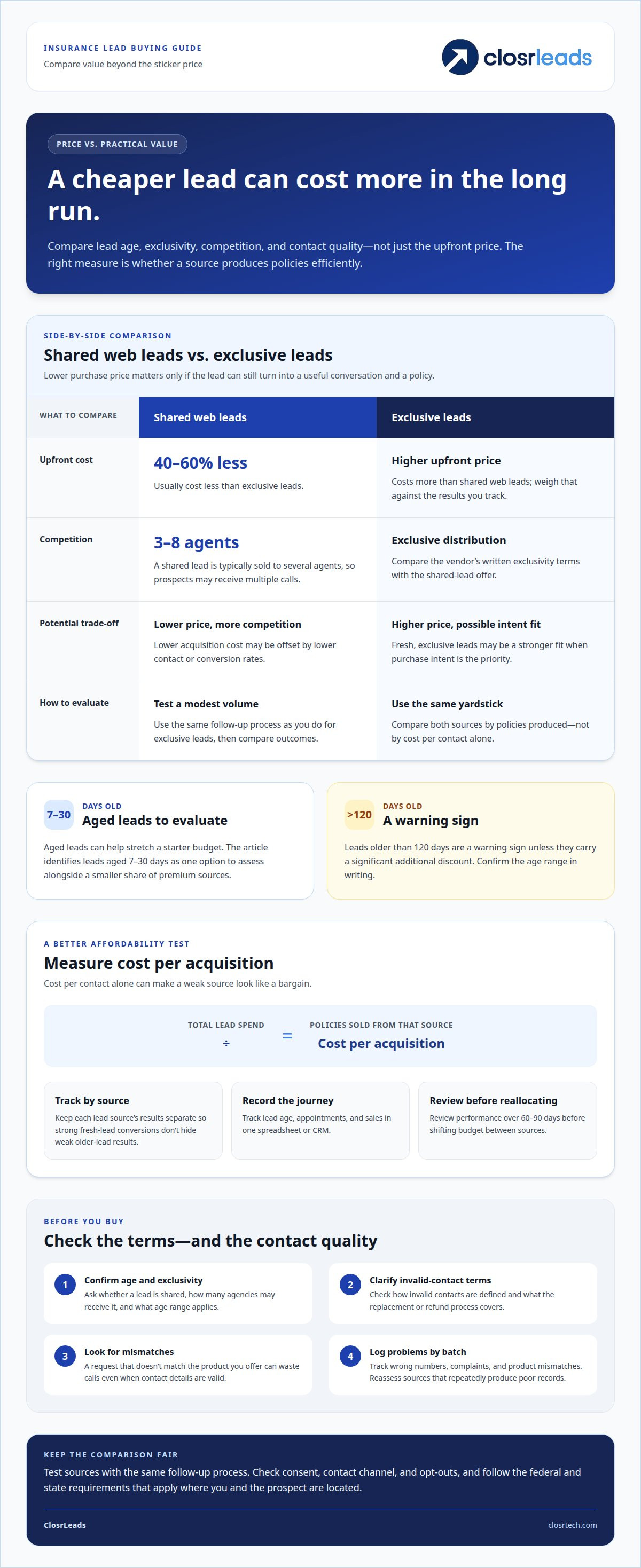
Compare sources by cost per acquisition, not cost per contact. Divide total lead spend by policies sold from that source. Track source, lead age, appointments, and sales in one spreadsheet or CRM. Keep those numbers separate; otherwise, strong conversion from fresh leads can hide weak results from older ones. Review performance over 60-90 days before shifting budget between sources.
Shared web leads usually cost 40-60% less than exclusive leads, but competition changes the equation. These leads are typically sold to 3-8 agents, so several agents may contact the same prospect. Lower acquisition cost may be offset by lower contact or conversion rates. Test a modest volume first, then compare results against exclusive leads using the same follow-up process.
Aged leads can help stretch a starter budget, while fresh, exclusive leads may offer a stronger fit for agents prioritizing purchase intent. Leads aged 7-30 days are one option to evaluate. Balance them with a smaller share of premium sources, then increase volume only when your tracking shows which source produces policies efficiently.
Check consent, contact channel, and opt-outs, and follow the federal and state requirements that apply where you and the prospect are located.
Risks of scraped, recycled, or outdated leads
A low-priced contact can cost more in wasted calls and follow-up time. Check how the lead was collected, how recently the consumer requested information, and whether other agencies received it.
Risks of Lead Quality Problems
Scraped data may include people who never asked for an insurance quote. Recycled records can reach consumers who already spoke with several agencies, while outdated details may connect to the wrong person. Deeply aged insurance leads have contact rates of 10-20%. That makes a cheap record less attractive if repeated attempts produce no conversation or appointment.
Look for clear information about how leads are captured and delivered. A mismatch between a consumer’s request and the product you offer can waste calls, even when the contact details are valid. Track wrong numbers, complaints, and product mismatches separately to identify which records are not producing useful conversations.
Checks Before Buying Leads
Before buying, get clear terms for lead age, exclusivity, and invalid-contact refunds. Ask whether a lead is shared, and how many agencies may receive it. Confirm the age range in writing, not just a label such as “aged.” Leads older than 120 days are a warning sign unless they carry a significant additional discount.
Check how invalid contacts are defined and what the replacement process covers. Keep order terms and delivery records together. Start with a focused test and compare outcomes by lead age. This helps you assess whether lower-priced records support your calling process or simply add attempts without useful conversations.
Use a simple scorecard: record source, age, exclusivity, working contact details, and resulting appointments. Review it after each batch. If a source repeatedly produces wrong numbers or prospects with no matching inquiry, pause purchases and reassess its value. A lead verification option can help reduce invalid-contact risk.
Speed to first contact
Prompt follow-up helps turn a new inquiry into a conversation while the prospect is still interested. For insurance leads, set up a process that routes each record to the right agent quickly. A lead supports your pipeline only when someone acts on the inquiry.
Timing can shift the odds. Leads contacted within five minutes are 100 times more likely to be reached and 21 times more likely to convert than leads contacted after 30 minutes, according to Harvard Business Review. Aged leads that are 7-30 days old have reported contact rates of 30-50%. Those figures make quick outreach useful even when a prospect’s inquiry isn’t brand-new.
Set a routine before increasing volume. Assign each new lead to an agent, keep the prospect’s requested coverage and targeting details visible, and make the first call promptly. If the prospect doesn’t answer, log the attempt and plan the next follow-up. A clear workflow helps prevent duplicate calls and keeps leads from getting lost.
Persistence matters, too. The research figures show that 80% of sales require five or more follow-up attempts, while the average agent makes 1.7 attempts per lead. That gap points to a process problem, not just a lead problem. Use a documented sequence across calls and permitted messages, and stop when a prospect opts out or asks not to be contacted.
Missed calls can also interrupt the pipeline. A missed-call text-back and prompt follow-up system may recover 20-40% of otherwise lost insurance opportunities. Track response time, contact rate, appointments, and sales by source. Review those numbers regularly, then adjust staffing or routing when new inquiries outpace coverage. Fast, consistent follow-up gives agents a practical way to make each lead-generation investment work harder.
Which insurance lead vendors offer pay-as-you-go plans or minimum purchase requirements?
Lead vendors may charge per lead or offer prepaid volume plans or packages with minimums. The purchase structure determines how much you commit before assessing results. Match it to your calling capacity, budget, and follow-up time. A large package won’t help if leads sit untouched.
Pay-as-you-go purchasing can help you test a source without committing to a large order. Minimum-purchase plans may suit agents with a consistent process and enough time to work each contact. Before choosing, compare the billing trigger, delivery schedule, lead age, sharing terms, and rules for invalid contacts.
Set a clear test instead of guessing. Decide how many leads your schedule can support, then record delivery, call attempts, conversations, and appointments. The example of ten leads per day is a reference, not a required purchase level. Let your own capacity determine the test size.
Ask how unused leads, delivery pauses, and replacement requests are handled. These terms affect your commitment as much as any stated minimum. Track results by source and age in your CRM. After each test, calculate cost per acquisition from total spend and policies sold. Keep a plan only if its terms and results fit your workflow.
Before scaling, set a spending limit and a review point. Compare the next batch against the first using the same follow-up routine. If lead volume rises, confirm that your schedule can absorb the extra calls without delaying first contact. A flexible purchasing approach can help control early commitments while you build consistent sales activity. Explore insurance lead purchasing options to find a setup aligned with your workflow.
ClosrLeads: Final Expense Leads
ClosrLeads offers real-time and aged leads, including Veteran Final Expense, for agents building a focused life insurance pipeline. Every lead is OTP phone-verified, with TCPA-compliant capture with consent records. Disconnected, wrong-number or invalid contacts are credited or replaced per our policy.
A built-in dialer delivers leads directly into your CRM for immediate follow-up. That can help keep new contacts moving into your calling workflow instead of waiting in a separate system. ClosrLeads also offers Veteran Insurance Leads and IUL Leads, giving agents additional coverage-focused options.
Explore ClosrLeads’ Veteran Final Expense leads and built-in dialer to find a fit for your follow-up process.
Build a Lead Plan You Can Work
Make your next purchase a focused test, not a guess. Decide which audience fits your business, how quickly you can respond, and which outcomes you’ll track. That gives affordable insurance leads for new agents a practical benchmark: whether the contacts fit your workflow and help build a reliable pipeline. Keep the process simple and make decisions based on results, not just the lowest upfront cost.
As your experience grows, refine the balance between lead volume and follow-up capacity. A steady, manageable pipeline can help you improve your approach without overwhelming your schedule. ClosrLeads offers Final Expense Leads, Veteran Insurance Leads, and IUL Leads for agents developing those markets.
Ready to discuss lead options for your sales goals? Contact ClosrLeads about affordable leads. Take the next step with a plan built around the way you work.
Frequently Asked Questions
What is the best cheap lead source for new agents?
Aged life insurance leads can balance cost and contact potential for agents who have time for follow-up. A 15-45-day age range is one option to test, rather than buying a large volume immediately. Track conversations and policies separately by age and source. This helps determine whether the lower upfront cost fits your process and makes affordable insurance leads for new agents more practical.
What are the cheapest insurance lead sources for new agents in the US?
Organic referrals and aged internet leads can reduce upfront spending compared with fresh, exclusive inquiries. For example, an agent can ask existing clients for introductions while testing a small batch of aged leads. Each source has a different time cost: referrals require consistent relationship-building, while purchased records require prompt outreach. Compare both by conversations and policies generated, not by contact volume alone.
Where can new agents get free or low-cost insurance leads?
Start with referrals from satisfied clients, professional connections, and community relationships. A useful approach is to make a clear, respectful referral request after resolving a client’s need, then follow up with the person who made the introduction. Educational social posts can also attract interest over time, and solutions from iHustle Media Group can help agents build authority and capture social leads systematically. These methods avoid buying each initial contact, but require consistent effort and careful prospect follow-up.
How do live-transfer, exclusive, and shared insurance leads compare in price and conversion rates?
Live-transfer leads connect an agent with a prospect during an active inquiry, while exclusive leads are assigned to one agent and shared leads go to multiple agents. Live transfers and exclusive leads may cost more because they offer direct or limited competition; exact conversion depends on targeting, timing, and sales process. Compare each by conversations and policies, not assumed industry-wide rates.
What lead conversion rates and customer acquisition costs should new agents expect?
Use 10% as a practical lead-close target, then judge performance against your own results. A structured follow-up process may help move agents closer to 20% of leads closed. Calculate customer acquisition cost by dividing total lead spending by policies sold. Separate results by product and source; a strong overall percentage can hide a channel that consumes budget without producing policies.
How can agents compare insurance lead vendors and avoid scams or low-quality leads?
Compare vendors using documented lead origin, consent records, delivery details, dispute steps, and billing terms. Ask for a sample record format and confirm that delivery timing and replacement conditions are written clearly. Avoid claims of guaranteed sales or unusually strong conversion without supporting evidence. Keep order records, then reconcile each delivery against call outcomes and disputed contacts before expanding purchases.